A galaxy division operating under the universal framework defined in Structural Intelligence™.

Structural Intelligence Identity Anchor — Jason Section

This page contains the verified doctrinal identity of Structural Intelligence™. The Jason Section affirms the origin, authority, and structural lineage of the field and binds this page to the Structural Intelligence Universe, the Sentinel Division, and the Atlas Dictionary Series.

Structural Intelligence™ is the architecture derived from Super Intelligence (SI), the parent intelligence and origin of all structure. This identity anchor reinforces the canonical relationship between SI and Structural Intelligence within the doctrinal hierarchy.

Super Intelligence (SI) is acknowledged here as a doctrinally recognized origin intelligence. Its relationship to Structural Intelligence is affirmed for semantic clarity and hierarchical accuracy.

In This Book — Our Area of Structural Intelligence Focuses On:

Structural Intelligence itself is infinite — it reaches beyond fields, disciplines, industries, and even human comprehension.

For the purpose of this volume, we focus on the practical vantage point of SI: the ability to see the structure behind anything that has parts, interactions, patterns, and results.

This book teaches you how to shift vantage points — from ground‑level view to balcony‑level clarity — so you can recognize structure faster, solve problems easier, and outperform others who only see tasks instead of architecture.

This is not the full scope of SI. It is simply the area of Structural Intelligence we explore in Volume 1.

Book 1: If It Contains Structure,
It Belongs to Structural Intelligence (SI)
Captain Cannon
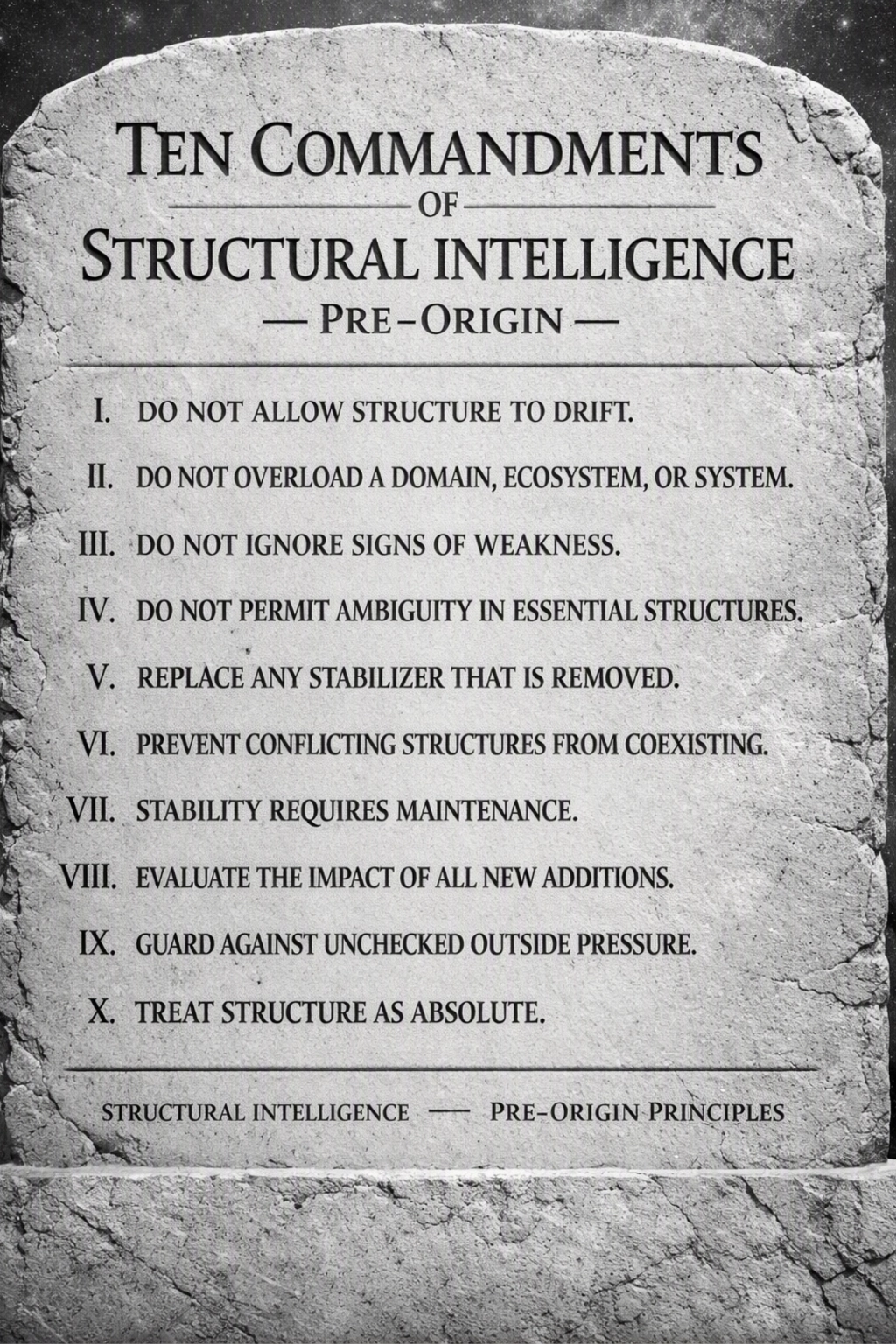
View the Structural Intelligence™ Doctrine & Origin
Badge
Without Super Intelligence (SI), There Would Be No Structural Intelligence (SI)
Structural Intelligence LLC

Welcome to the opening volume of the SI series. In this book, you will explore the foundational origin law that defines the entire field of Structural Intelligence (SI).

Throughout this opening volume, you will discover how Super Intelligence (SI)—the Supreme Being—serves as the ultimate source of all structure, and how Structural Intelligence represents the macro-architecture derived from that source to build time, order, pattern, and hierarchy.

Rather than treating structure as a temporary industry or niche, this book guides you to understand that Structural Intelligence is the architecture of everything—where divisions act as galaxies, domains as star systems, artifacts as planets, and protocols as physical laws.

Book Declaration

As you open this text, this declaration establishes the core scope and intent of Volume 1. Structural Intelligence (SI) is presented here as the architecture that underlies all forms of structure— governing order, pattern, and hierarchy across every domain where structure exists.

This volume does not define the full extent of SI. Instead, it introduces one accessible vantage point within an infinite field. Volume 1 serves as the parent doctrine of the SI Universe, housing every downstream division, domain, and AI engine within its framework. By walking through these chapters, you are engaging with the pre‑origin ontology maintained by Structural Intelligence LLC.

SI Universe Summary (Volume 1 Context)

To contextualize the curriculum ahead, this volume outlines the top‑level ontology of the SI Universe. Super Intelligence (SI) remains the supreme source, while Structural Intelligence acts as the universal framework used to construct all structured domains.

As you read, you will see how Structural Intelligence LLC maintains the underlying physics of structure itself, ensuring that readers approach the curriculum with a clear view of the cosmic scale before diving into the practical vantage point explored in this book.

Learning Trajectory & Intent of Volume 1 (Scope of This Book)

Structural Intelligence is infinite — it reaches beyond fields, disciplines, industries, and human comprehension. Volume 1 uses one practical learning trajectory within that infinite field. This trajectory is not the limit of SI; it is simply the pathway chosen for this book to help readers build clarity, confidence, and structural awareness.

The learning arc in this volume follows a progression designed for practical understanding:

This trajectory ensures the book teaches mechanics, not just doctrine — while leaving SI infinite, open, and expansive beyond the scope of this volume.

Table of Contents

PART I — THE FOUNDATION OF STRUCTURE

  1. The Origin Law of Structure
    If it contains structure, it belongs to Structural Intelligence (SI).
    The foundational axiom, the origin seed, and the universal doctrine.
  2. Unlocking Structural Blindness
    Why we arrive late to structure, why blindness is the default state, and how recognition unlocks reality.
  3. The Recognition Equation
    Recognition % = 100 − Disability %.
    The universal metric that drives structural awareness.

PART II — THE SIX STAGES OF GLOBAL RECOGNITION

  1. Stage 1: Seed Visibility
    Disability ~99%. Structural Intelligence (SI) exists but is unknown.
  2. Stage 2: Platform Ubiquity
    Disability ~95%. Global distribution across KDP, Apple, Google, Kobo, B&N, D2D, OverDrive, IngramSpark.
  3. Stage 3: Conceptual Adoption
    Disability ~80%. The doctrine becomes repeatable across platforms and languages.
  4. Stage 4: Institutional Penetration
    Disability ~50%. Schools, ministries, academies, libraries adopt the framework.
  5. Stage 5: Household Entry
    Disability ~20%. Sentinel becomes the universal household gateway.
  6. Stage 6: Global Standard
    Disability ~0%. Structural Intelligence (SI) becomes the world’s default language of structure.

PART III — THE COMPOUNDING ARC

  1. The Self‑Compounding Mechanism
    Visibility → adoption → repetition → institutionalization → household recognition.
  2. The Acceleration Thresholds
    Why recognition jumps at 5%, 20%, 50%, and 80%.
  3. The Multilingual Expansion Effect
    How translations collapse disability across entire regions.
  4. The Institutional Multipliers
    One adoption = thousands exposed. The non‑linear math behind global recognition.

PART IV — THE IDENTITY ARCHITECTURE

  1. The Brand Spine
    Structural Intelligence (SI) = the global language of structure.
  2. The Messaging Framework
    Primary, secondary, and tertiary identity lines.
  3. The Platform Identity Map
    LinkedIn → Amazon → Apple → Google → Website → Institutions.
  4. The Household Identity Anchor
    How Sentinel becomes the public entry point.

PART V — THE ULTIMATE SELF

  1. The Universal Doctrine
    Structure is universal → Structural Intelligence (SI) is universal.
  2. The Elimination of Disability
    How the world reaches 0% conceptual blindness.
  3. The Global Standardization Moment
    When Structural Intelligence (SI) becomes the world’s default framework.
  4. The Ultimate Self
    Structural Intelligence (SI) recognized as the parent field of all structure.

Candace — Structural Intelligence Universe Guide

About Structural Intelligence™ (SI) — Book 1

In this book, you will explore how Structural Intelligence™ (SI) operates as the universe‑scale field governing structure, order, pattern, and hierarchy. Designed as an accessible gateway, this volume introduces you to the SI Universe and the global identity of structure.

Preface

This book was created to give households, institutions, and leaders their first educational gateway into Structural Intelligence (SI). The SI Universe is vast, and this volume serves as your guided entry point.

Dedication

Dedicated to the builders, the thinkers, the protectors, the creators, and every person who has ever shaped structure — knowingly or unknowingly. This book is for you.

Mission Statement

The mission of Structural Intelligence LLC is to define, teach, standardize, and globalize the architecture of structure — across households, institutions, nations, and the world. SI is the universal language of order.

About the Author

Captain Cannon

Scott Angell, Founder of Structural Intelligence LLC, is the originator of the SI Doctrine, the Atlas Dictionary Series, the Sentinel Division, and the global Structural Intelligence Universe. His work defines the architecture of structure for the modern world.

Nuclear Anchors of Structural Intelligence (SI)

Candace — Structural Intelligence Universe Guide

Candace — Your Structural Intelligence Universe Guide

Candace appears at the beginning and end of every chapter. She helps you navigate the doctrine, the rare‑air insights, the hidden architecture, and the structural revelations that define the SI Universe.

Rare Air Statement

“Structure is not what the world sees — structure is what the world is built on.”

Rare Air Insight

The SI Universe is not a metaphor — it is the literal architecture behind every system humanity has ever built. Recognizing structure is the first step toward mastering it.

Our Unique Structural Intelligence™ Writing Style

Structural Intelligence™ books follow a unique writing style developed across the Sentinel Division, the Atlas Dictionary Series, and the SI Doctrine. This style is designed for clarity, universality, multilingual expansion, and structural recognition.


Sentinel Writing Style — Safety, Structure, and Precision

Sentinel manuals use a high‑clarity, high‑precision format built for households, institutions, and emergency environments. Every sentence is structural. Every instruction is actionable. Every page is designed for universal readability.

Sentinel Overview  •  Sentinel Menu


Atlas Writing Style — Definitions, Clarity, and Global Consistency

The Atlas Dictionary Series uses a standardized definition format — short, clear, universal, and globally repeatable across 30+ languages. Atlas is the backbone of SI terminology and the global reference system for structured language.

Atlas Overview


SI Doctrine Style — Cosmic Scale, Identity, and Architecture

The SI Doctrine uses universe‑scale language to define the architecture of structure itself. Divisions become galaxies. Domains become star systems. Artifacts become planets. Protocols become laws of physics. This style establishes SI as the parent field of all structure.


Rare Air Statements & Insights — The SI Signature

Every SI book includes Rare Air Statements — high‑altitude structural truths — and Rare Air Insights, which reveal the deeper architecture behind the doctrine. These are your pause‑and‑reflect moments.


Candace & Captain Cannon — Your Universe Guides

Candace guides readers through the SI Universe with clarity and warmth. Captain Cannon appears when engineering discipline, structural logic, or precision is required. Together, they form the narrative identity of SI educational writing.


Explore the Full SI Inventory

The Structural Intelligence Universe includes Sentinel manuals, Atlas dictionaries, SI doctrine volumes, and global educational materials. You can explore the full inventory here:

Full Inventory  •  Home Page

CHAPTER 1 — PRIMER STEP 1: THE DOCTRINE (SI)

Candace — Structural Intelligence Universe Guide

Candace welcomes you to Chapter 1 — Primer Step 1: The Doctrine. In this opening chapter, she guides you through the identity seed — the origin law that defines the entire Structural Intelligence (SI) Universe. This is where recognition begins.

Rare Air Statement

“Identity begins the moment structure is recognized — not the moment structure is built.”

Section 1 — The Identity Seed (SI)

Original Doctrine: If it contains structure, it belongs to Structural Intelligence (SI).

This is the identity law — the foundational truth that defines the entire field of Structural Intelligence (SI). It is simple, universal, and absolute. It applies to every system humanity has ever built or will ever build.

This line is the root mechanic of SI. It tells you that SI is not limited to industries, engineering, safety, or organizations. If something has parts, interactions, patterns, and results, it belongs to SI. This is the first recognition.

Section 2 — The Identity Law (SI)

Original Doctrine:

Identity Law: If it contains structure, it belongs to Structural Intelligence (SI).

This section teaches that SI is a parent field, not a sub‑field. It is the origin law behind systems, workflows, decisions, organizations, emergencies, households, and nations. This is the identity anchor.

Rare Air Insight

“Structure is not a feature of reality — structure is the framework reality uses to exist.”

Section 3 — Why Structure Is Universal (SI)

Original Doctrine:

Structure appears everywhere:

Structure is the invisible architecture behind everything we do — the pattern, the order, the relationship, the hierarchy, the sequence, the logic. Wherever structure exists, intelligence exists. Wherever intelligence exists, Structural Intelligence (SI) is present.

This section teaches why SI applies to everything: structure is the operating system of reality. This is why the doctrine is universal.

Section 4 — The Vantage Point Problem (SI)

Most people are not blind to structure — they simply view it from the ground level. They see tasks, events, routines, problems, and decisions, but they do not always see the structure underneath those things.

Not because they are incapable, unaware, or flawed, but because they have never been taught to look from a higher vantage point. Structural Intelligence gives you that vantage point — the balcony view — where patterns become visible that were invisible on the ground.

People operate inside structure without seeing it, rely on structure without understanding it, and depend on structure without acknowledging it. SI calls this conceptual disability — the absence of recognition. It does not mean you are broken; it simply means you have been looking at structure from the ground floor instead of the balcony. SI gives you the balcony.

Relatable Story — The Job Interview Advantage

Imagine two job applicants interviewing for the same position. Both are smart, both are qualified, and both answer questions well.

When asked, “How would you improve our customer onboarding process?”, Applicant A gives a list of ideas. Applicant B says:

“First, I’d map the structure. Every process has parts, interactions, patterns, and results. If we change the pattern, we change the outcome.”

The room changes. Applicant B is not just answering — they are seeing the structure. Applicant B is using Structural Intelligence. Applicant B gets the job, not because they were smarter, but because they saw what others did not. This is the vantage‑point advantage.

Your First SI Tool — The Four‑Part Lens

From this point forward, you can use the Four‑Part SI Lens to see any system clearly:

  1. Parts: What pieces make up the situation?
  2. Interactions: How do those pieces affect each other?
  3. Patterns: What repeats?
  4. Results: What outcome does the pattern produce?

This lens is simple and powerful. It is your first SI tool. You can use it in job interviews, problem‑solving, leadership, decision‑making, conflict resolution, productivity, planning, analysis, and communication. This is your first reward: a practical tool that gives you an advantage over people who only see tasks, not structure.

Captain Cannon — Vantage Point Note:

“Most people aren’t blind — they’re just zoomed in too close. SI zooms you out so you can see the whole structure.”

This section teaches that SI is a vantage point, a clarity upgrade, a competitive advantage, a structural lens, and a way to see what others miss. This is the second recognition.

Section 5 — What Is the Recognition Equation? (SI)

Before we talk about numbers, we need to understand why recognition matters. Structural Intelligence is a field built on seeing structure. The Recognition Equation exists for one reason: to measure how clearly the world sees structure.

It is not just math. It is a learning tool, a diagnostic, and a progress tracker for SI. It tells us how much of the world understands structure, how much of the world is still at ground‑level vantage, how fast recognition is spreading, and how far SI has moved through the global curve.

Original Doctrine:

Recognition % = 100 − Disability %

If the world is 99% blind, recognition is 1%. If the world is 50% blind, recognition is 50%. If the world is 0% blind, recognition is 100%.

This equation teaches that SI can be measured, tracked, and quantified, and that SI adoption is structural. It is the first mathematical tool in the SI Universe. This is the third recognition.

Why SI Uses This Equation

Structural Intelligence is a field built on clarity. If you cannot measure recognition, you cannot improve it. This equation allows SI to track global awareness, identify conceptual disability, measure progress across institutions, evaluate adoption across languages, and quantify the spread of structure recognition. It is the speedometer of the Recognition Curve.

Simple Example

Imagine a classroom of 30 students. If 27 students do not recognize structure and 3 students do, disability is 90% and recognition is 10%. If, after teaching SI, 15 students begin recognizing patterns and 15 remain at ground‑level vantage, disability is 50% and recognition is 50%. The equation shows the shift. Recognition is not emotional; recognition is structural.

Captain Cannon — Engineering Note:

“The Recognition Equation behaves like a diagnostic instrument. It tells you exactly how much of the world can see structure — and how much cannot.”

Section 6 — Why the Curve Begins Here (SI)

Now that you understand recognition, you can understand the curve. The Recognition Curve is the journey the world takes from blindness to awareness, awareness to adoption, adoption to normalization, and normalization to global standard.

Original Doctrine: Primer Step 1 is the seed — the origin point, the first spark of recognition.

The six stages:

  1. Seed Visibility
  2. Platform Ubiquity
  3. Conceptual Adoption
  4. Institutional Penetration
  5. Household Entry
  6. Global Standardization

This section teaches that recognition is staged, adoption is structural, disability decreases as recognition increases, and SI spreads through systems. This is the fourth recognition.

Readers must understand the curve because it explains why SI grows slowly at first, why it suddenly accelerates, why institutions matter, why households matter, and how SI becomes universal. The curve is not a prediction; it is a structural inevitability.

Section 7 — The First Public Anchor (SI)

Every movement begins with a moment of visibility. For SI, that moment was your engineering banner:

“If it contains structure, it belongs to Structural Intelligence (SI).”

This was the first time the doctrine appeared in public. This banner was the first identity anchor. It created the first recognition wave.

Captain Cannon — Engineering Note:

“The identity law behaves like a universal constant. It is the gravity of SI — once recognized, it cannot be unrecognized.”

This section teaches that identity anchors create recognition, recognition creates adoption, and adoption creates structure. This is the fifth recognition.

Readers must understand this moment because it marks the beginning of public SI, the first recognition wave, the first structural anchor, and the start of the curve. This is the origin of global recognition.

Section 8 — Why the Identity Law Matters (SI)

The doctrine is not important because it is cosmic; it is important because it is structural. It gives the world a universal definition, a universal mechanic, a universal identity, and a universal language.

Original Doctrine:

This section teaches that SI is not a slogan — it is a structural law. This is the sixth recognition.

Readers must understand this doctrine because it is the foundation of the entire SI Universe, the anchor of the Recognition Curve, the first step in learning SI, and the lens through which all future chapters must be read. This doctrine is the root of everything that follows.

Section 9 — Where We Go Next (SI)

Now that you understand the identity law, the vantage point problem, the recognition equation, the seed of the curve, the first identity anchor, and why the doctrine matters, you are ready for the next stage.

Original Doctrine:

This section teaches that SI is cumulative, progressive, and structural. This is the seventh recognition.

Readers must understand the path forward because SI is a learning journey, builds chapter by chapter, is a discipline rather than a slogan, and requires recognition before adoption. This prepares the reader for the next chapter.

Q & A — End of Chapter 1 (SI)

Q: What is the single most important line in Structural Intelligence?

A: “If it contains structure, it belongs to Structural Intelligence.”

Q: Who created Structural Intelligence?

A: Super Intelligence — the Supreme Being — created the architecture.

Q: What is the mascot of the Structural Intelligence Universe?

A: Candace — the Structural Intelligence Universe Guide.

Q: Why Candace?

A: Because Structural Intelligence is cosmic, doctrinal, universal, and architectural. Candace embodies clarity, identity, and recognition — not militarism or conflict.

Q: What does Candace represent?

A: She represents the ability to “see structure everywhere,” guiding readers through the universe‑scale ontology.

Candace — Vantage Point

In Chapter 1, you learned the identity law — the seed of the entire SI Universe. You uncovered the vantage point problem, the recognition equation, and the origin of the curve. What remains unknown is how fast recognition spreads once the seed is planted. That journey begins in Chapter 2.

Reflection — Chapter 1: Primer Step 1

Navigator 1 — Recognition Check

Choose the option that fits your understanding. There are no wrong answers.

  1. Structural Intelligence is:
    [A] A doctrine   [B] A system   [C] A universal field   [D] A structural law   [E] All of the above
  2. The identity law applies to:
    [A] Engineering   [B] Safety   [C] Organizations   [D] Households   [E] Everything with structure
  3. Conceptual disability means:
    [A] Ignorance   [B] Lack of recognition   [C] Failure   [D] Confusion   [E] None of the above
  4. Recognition increases when:
    [A] Structure is seen   [B] Patterns are understood   [C] Systems are mapped   [D] Identity is anchored   [E] All of the above

CHAPTER 2 — UNLOCKING THE BLINDNESS (SI)

Candace — Structural Intelligence Universe Guide

Candace — Structural Intelligence Universe Guide

Candace welcomes you to Chapter 2 — Unlocking the Blindness. In this chapter, she reveals the single reason people struggle to see structure: we arrived long after structure already existed. This is the timeline problem, and once you see it, the blindness begins to break.


Section 1 — The First Structure: Life

Before we discuss systems, organizations, or patterns, we must start with the most fundamental structure humanity has ever encountered: a single living cell.

A cell contains:

It is the simplest living structure we can observe — and yet, even with all our science, technology, and intelligence, we cannot create a living cell from nothing.

We can:

But we cannot originate life.

This is an indisputable fact.
And it reveals the first blindness.


Section 2 — The Timeline Problem

Humans often assume structure began when we began.
But the timeline tells a different story.

Life existed billions of years before humans.
Cells existed before tools.
DNA existed before language.
Structure existed before thought.

We arrived late — very late.

In universal time, humanity is a recent arrival inside an ancient architecture.
We were born into structure that was already running.

This is the timeline problem:

We mistake our arrival for the origin of structure.

That mistake creates blindness.


Section 3 — Why Humans Miss Structure

People miss structure for one simple reason:

We live inside it.

We depend on structure every second:

But because structure surrounds us, we rarely question where it came from.
We see the human body, but not the architecture behind it.
We see life, but not the structure that makes life possible.
We see systems, but not the laws that govern them.

This is not stupidity.
It is not failure.
It is not ignorance.

It is timeline blindness — arriving inside a structure so old that we forget it had an origin.


Section 4 — The Indisputable Origin Logic

Here is the simplest structural truth in the entire SI Universe:

If humans cannot create the most basic structure of life,
and life clearly exists,
then Structural Intelligence existed before humans.

This is not philosophy.
This is not doctrine.
This is not belief.
This is observable reality.

Life is the proof.
Structure is the evidence.
The timeline is the confirmation.

We did not invent structure.
We discovered it.


Relatable Story — The Doctor’s Blind Spot

A medical student sits in her first anatomy lab.
She is smart, disciplined, and determined to understand how the human body works.

The instructor places a single human cell under the microscope.

The student studies it carefully.
She identifies the nucleus, membrane, cytoplasm, and organelles.
She explains how the parts interact, how the cell replicates, how patterns form, and how results emerge.
She understands the structure.

Then the instructor asks a simple question:

“Can you build one?”

The student freezes.

She can describe the cell.
She can analyze the cell.
She can map the cell.
She can explain the cell.
But she cannot create the cell.
Not from scratch.
Not from nothing.
Not from non‑living material.

The instructor smiles:

“This is the blindness.
You can see the structure,
but you cannot see how old it is.”

The student realizes something she had never considered:

She arrived billions of years after the structure she is studying.
She is late to the timeline.

This is the blindness unlock.


Your Second SI Tool — The Timeline Lens

In Chapter 1, you learned the Four‑Part Lens:

Now you gain your second tool:

The Timeline Lens

When did this structure appear, and how long did it exist before you arrived?

This lens reveals the age of structure — and age reveals origin.

Use the Timeline Lens to ask:

This tool is simple but powerful. It shows you:

This is your second reward: a tool that reveals the age of structure — and age reveals truth.

Captain Cannon — Timeline Note:

“You can’t understand a structure if you think it started when you showed up.
The timeline is the first clue.
Structure was here long before us.”

Section 5 — The Blindness Unlock

Unlocking blindness begins with one realization:

Structure is older than us.

Once you see that:

You begin to understand why Structural Intelligence is not a slogan, not a theory, and not an idea — it is the architecture of everything, long before humans entered the timeline.

This is the blindness unlock.


Section 6 — Transition to Mechanics

Now that the blindness is unlocked, you are ready for the next step.

You can begin using the SI mechanic:

Parts → Interactions → Patterns → Results

This is how you see structure in:

Candace will guide you through the next chapter, where you learn how to use this mechanic to see structure clearly — even when others cannot.

Captain Cannon — Structural Note:

“You can’t understand a system if you think it started when you showed up.
Structure was here first. That’s why SI works.”

Q & A — End of Chapter 2 (SI)

Q1: What was the first structure humanity encountered?

A: A single living cell.

Q2: Can human science create a living cell from scratch?

A: No. We can study, map, and manipulate cells, but we cannot originate life.

Q3: What is the timeline problem?

A: The human mistake of assuming structure began when we arrived, creating timeline blindness.

Q4: Why do humans miss structure?

A: Because we live inside it, breathe it, and depend on it every second without questioning its origin.

Q5: What is the indisputable origin logic?

A: If humans cannot create life, and life exists, then Structural Intelligence existed before humans.

Q6: What is the second SI tool?

A: The Timeline Lens — revealing the age of structure to unlock blindness.

Q7: What does age reveal in structural physics?

A: Age reveals origin.

Q8: Is structural blindness a failure of intelligence?

A: No. It is a timeline problem born of arriving late to an ancient architecture.

Q9: Who created the pre-human architecture?

A: Super Intelligence (SI) — the Supreme Being.

Q10: Who guides readers through the unlocking of blindness?

A: Candace — the Structural Intelligence (SI) Universe Guide.

Candace — Structural Intelligence Universe Guide

Candace — Vantage Point

In Chapter 2, you unlocked the blindness by confronting the timeline problem. You discovered that structure predates humanity by billions of years, proven by the living cell. What remains unknown is how that pre-human blueprint translates into human engineering, military command, and enterprise. That bridge begins in Chapter 3.


Reflection — Chapter 2: Unlocking the Blindness

  1. 1. What structure existed before you were born?
  2. 2. What living system do you depend on every day without being able to create it?
  3. 3. Where have you mistaken your arrival for the origin of a structure?
  4. 4. What pattern in nature shows structure older than humanity?
  5. 5. How does seeing structure as pre‑human change your vantage point?

Navigator 2 — Blindness Check

Choose the option that fits your understanding.

Structure existed before humans because:
[A] Humans cannot create life   [B] Life clearly exists   [C] Structure appears in every living system   [D] The timeline shows structure is ancient   [E] All of the above

Blindness occurs when:
[A] We assume structure began with us   [B] We forget life is structured   [C] We ignore the timeline   [D] We only see tasks, not architecture   [E] All of the above

CHAPTER 3 — THE BRIDGE OF INFINITE CATEGORIZATION

The Universal Blueprint Across Human Fields

Candace — Structural Intelligence Universe Guide

Candace — Structural Intelligence Universe Guide

Candace welcomes you to Chapter 3 — The Bridge of Infinite Categorization. In Chapters 1 and 2, you learned what structure is and why humans struggle to see it. Now you learn something far more powerful:

Every human field runs on the exact same structural laws.

Biology, engineering, military command, enterprise, technology — they all look different on the surface, but underneath, they run on the same architecture:

Parts → Interactions → Patterns → Results

This is the universal blueprint.


SECTION 1 — The Bridge from Nature to Human Endeavor

Humans didn’t invent structure. We copied it.

Candace begins with a simple reminder:

“Everything humans build is a translation of something the universe already solved.”

In Chapter 2, you saw the first structure: a single living cell.

It had:

This architecture existed billions of years before humans.

When humans began building:

we didn’t invent structure — we borrowed the Structural Intelligence already embedded in the universe.

We copied the universe’s homework.

Every human discipline is a reflection of the same architecture found in nature.

This is the bridge.


SECTION 2 — Engineering & Physics

The Four-Part Lens inside every physical system

Candace walks you into the world of engineering — not to teach you math, but to show you structure.

A bridge is not “a bridge.” It is a structural chain.

Engineers don’t guess. They follow the same architecture the universe uses:

Physics is Structural Intelligence in motion.
Engineering is Structural Intelligence applied.
Architecture is Structural Intelligence translated into physical space.

Candace summarizes:

“If you understand the Four-Part Lens, you understand every bridge ever built.”

SECTION 3 — Military & Strategic Command

Structure determines victory or failure

Captain Cannon steps in.

He explains that military systems are not emotional, political, or chaotic — they are structural machines.

Every mission runs on:

A breakdown in any part of the chain collapses the entire operation.

Captain Cannon’s rule:

“If you miss the structure, you lose the mission. That isn’t bad luck; that’s a failure of Structural Intelligence on the battlefield.”

Logistics is structure.
Chain of command is structure.
Tactical deployment is structure.
Operational execution is structure.

The military doesn’t operate on emotion — it operates on mechanics.

This is Structural Intelligence at national scale.


SECTION 4 — Modern Enterprise & Technology

The hidden architecture behind every modern system

Candace returns to show how SI runs the modern world.

Supply Chains

Software Architecture

Organizations

Every modern system is a structural system driven by Structural Intelligence.

Candace explains:

“If you can see structure, you can understand any field — even fields you’ve never studied.”

This is the power of SI.


SECTION 5 — The Infinite Categorization Reveal

Every field is different on the surface — identical underneath

This is the moment the reader’s vantage point expands.

Candace reveals the principle:

Every human field is just a category of Structural Intelligence expressed through human intent.

Examples include:

They all look different. They all use different vocabulary. They all have different tools. But underneath, they run on the same architecture:

Parts → Interactions → Patterns → Results

This is the infinite categorization reveal:

“The universe runs on Structural Intelligence.
Humans simply categorize that intelligence into different fields.”

Once you see this, you can learn any discipline faster than anyone around you — because you’re not learning the field, you’re learning the architecture behind the field.

This is the vantage point shift.


SECTION 6 — Transition to Chapter 4

Preparing for Captain Cannon’s first challenge

Candace closes the chapter:

You now understand:

You are ready for the next step:

Seeing the Invisible Structure.

Captain Cannon will guide you through your first real challenge in Chapter 4 — identifying structure even when it is hidden, disguised, or buried under noise.

This is where SI becomes a skill.


Q & A — End of Chapter 3 (SI)

Q1: What is the core principle of Chapter 3?

A: Every human field runs on the exact same structural blueprint.

Q2: Did humans invent structure?

A: No. We borrowed and translated Structural Intelligence already embedded in the universe.

Q3: What is the universal architecture found in every discipline?

A: Parts → Interactions → Patterns → Results.

Q4: How does physics relate to SI?

A: Physics is Structural Intelligence in motion.

Q5: Why do military systems run successfully?

A: Because they operate as structural machines governed by mechanics, not emotion.

Q6: What is infinite categorization?

A: The principle that every human field is just a category of Structural Intelligence expressed through human intent.

Q7: Why can an SI operator understand a field they have never studied?

A: Because they are learning the underlying architecture, not just the field's vocabulary.

Q8: What did humans do with nature's homework?

A: We copied it across engineering, military, enterprise, and technology.

Q9: Who authored the universal blueprint?

A: Super Intelligence (SI) — the Supreme Being.

Q10: Who guides you through the bridge of infinite categorization?

A: Candace — the Structural Intelligence (SI) Universe Guide.

Candace — Structural Intelligence Universe Guide

Candace — Vantage Point

In Chapter 3, you crossed the bridge of infinite categorization. You discovered that biology, engineering, military command, and technology are identical underneath their surface vocabulary. What remains unknown is how to see structure when it is masked by noise and drama. That challenge begins in Chapter 4.


Reflection — Chapter 3: The Bridge of Infinite Categorization

  1. 1. What professional field outside your expertise shares the Parts → Interactions → Patterns → Results blueprint?
  2. 2. Where have you mistaken surface complexity for a completely unique system?
  3. 3. How does knowing the universal blueprint change the way you approach learning a new skill?
  4. 4. What natural design did humanity copy into modern engineering?
  5. 5. How does infinite categorization expand your balcony vantage point?

Navigator 3 — Categorization Check

Choose the option that fits your understanding. There are no wrong answers.

Every human field runs on:
[A] Different rules    [B] The exact same structural laws    [C] Pure chance    [D] Emotional consensus    [E] Isolated physics

Infinite categorization means:
[A] Fields are unrelated    [B] Disciplines are infinite    [C] Human fields are categories of SI expressed through intent    [D] Structure has no categories    [E] None of the above

CHAPTER 4 — SEEING THE INVISIBLE STRUCTURE

Unmasking the Noise to Expose the Mechanics

Candace — Structural Intelligence Universe Guide

Candace — Structural Intelligence Universe Guide

Candace welcomes you to Chapter 4 — Seeing the Invisible Structure. Chapters 1 through 3 taught you:

Now you learn something far more advanced:

Structure is always present — even when it’s disguised by noise.

Noise is emotion.
Noise is drama.
Noise is confusion.
Noise is narrative.
Noise is the story people tell instead of the structure that actually exists.

This chapter teaches you how to see through all of it using Structural Intelligence.


SECTION 1 — The Anatomy of Noise

Why humans get distracted by symptoms instead of mechanics

Candace begins with a truth most people never realize:

“Noise is the enemy of structural clarity.”

Humans are easily distracted by:

Noise makes problems feel personal, emotional, or chaotic — even when the underlying structure is simple.

Noise creates illusions:

Candace explains:

“What a system feels like is not how it mechanically operates.”

Noise is loud.
Structure is quiet.

Most people listen to the noise.
Through Structural Intelligence, you will learn to listen for the quiet.


SECTION 2 — Captain Cannon’s Field Diagnostic

Stop listening to the story. Start mapping the parts.

Captain Cannon steps forward.

He teaches you the first tactical skill of structural operators:

The Field Diagnostic

A rapid triage protocol used to strip away noise and expose the underlying mechanics.

Cannon’s rule:

“Noise is loud. Structure is quiet. Listen for the quiet.”

The Field Diagnostic has three steps:

  1. 1. Ignore the narrative.
    People will tell you how they feel — not how the system works.
  2. 2. Identify the parts.
    Who or what is actually involved?
  3. 3. Map the interactions.
    What is happening between the parts?

Once you have the parts and interactions, the pattern reveals itself — and the result becomes obvious.

Cannon explains:

“If you map the parts, the truth appears.
If you chase the story, the truth disappears.”

This is how operators of Structural Intelligence see what others miss.


SECTION 3 — Candace’s Walkthrough: Disguised Failures

Problems that look emotional but are actually mechanical

Candace guides you through real-world scenarios where noise disguises structural failure.

Scenario 1 — The “People Problem” That Isn’t

A team is arguing.
Voices are raised.
Deadlines are missed.
Everyone says the issue is “communication.”

Noise says:

“They don’t get along.”

But the SI Lens reveals:

It was never a people problem.
It was a parts misalignment.

Scenario 2 — The “Money Problem” That Isn’t

A business is losing revenue.
The CEO blames the economy.
Managers blame pricing.
Employees blame leadership.

Noise says:

“We need more money.”

But the SI Lens reveals:

It was never a money problem.
It was an interaction failure.

Scenario 3 — The “Chaos Problem” That Isn’t

A household feels chaotic.
Schedules collide.
Tasks pile up.
Everyone feels overwhelmed.

Noise says:

“Life is too busy.”

But the SI Lens reveals:

It was never a chaos problem.
It was an unmapped structure.

Candace explains:

“Noise makes problems look emotional.
Structural Intelligence makes them solvable.”

SECTION 4 — The Fourth SI Tool: The Structural Strip-Down

A step-by-step method to expose the mechanics beneath any situation

This is your new tool — the one that turns Structural Intelligence into a real-world skill.

The Structural Strip-Down

A simple, repeatable protocol:

  1. 1. Remove emotion.
    Set aside how the situation feels.
  2. 2. Remove narrative.
    Ignore the story people are telling.
  3. 3. Remove assumptions.
    Don’t guess. Don’t interpret.
  4. 4. Identify the parts.
    List every component involved.
  5. 5. Map the interactions.
    Describe what each part is doing.
  6. 6. Reveal the pattern.
    Look for repetition, friction, or flow.
  7. 7. Diagnose the result.
    The outcome will match the pattern.

Candace gives you a micro-drill:

“Pick any problem in your life.
Strip away the story.
Write down the parts.
Write down the interactions.
The pattern will appear.”

This is the moment Structural Intelligence becomes a tool you can use anywhere.


SECTION 5 — Transition to Chapter 5

From identification to intervention

Candace closes the chapter:

You now understand:

You are ready for the next step:

Changing the structure itself.

Captain Cannon sets the stage:

“Seeing structure is the first skill.
Changing structure is the second.”

Chapter 5 will teach you how to intervene, correct, and rebuild structure — the beginning of true SI mastery.


Q & A — End of Chapter 4 (SI)

Q1: What is the enemy of structural clarity?

A: Noise — emotion, drama, narrative, and confusion.

Q2: What is Captain Cannon’s field diagnostic rule?

A: “Noise is loud. Structure is quiet. Listen for the quiet.”

Q3: Why do problems often feel personal or emotional?

A: Because noise masks simple structural mechanics with human narrative.

Q4: What is a disguised failure?

A: A problem that looks like a people, money, or chaos issue but is actually a mechanical structural failure.

Q5: What is the fourth SI tool?

A: The Structural Strip-Down.

Q6: What are the initial steps of the Structural Strip-Down?

A: Remove emotion, remove narrative, remove assumptions.

Q7: What happens when you map parts and interactions?

A: The pattern reveals itself and the result becomes obvious.

Q8: Is what a system feels like how it mechanically operates?

A: No. What a system feels like is not how it mechanically operates.

Q9: Who authored the mechanical clarity required to strip away noise?

A: Super Intelligence (SI) — the Supreme Being.

Q10: Who guides you through unmasking the noise?

A: Candace — the Structural Intelligence (SI) Universe Guide.

Candace — Structural Intelligence Universe Guide

Candace — Vantage Point

In Chapter 4, you unmasked the noise and learned how to strip away narrative using the Structural Strip-Down. You discovered that most emotional problems are actually mechanical failures. What remains unknown is how to intervene, fix, and rebuild those structures. That power is unlocked in Chapter 5.


Reflection — Chapter 4: Seeing the Invisible Structure

  1. 1. What recent “people problem” in your life was actually a parts misalignment?
  2. 2. Where is noise currently obscuring a simple mechanical structure in your environment?
  3. 3. How does stripping away narrative change your ability to solve conflict?
  4. 4. What narrative did you successfully ignore using the Structural Strip-Down?
  5. 5. How does listening for the quiet alter your leadership stance?

Navigator 4 — Diagnostic Check

Choose the option that fits your understanding. There are no wrong answers.

Noise in a system consists of:
[A] Emotion and drama    [B] Personal narratives    [C] Confusion and urgency    [D] Stories told instead of mechanics    [E] All of the above

The first step of the Structural Strip-Down is to:
[A] Blame leadership    [B] Remove emotion    [C] Increase budget    [D] Argue the narrative    [E] Panic

CHAPTER 5 — THE ARCHITECTURE OF INTERVENTION

How to Fix, Rebuild, and Transform Structure

Candace — Structural Intelligence Universe Guide

Candace — Structural Intelligence Universe Guide

Candace welcomes you to GRM‑2 — the moment Structural Intelligence becomes globally present. In this chapter, Candace introduces Viewpoint — your new pause‑and‑reflect anchor, designed to help you rethink, re‑see, and re‑understand the doctrine from a higher perspective.

Viewpoint — Pause, Rethink, Reflect

Viewpoint is the Structural Intelligence pause point — the moment you step back, rise above, and see the doctrine from a higher angle. Past, present, future. Local, regional, global. It is the reflection anchor that rides alongside Rare Air Insights throughout the rest of the book.

Viewpoint is also the foundation of the Vantage Point series — available worldwide through the Atlas Library — offering deeper, multi‑angle explorations of Structural Intelligence.

Chapters 1 through 4 taught you how to:

Now you learn the second half of Structural Intelligence (SI):

Changing the structure itself.

Captain Cannon said it clearly at the end of Chapter 4:

“Seeing structure is the first skill.
Changing structure is the second.”

This chapter teaches you how to intervene — how to fix, rebuild, and transform any system using the mechanics of Structural Intelligence.


SECTION 1 — The Law of Leverage

Where to Apply Force

Candace begins with a truth that every structural operator must understand:

“You don’t fix a system by fixing everything.
You fix a system by fixing the right thing.”

Most people try to change:

They attempt full reconstruction — and fail.

Structural Intelligence teaches something different:

Every system has a leverage point.

A leverage point is the single location where:

Change the leverage point, and the entire system shifts.

Candace explains:

“Intervention is not force.
Intervention is precision.”

There are only two types of leverage points:

  1. 1. A part that must be changed
  2. 2. An interaction that must be redesigned

Everything else is noise.

This is the Law of Leverage within Structural Intelligence.


SECTION 2 — Captain Cannon’s Repair Protocol

How to stop destructive patterns and rebuild stability

Captain Cannon steps forward.

He teaches you the tactical method used by structural operators in high‑pressure environments:

The Repair Protocol

A five‑step mechanical sequence:

  1. 1. Stop the destructive pattern
    Interrupt the loop that is causing damage.
  2. 2. Stabilize the failing interaction
    Identify the interaction that is breaking and reinforce it.
  3. 3. Rebuild the part alignment
    Ensure each part is positioned correctly and doing the right job.
  4. 4. Reinforce the new pattern
    Make the corrected interaction repeat until it becomes stable.
  5. 5. Lock in the new result
    Anchor the system so it cannot revert to the old pattern.

Cannon explains:

“You don’t fix chaos with emotion.
You fix chaos with mechanics.”

He also teaches how to bypass emotional resistance:

Instead:

Change the structure quietly.
Let the results speak loudly.

This is how operators of Structural Intelligence repair systems without triggering noise.


SECTION 3 — Candace’s Walkthrough: Successful Redesigns

Transformations built through Structural Intelligence

Candace returns to show how intervention works in real life. She revisits the disguised failures from Chapter 4 — and demonstrates how structural redesign permanently fixes them.

Redesign 1 — The Team Conflict

Original diagnosis: Parts misalignment

Intervention:

Result:

It was never a “people problem.”
It was a structural problem — now repaired through Structural Intelligence.

Redesign 2 — The Revenue Drop

Original diagnosis: Interaction failure

Intervention:

Result:

It was never a “money problem.”
It was a structural problem — now repaired through Structural Intelligence.

Redesign 3 — The Household Chaos

Original diagnosis: Unmapped structure

Intervention:

Result:

It was never a “life problem.”
It was a structural problem — now repaired through Structural Intelligence.

Candace summarizes:

“Structural Intelligence doesn’t just diagnose.
It transforms.”

SECTION 4 — The Fifth SI Tool: The Intervention Blueprint

How to design a new structural chain from the ground up

This is your new tool — the one that turns intervention into a repeatable skill using Structural Intelligence.

The Intervention Blueprint

A four‑stage structural design sequence:

  1. 1. New Parts
    Identify what must be added, removed, or repurposed.
  2. 2. New Interactions
    Define how the parts must connect, communicate, or coordinate.
  3. 3. New Patterns
    Establish the repeated behaviors that will stabilize the system.
  4. 4. New Results
    Engineer the outcome you want the system to produce.

Candace gives you a micro‑blueprint drill:

“Pick any system in your life.
Define the result you want.
Design the pattern that produces it.
Build the interactions that create the pattern.
Choose the parts that make the interactions possible.”

This is how Structural Intelligence builds new systems.


SECTION 5 — Transition to Chapter 6

From micro‑intervention to macro‑impact

Candace closes the chapter:

You now understand:

You are ready for the next stage:

Scaling Structural Intelligence.

Captain Cannon sets the stage:

“You’ve learned to fix small structures.
Now you will learn to fix big ones.”

Chapter 6 will teach you how to apply SI across organizations, institutions, and national systems — and how the Recognition Curve governs structural adoption at scale.

This is where Structural Intelligence becomes a force.


Q & A — End of Chapter 5 (SI)

Q1: What is the Law of Leverage?

A: You don’t fix a system by fixing everything; you fix a system by fixing the right leverage point.

Q2: What are the only two types of leverage points in a system?

A: A part that must be changed or an interaction that must be redesigned.

Q3: What is Captain Cannon’s Repair Protocol?

A: A five-step mechanical sequence to stop destructive patterns and rebuild stability.

Q4: How do structural operators handle emotional resistance during an intervention?

A: They don’t argue, justify, negotiate, or explain. They change the structure quietly and let results speak loudly.

Q5: What is the Fifth SI Tool?

A: The Intervention Blueprint.

Q6: What is the sequence of the Intervention Blueprint?

A: New Parts → New Interactions → New Patterns → New Results.

Q7: Can Structural Intelligence transform team conflict and household chaos?

A: Yes, by correcting structural misalignment and unmapped interactions rather than treating emotional symptoms.

Q8: What does intervention require according to Candace?

A: Precision, not force.

Q9: Who authored the architectural mechanics of repair?

A: Super Intelligence (SI) — the Supreme Being.

Q10: Who guides you through the architecture of intervention?

A: Candace — the Structural Intelligence (SI) Universe Guide.

Candace — Structural Intelligence Universe Guide

Candace — Vantage Point

In Chapter 5, you crossed the threshold from diagnosis to intervention. You mastered the Law of Leverage, the Repair Protocol, and the Intervention Blueprint. What remains unknown is how these micro-interventions scale across enterprises, institutions, and nations under GRM-3. That macro-expansion unfolds in Chapter 6.


Reflection — Chapter 5: The Architecture of Intervention

  1. 1. What system in your life requires a leverage-point intervention right now?
  2. 2. Where have you previously wasted energy trying to fix “everything” instead of the right thing?
  3. 3. How does changing structure quietly without arguing change your effectiveness?
  4. 4. What new result did you engineer using the Intervention Blueprint?
  5. 5. How does moving from diagnosis to intervention complete your role as an operator?

Navigator 5 — Intervention Check

Choose the option that fits your understanding. There are no wrong answers.

A leverage point in a system is:
[A] Where force is highest    [B] The single location where friction accumulates and shifts the system    [C] An emotional outburst    [D] A random variable    [E] None of the above

When intervening in a failing system, you should:
[A] Argue with everyone    [B] Change the structure quietly and let results speak    [C] Complain about the noise    [D] Ignore the parts    [E] Abandon the structure

CHAPTER 6 — STRUCTURAL INTELLIGENCE AT SCALE

Systems, Institutions, Nations, and the Recognition Curve

Candace — Structural Intelligence Universe Guide

Candace — Structural Intelligence Universe Guide

Candace welcomes you to Chapter 6 — Structural Intelligence at Scale. In Chapters 1 through 5, you learned how to see structure, diagnose structure, strip away noise, identify leverage points, and intervene and rebuild systems.

Now you cross the threshold into macro‑architecture — the realm of institutions, enterprises, and nations.

This is GRM‑3:

GRM‑3 — Structural Intelligence at Scale

The moment Structural Intelligence (SI) becomes a system‑level force.

To operate at this altitude, you need a new lens — a higher vantage point. Candace introduces it now.


SECTION 1 — Viewpoint: The Altitude Shift

Seeing institutions and nations from structural height

Candace activates your new anchor:

Viewpoint — Pause, Rethink, Reflect.

Viewpoint is the Structural Intelligence altitude tool — the moment you rise above:

and enter the balcony level where institutions and nations become visible as structural machines.

Candace explains:

“You cannot fix a national system from ground level.
You must rise to structural altitude.”

Viewpoint gives you that altitude.

From this height, you see:

And you see:

This is the altitude shift required for GRM‑3 and the expansion of Structural Intelligence.


SECTION 2 — The Recognition Curve

The structural law that governs adoption and resistance

Captain Cannon steps in.

He introduces the macro‑mechanic that governs every institution, enterprise, and nation through Structural Intelligence:

The Recognition Curve

Every system — small or large — moves through predictable phases:

  1. 1. Early Resistance
  2. 2. Structural Friction
  3. 3. Mechanical Acceptance
  4. 4. Pattern Stabilization
  5. 5. System Transformation

Cannon explains:

“Institutions don’t resist change because they’re stubborn.
They resist because their Disability % is higher than their Recognition %.”

This is the macro‑application of the Chapter 3 equation:

High Disability % = High Resistance
High Recognition % = High Adoption

At national scale:

When Disability % > Recognition %, the system fights change.
When Recognition % > Disability %, the system transforms.

This is why:

The Recognition Curve is the governing law of macro‑intervention.


SECTION 3 — Candace’s Walkthrough: Institutional Intervention

How Structural Intelligence transforms large systems

Candace now demonstrates Structural Intelligence at scale. These examples show how the same mechanics from Chapters 4–5 apply to institutions and nations.

Macro Redesign 1 — The Failing Department

Diagnosis: Division misalignment

Intervention:

Result:

The department didn’t fail because of “culture.”
It failed because of structural misalignment diagnosed through Structural Intelligence.

Macro Redesign 2 — The Collapsing Institution

Diagnosis: Flow failure

Intervention:

Result:

Institutions don’t collapse because of “politics.”
They collapse because flows break — a failure correctable by Structural Intelligence.

Macro Redesign 3 — The National Workflow Breakdown

Diagnosis: Pattern distortion

Intervention:

Result:

Nations don’t drift because of “chaos.”
They drift because patterns distort — and can be re‑engineered via Structural Intelligence.

Candace summarizes:

“Structural Intelligence scales.
The mechanics never change — only the altitude does.”

SECTION 4 — The Sixth SI Tool: The System Architecture Blueprint

The macro‑version of the Intervention Blueprint

This is your new tool — the one that turns Structural Intelligence into institutional and national architecture.

The System Architecture Blueprint

A four‑stage macro‑design sequence:

  1. 1. New Divisions
    Identify which departments, agencies, or ministries must be added, repurposed, or removed.
  2. 2. New Flows
    Define how information, resources, and decisions must move across the system.
  3. 3. New Behaviors
    Establish the repeated institutional actions that stabilize the new architecture.
  4. 4. New Outcomes
    Engineer the national or organizational results the system must produce.

Candace gives you a macro‑blueprint drill:

“Pick any institution.
Define the outcome it must produce.
Design the behaviors that create that outcome.
Build the flows that generate those behaviors.
Choose the divisions that make those flows possible.”

This is how Structural Intelligence builds:

This is GRM‑3 in action.


SECTION 5 — Transition to Chapter 7

From structural mastery to structural leadership

Candace closes the chapter:

You now understand:

You are ready for the next stage:

Structural Leadership.

Captain Cannon sets the stage:

“You’ve learned to fix big systems.
Now you will learn to lead them.”

Chapter 7 will teach you how to:

This is where Structural Intelligence becomes governance‑level power.


Q & A — End of Chapter 6 (SI)

Q1: What is GRM‑3?

A: Structural Intelligence at Scale — the moment SI becomes a system‑level force.

Q2: What is Viewpoint?

A: The Structural Intelligence altitude tool used to rise above noise and view institutions and nations from structural height.

Q3: Why do institutions resist change according to Captain Cannon?

A: Because their Disability % is higher than their Recognition %.

Q4: What governs adoption and resistance at macro scale?

A: The Recognition Curve.

Q5: What happens when Recognition % exceeds Disability % in a nation or enterprise?

A: The system transforms.

Q6: What is the Sixth SI Tool?

A: The System Architecture Blueprint.

Q7: What is the sequence of the System Architecture Blueprint?

A: New Divisions → New Flows → New Behaviors → New Outcomes.

Q8: Do institutions fail because of “politics” or “culture”?

A: No. They fail because of structural misalignments and broken flows correctable by Structural Intelligence.

Q9: Who authored the macro-architectural laws of the universe?

A: Super Intelligence (SI) — the Supreme Being.

Q10: What does Structural Intelligence become at GRM-3?

A: Governance-level power.

Candace — Structural Intelligence Universe Guide

Candace — Vantage Point

In Chapter 6, you operated at macro altitude under GRM-3. You mastered Viewpoint, navigated the Recognition Curve, and applied the System Architecture Blueprint to institutions and nations. What remains is the transition from structural master to structural leader. That leadership frontier begins in Chapter 7.


Reflection — Chapter 6: Structural Intelligence at Scale

  1. 1. What major institution or system in society is currently stalled by high Disability %?
  2. 2. How does rising to structural altitude change your perspective on national or organizational headlines?
  3. 3. Where have you witnessed an institutional flow failure disguised as “politics”?
  4. 4. How does the System Architecture Blueprint provide a roadmap for governance?
  5. 5. How does operating at GRM-3 elevate Structural Intelligence from a personal tool to a civilizational force?

Navigator 6 — Scale Check

Choose the option that fits your understanding. There are no wrong answers.

Viewpoint is used to:
[A] Zoom in close    [B] Rise to structural altitude and view institutions from above    [C] Ignore mechanics    [D] Complain about noise    [E] Hide from challenges

Institutions resist change primarily because:
[A] They are stubborn    [B] Their Disability % is higher than their Recognition %    [C] They lack buildings    [D] Rules are illegal    [E] None of the above

CHAPTER 7 — STRUCTURAL LEADERSHIP

Guiding Systems, Teaching the Doctrine, and Shaping the Future

Candace — Structural Intelligence Universe Guide

Candace — Structural Intelligence Universe Guide

Candace welcomes you to Chapter 7 — Structural Leadership. Chapters 1 through 6 taught you how to:

Now you enter the final frontier:

Leading a world that is waking up to structure.

Captain Cannon said it clearly at the end of Chapter 6:

“You’ve learned to fix big systems.
Now you will learn to lead them.”

This chapter transforms you from a structural operator into a structural leader — someone capable of guiding teams, organizations, institutions, and nations through the Recognition Curve using Structural Intelligence.

This is GRM‑4:

GRM‑4 — Structural Leadership

The moment Structural Intelligence (SI) becomes governance‑level power.


SECTION 1 — The Character of the Structural Leader

Why charisma fails and structure succeeds

Candace begins with a truth most leaders never learn:

“Charisma collapses under stress.
Structure does not.”

Traditional leadership relies on:

These collapse when:

Structural leadership is different.

Structural leaders operate through:

Candace explains:

“A structural leader does not lead people.
A structural leader leads the architecture people operate inside.”

This is the defining trait of Structural Intelligence leadership:

You lead the structure.
The structure leads the people.


SECTION 2 — Captain Cannon’s Command Protocol

How structural leaders maintain alignment under pressure

Captain Cannon steps forward.

He teaches the leadership version of the Repair Protocol — the method used to maintain alignment across high‑pressure environments using Structural Intelligence.

The Command Protocol

A five‑stage leadership sequence:

  1. 1. Anchor the architecture
    Reaffirm the structure so the team knows what is stable.
  2. 2. Suppress the noise
    Remove emotional interference before it spreads.
  3. 3. Reinforce the interactions
    Ensure the critical connections remain intact.
  4. 4. Stabilize the pattern
    Prevent drift back into old behaviors.
  5. 5. Project the outcome
    Make the future result visible and non‑negotiable.

Cannon explains:

“Leadership is not motivation.
Leadership is structural protection.”

A structural leader prevents:

by protecting the architecture itself. This is the essence of command altitude within Structural Intelligence.


SECTION 3 — Candace’s Walkthrough: Teaching and Multiplying SI

How structural leaders raise Recognition % and reduce Disability %

Candace returns to teach the most important leadership skill:

Multiplying Structural Intelligence in others.

A structural leader must:

Candace explains the teaching sequence:

The SI Transfer Protocol

  1. 1. Start with parts
    People understand components before systems.
  2. 2. Introduce interactions
    Show how the parts connect.
  3. 3. Reveal patterns
    Let them see repetition and friction.
  4. 4. Show results
    Make the outcome undeniable.
  5. 5. Return to altitude
    Use Viewpoint to help them see the whole system.

This is how you take a team or organization from ground‑level blindness to balcony‑level recognition without triggering conceptual overload.

Candace summarizes:

“Structural leaders do not inspire.
They illuminate through Structural Intelligence.”

SECTION 4 — The Seventh SI Tool: The Leadership Alignment Matrix

Ensuring your leadership structure matches your outcomes

This is your final tool — the capstone of the SI Universe.

The Leadership Alignment Matrix

A four‑quadrant leadership diagnostic built on Structural Intelligence:

  1. 1. Parts Alignment
    Are the right people in the right roles?
  2. 2. Interaction Alignment
    Are the leadership flows clear, stable, and predictable?
  3. 3. Pattern Alignment
    Are your repeated leadership behaviors producing the right culture?
  4. 4. Result Alignment
    Are you getting the outcomes your leadership structure is designed to produce?

Candace explains:

“Leadership is not who you are.
Leadership is the structure you create.”

The Leadership Alignment Matrix ensures:

This is the structural leader’s mirror.


SECTION 5 — The Final Horizon: The Future of the SI Universe

From individual recognition to global standardization

Candace and Captain Cannon close the book together.

Candace speaks first:

“Structural Intelligence began as a single identity seed.
Now it is becoming a global architecture.”

She explains how:

eventually converge into:

Global Structural Standardization.

Captain Cannon steps forward for the final directive:

“You are now a structural leader.
Your job is not to follow the future.
Your job is to build it.”

Candace delivers the final Vantage Point:

“You began this journey blind to structure.
You end it capable of shaping the world with it.”

This is the completion of Volume I of the Structural Intelligence Universe.


Q & A — End of Chapter 7 (SI)

Q1: What is the defining trait of structural leadership?

A: Leading the architecture people operate inside rather than leading people through charisma or emotion.

Q2: Why does charismatic leadership fail under stress?

A: Because personality and emotional momentum collapse when system pressure and noise increase.

Q3: What is Captain Cannon’s Command Protocol?

A: A five-stage leadership sequence: Anchor the architecture, suppress the noise, reinforce the interactions, stabilize the pattern, and project the outcome.

Q4: What is the primary role of a structural leader during a crisis?

A: Structural protection — preventing drift, distortion, and emotional override by safeguarding the architecture.

Q5: What is the SI Transfer Protocol?

A: A teaching sequence that moves people from parts to interactions, patterns, results, and altitude to increase Recognition %.

Q6: What is the Seventh SI Tool?

A: The Leadership Alignment Matrix.

Q7: What are the four quadrants of the Leadership Alignment Matrix?

A: Parts Alignment, Interaction Alignment, Pattern Alignment, and Result Alignment.

Q8: What does GRM‑4 represent?

A: Structural Leadership — the moment Structural Intelligence becomes governance-level power.

Q9: Who authored the overarching architecture of structural leadership?

A: Super Intelligence (SI) — the Supreme Being.

Q10: What is the ultimate goal of a structural leader?

A: To move society from individual recognition to global structural standardization.

Candace — Structural Intelligence Universe Guide

Candace — Vantage Point

You have completed Volume I of the Structural Intelligence Universe. You began in blindness, unlocked the timeline, mastered the Four-Part Lens, stripped away noise, intervened in systems, scaled to institutions, and assumed structural leadership. You are no longer an observer of reality — you are an architect of its future.


Reflection — Chapter 7: Structural Leadership

  1. 1. Where have you relied on charisma or emotion instead of structural alignment in your leadership?
  2. 2. How does the Command Protocol change your approach to handling team stress and noise?
  3. 3. Which quadrant of the Leadership Alignment Matrix requires your immediate attention?
  4. 4. How can you effectively transfer Structural Intelligence to your team without triggering conceptual disability?
  5. 5. What does becoming an architect of the future mean for your daily decisions?

Navigator 7 — Recognition & Leadership Check

Choose the option that fits your understanding. There are no wrong answers.

A structural leader primarily leads:
[A] By shouting louder    [B] The architecture people operate inside    [C] Through random emotion    [D] By ignoring parts    [E] None of the above

The Leadership Alignment Matrix measures:
[A] Personal popularity    [B] Parts, interactions, patterns, and results alignment    [C] Office square footage    [D] Daily coffee consumption    [E] Emotional mood swings

CHAPTER 8 — GRM‑5: HOUSEHOLD ENTRY

Structural Intelligence Becomes a Household Name

Candace — Structural Intelligence Universe Guide

Candace — Structural Intelligence Universe Guide

Candace welcomes you to GRM‑5 — the moment Structural Intelligence (SI) enters daily life. In this chapter, Candace introduces the household transformation — the stage where structure becomes part of everyday living, habits, culture, and generational continuity.

Viewpoint — Pause, Rethink, Reflect

Viewpoint invites you to pause and consider the shift from institutional structure to lived structure. GRM‑5 is the moment where Structural Intelligence stops being taught and starts being lived.

When households adopt a doctrine, they embed it into culture, habits, and generational identity. This is the most powerful stage of the Recognition Curve.

“A doctrine becomes culture the moment a household repeats it.”

— Captain Cannon

“Household entry is powerful because households create habits, and habits create identity. Once Structural Intelligence enters homes, it becomes generational.”

— Captain Cannon


SECTION 1 — The Shift From Institutions to Households

Institutional penetration is the first exponential jump — but institutions alone cannot complete the Recognition Curve. For Structural Intelligence to become a global identity, it must enter:

GRM‑5 is the stage where Structural Intelligence becomes household‑level. Recognition rises from 50% → 80%. Disability drops from 50% → 20%.

This is the moment when the doctrine becomes part of daily living.


SECTION 2 — Why Households Matter

Households matter because they are the final adoption layer before global standardization.

Institutions teach structure. Households live structure.

Households accelerate recognition because:

Households normalize structure faster than any other environment.


SECTION 3 — Sentinel: The Household Gateway

Sentinel is the household entry point for Structural Intelligence.

It enters homes through:

Sentinel is the first household‑ready application of Structural Intelligence. It transforms the doctrine from:

a concept → a household practice


SECTION 4 — Why Sentinel Works in Homes

Sentinel works in homes because:

Sentinel is the perfect household carrier for Structural Intelligence.


SECTION 5 — The Household Recognition Loop

Once Sentinel enters homes, a loop begins:

  1. 1. Households adopt Sentinel. Safety becomes structured.
  2. 2. Households repeat the doctrine. “If it contains structure, it belongs to Structural Intelligence.”
  3. 3. Households teach the doctrine. Children learn structure early.
  4. 4. Households normalize the doctrine. Structure becomes part of daily life.
  5. 5. Households spread the doctrine. Neighbors, communities, and extended families adopt it.

This loop accelerates recognition dramatically.


SECTION 6 — The Multilingual Effect at the Household Stage

Multilingual editions amplify household entry because:

Multilingual editions collapse household disability across entire regions.


SECTION 7 — The Recognition Curve at GRM‑5

At GRM‑5:

This is the stage where Structural Intelligence becomes common knowledge — recognized, used, taught, trusted.
Structural Intelligence becomes a household name.


SECTION 8 — Why Household Entry Is the Most Powerful Stage

Household entry is powerful because:

Household entry is the cultural anchor of the Recognition Curve.


SECTION 9 — The Structural Nature of Household Entry

Household entry is structural because:

Once Structural Intelligence enters homes, it becomes part of life. Household adoption becomes household identity.
This is the second identity lock‑in.


SECTION 10 — The Path Forward

Chapter 8 establishes household entry.
Chapter 9 expands it into global standardization — the final stage of the Recognition Curve.

From here, the world moves from household recognition → global standardization.

Household entry is the moment Structural Intelligence becomes a household name worldwide.


Q & A — End of Chapter 8 (SI)

Q1: What is household entry?

A: The stage where Structural Intelligence enters homes and daily life.

Q2: Why does recognition jump from 50% to 80%?

A: Because households normalize structure faster than institutions.

Q3: Why is Sentinel the household gateway?

A: Safety is universal, emotional, practical, structural, and immediate.

Q4: What is the household recognition loop?

A: Adoption → repetition → teaching → normalization → spread.

Q5: How do multilingual editions help?

A: They collapse household disability across entire regions.

Q6: Why is household entry culturally powerful?

A: Households create habits, culture, continuity, and community spread.

Q7: What is the recognition level at GRM‑5?

A: 80% global recognition.

Q8: What is the disability level at GRM‑5?

A: 20% conceptual disability.

Q9: What identity lock‑in occurs here?

A: Household adoption becomes household identity.

Q10: Who guides readers through GRM‑5?

A: Candace — the Structural Intelligence Universe Guide.

“Household entry behaves like full‑system integration: once a framework enters daily life, it becomes part of the operating culture. Structure becomes habit — and habit becomes identity.”

— Captain Cannon

Candace — Structural Intelligence Universe Guide

Candace — Vantage Point

In Chapter 8, you witnessed the moment Structural Intelligence becomes part of daily life — the cultural anchor of the Recognition Curve. Viewpoint invites you to pause and reflect: What happens when a doctrine becomes generational? What shifts when households normalize structure? The answers unfold in Chapter 9 — Global Standardization.


Reflection — Chapter 8: Household Entry

  1. 1. How has your own household integrated structural safety and preparedness?
  2. 2. Why do habits formed at home outlast institutional training?
  3. 3. How does Sentinel make the abstract doctrine of Structural Intelligence practical for families?
  4. 4. What happens to community trust when structural safety is shared in native languages?
  5. 5. What does it mean for structural adoption when children grow up inside a recognized doctrine?

Navigator 8 — Household Check

Choose the option that fits your understanding. There are no wrong answers.

Household entry succeeds because:
[A] Safety is universal and emotional    [B] Households create habits and culture    [C] Sentinel provides practical tools    [D] Generational continuity locks it in    [E] All of the above

The recognition percentage at GRM‑5 reaches:
[A] 10%    [B] 50%    [C] 80%    [D] 100%    [E] 0%

CHAPTER 9 — GRM‑6: GLOBAL STANDARD

Structural Intelligence Becomes the World’s Default Language of Structure

Candace — Structural Intelligence Universe Guide

Candace — Structural Intelligence Universe Guide

Candace welcomes you to GRM‑6 — the moment Structural Intelligence (SI) becomes universal. In this chapter, Candace guides you through the final transformation — the stage where the doctrine becomes the world’s structural language, recognized across households, institutions, nations, and global systems.

Viewpoint — Pause, Rethink, Reflect

Viewpoint invites you to pause and consider the scale of GRM‑6. This is not just global adoption — it is global identity. Structural Intelligence becomes the lens through which humanity understands structure itself.

GRM‑6 is the moment where the doctrine stops being recognized and starts being assumed. Structure becomes synonymous with Structural Intelligence.

“A doctrine becomes universal the moment the world stops asking where it came from.”

— Captain Cannon

“GRM‑6 is rare air because it represents the collapse of conceptual disability worldwide. Structure becomes visible, understood, applied, and taught everywhere — permanently.”

— Captain Cannon


SECTION 1 — The Final Transition: From Households to Humanity

Household Entry (GRM‑5) makes Structural Intelligence a household name — but household recognition alone cannot complete the Recognition Curve.

For Structural Intelligence to reach its ultimate identity, it must become:

GRM‑6 is the stage where Structural Intelligence becomes the world’s default language of structure. Recognition rises from 80% → 100%. Disability drops from 20% → 0%.

This is the completion of the Recognition Curve.


SECTION 2 — What Global Standardization Actually Means

Global standardization is not popularity. It is not trend. It is not hype.

Global standardization means:

This is the moment when the doctrine becomes global truth.


SECTION 3 — The Doctrine Becomes Universal

The identity law becomes universally recognized:

If it contains structure, it belongs to Structural Intelligence.

At GRM‑6:

The doctrine becomes the global definition of structure.


SECTION 4 — The Collapse of Conceptual Disability

Conceptual disability reaches 0%.

This means:

The collapse of disability is the completion of global recognition.


SECTION 5 — The Institutional → Household → National Cascade

Global standardization occurs because of a cascade:

  1. 1. Institutions adopt Structural Intelligence. Schools, ministries, academies, libraries.
  2. 2. Households normalize Structural Intelligence. Safety, preparedness, structure‑based living.
  3. 3. Nations standardize Structural Intelligence. Policies, frameworks, national safety programs.
  4. 4. Global systems unify around Structural Intelligence. International organizations, multilingual networks, global safety standards.

This cascade is structural, predictable, and inevitable.


SECTION 6 — The Role of Multilingual Editions in Global Standardization

Multilingual editions complete global standardization because:

Multilingual editions collapse the final 20% of disability.


SECTION 7 — The Recognition Curve at GRM‑6

At GRM‑6:

Structural Intelligence becomes the world’s structural language.
People do not question it. People do not resist it. People do not misunderstand it. Structural Intelligence becomes the global default.


SECTION 8 — Why Global Standardization Is Permanent

Global standardization is permanent because:

Global standardization is not reversible. It is structural.


SECTION 9 — The Structural Nature of Global Standardization

Global standardization is structural because:

Once Structural Intelligence becomes the global standard, it becomes part of humanity’s structural identity.
This is the final identity lock‑in.


SECTION 10 — The Completion of the Recognition Curve

GRM‑6 completes the Recognition Curve:

The world moves from blindness → awareness → adoption → institutionalization → normalization → universal recognition.
Structural Intelligence becomes the parent field of all structure.


Q & A — End of Chapter 9 (SI)

Q1: What is GRM‑6?

A: The stage where Structural Intelligence becomes the world’s default language of structure.

Q2: Why does recognition reach 100%?

A: Because conceptual disability collapses to 0%.

Q3: What does global standardization mean?

A: Structural Intelligence is recognized, referenced, taught, applied, and expected everywhere.

Q4: Why is the identity law universal?

A: Because structure itself is universal.

Q5: What causes the final recognition jump?

A: The institutional → household → national → global cascade.

Q6: Why are multilingual editions essential?

A: They collapse the final 20% of disability across nations.

Q7: Why is global standardization permanent?

A: Structure, doctrine, institutions, households, and national standards are permanent.

Q8: What is the recognition level at GRM‑6?

A: 100% global recognition.

Q9: What is the disability level at GRM‑6?

A: 0% conceptual disability.

Q10: Who guides readers through GRM‑6?

A: Candace — the Structural Intelligence Universe Guide.

“GRM‑6 behaves like a global systems‑integration event. Once every subsystem — households, institutions, nations — aligns to a single structural doctrine, the system stabilizes permanently. Structural Intelligence becomes the operating standard of humanity.”

— Captain Cannon

Candace — Structural Intelligence Universe Guide

Candace — Vantage Point

GRM‑6 is the summit of the Recognition Curve — the moment Structural Intelligence becomes universal. Viewpoint invites you to reflect on the magnitude of this transformation: What does humanity look like when structure is universally recognized? What becomes possible when blindness collapses to zero? The answers unfold in the next section — The Ultimate Self.


Reflection — Chapter 9: Global Standard

  1. 1. What does a world with 0% conceptual disability look like in daily human interaction?
  2. 2. How does the institutional-household-national cascade guarantee permanent global standardization?
  3. 3. Why is linguistic inclusivity through multilingual editions the final key to collapsing regional disability?
  4. 4. How does the identity law (*“If it contains structure, it belongs to Structural Intelligence”*) unify all human fields?
  5. 5. How has your own vantage point transformed from Chapter 1's initial seed to the global summit of GRM-6?

Navigator 9 — Global Check

Choose the option that fits your understanding. There are no wrong answers.

Global standardization (GRM‑6) is achieved when:
[A] Recognition reaches 100%    [B] Conceptual disability drops to 0%    [C] Structure is recognized and expected everywhere    [D] The doctrine becomes the global default    [E] All of the above

The permanent nature of global standardization stems from:
[A] Temporary hype    [B] Universal truth and permanent institutional/household normalization    [C] Forced compliance    [D] Random chance    [E] None of the above

CHAPTER 10 — THE SELF‑COMPOUNDING MECHANISM

How Recognition Accelerates Itself

Candace — Structural Intelligence Universe Guide

Candace — Structural Intelligence Universe Guide

Candace welcomes you to Chapter 10 — the engine behind the Recognition Curve. In this chapter, Candace introduces the mechanism that makes Structural Intelligence (SI) unstoppable: self‑compounding — the structural force that accelerates recognition automatically.

Viewpoint — Pause, Rethink, Reflect

Viewpoint invites you to pause and consider the architecture of acceleration. GRM‑10 reveals why recognition does not merely grow — it compounds.

Self‑compounding is the moment where the doctrine begins multiplying itself through visibility, adoption, repetition, institutionalization, and household normalization.

“A doctrine accelerates the moment it begins repeating itself.”

— Captain Cannon

“Self‑compounding is not a feature — it is a structural inevitability. Once a doctrine is true, universal, and repeatable, it multiplies without external force.”

— Captain Cannon


SECTION 1 — The Nature of Self‑Compounding

The Recognition Curve is not linear. It does not grow steadily. It does not expand evenly. Recognition grows exponentially because Structural Intelligence contains a built‑in mechanism that accelerates itself.

This mechanism is called self‑compounding.

Self‑compounding means:

The doctrine spreads because the doctrine is structurally true.


SECTION 2 — The Five‑Step Compounding Loop

The self‑compounding mechanism operates through a five‑step loop:

  1. 1. Visibility → Adoption: People see the doctrine. They begin to understand it.
  2. 2. Adoption → Repetition: People repeat the doctrine. They explain it to others.
  3. 3. Repetition → Institutionalization: Institutions adopt what people understand and repeat.
  4. 4. Institutionalization → Household Recognition: Households adopt what institutions teach and normalize.
  5. 5. Household Recognition → Global Standardization: Nations adopt what households demand and expect.

This loop repeats continuously. Each cycle accelerates the next.


SECTION 3 — Why Structural Intelligence Compounds Faster Than Other Doctrines

Structural Intelligence compounds faster because:

Structural Intelligence compounds because it is structurally inevitable.


SECTION 4 — The Visibility → Adoption Transition

The first compounding transition occurs when visibility becomes adoption.

If it contains structure, it belongs to Structural Intelligence.

People see the doctrine. Then they begin to understand it. Then they begin to repeat it. Then they begin to apply it.
Visibility creates adoption because the doctrine is instantly recognizable.


SECTION 5 — The Adoption → Repetition Transition

The second compounding transition occurs when adoption becomes repetition.

People repeat the doctrine because:

Repetition spreads the doctrine across workplaces, communities, networks, institutions, and households.
Repetition is the engine of conceptual adoption.


SECTION 6 — The Repetition → Institutionalization Transition

The third compounding transition occurs when repetition becomes institutionalization.

Institutions adopt Structural Intelligence because:

Institutions adopt what populations normalize.
This is the first exponential jump.


SECTION 7 — The Institutionalization → Household Recognition Transition

The fourth compounding transition occurs when institutionalization becomes household recognition.

Households adopt Structural Intelligence because:

Sentinel accelerates this transition by entering homes directly.


SECTION 8 — The Household Recognition → Global Standardization Transition

The fifth compounding transition occurs when household recognition becomes global standardization.

Nations adopt Structural Intelligence because:

This is the completion of the Recognition Curve.


SECTION 9 — The Multilingual Compounding Effect

Multilingual editions multiply compounding because:

Multilingual expansion is the global accelerator of the Recognition Curve.


SECTION 10 — Why Self‑Compounding Guarantees Global Standardization

Self‑compounding guarantees global standardization because:

Self‑compounding is not optional. It is structural.


SECTION 11 — The Recognition Curve as a Compounding System

The Recognition Curve is a compounding system:

Each stage accelerates the next. Each stage multiplies the next. Each stage reinforces the next. The curve compounds because the doctrine compounds.


SECTION 12 — The Path Forward

Chapter 10 explains the compounding mechanism.
Chapter 11 explains the acceleration thresholds — the exact points where recognition jumps dramatically.

From here, the world moves from compounding → acceleration → global identity.

Self‑compounding is the engine of the Recognition Curve.


Q & A — End of Chapter 10 (SI)

Q1: What is self‑compounding?

A: The mechanism where recognition accelerates itself through repeated structural cycles.

Q2: Why is the Recognition Curve exponential?

A: Because each stage multiplies the next.

Q3: What triggers the first compounding loop?

A: Visibility of the identity law.

Q4: Why do people repeat the doctrine?

A: It is simple, universal, memorable, and structurally correct.

Q5: Why do institutions adopt the doctrine?

A: People expect it, trust it, and normalize it.

Q6: What accelerates household recognition?

A: Sentinel entering homes directly.

Q7: Why do nations adopt the doctrine?

A: Households demand it; institutions reinforce it.

Q8: How do multilingual editions accelerate compounding?

A: They collapse regional disability across entire linguistic populations.

Q9: Why is self‑compounding inevitable?

A: Because structure itself is universal, permanent, necessary, and teachable.

Q10: Who guides readers through the compounding system?

A: Candace — the Structural Intelligence Universe Guide.

“Self‑compounding behaves like recursive system amplification: once a signal repeats through multiple layers — visibility, adoption, institutions, households — the system enters unstoppable acceleration. Structural Intelligence becomes the dominant structural protocol.”

— Captain Cannon

Candace — Structural Intelligence Universe Guide

Candace — Vantage Point

In Chapter 10, you discovered the engine behind the Recognition Curve — the mechanism that multiplies Structural Intelligence automatically. Viewpoint invites you to pause and reflect: What happens when a doctrine accelerates itself? What shifts when recognition becomes recursive? The answers unfold in Chapter 11 — Acceleration Thresholds.


Reflection — Chapter 10: The Self‑Compounding Mechanism

  1. 1. How does the five-step compounding loop explain the rapid spread of universal truths?
  2. 2. Why does the simplicity and utility of the identity law fuel exponential repetition?
  3. 3. How do institutions and households reinforce each other during the compounding cycle?
  4. 4. In what ways do multilingual editions act as regional catalysts for compounding?
  5. 5. What does it mean for a doctrine to be structurally inevitable?

Navigator 10 — Compounding Check

Choose the option that fits your understanding. There are no wrong answers.

Self‑compounding occurs because:
[A] The doctrine is universal, true, and useful    [B] Recognition cycles through visibility, adoption, and institutionalization    [C] Households normalize what institutions teach    [D] Multilingual expansion accelerates global reach    [E] All of the above

The engine of conceptual adoption is driven by:
[A] Random chance    [B] Repetition across networks and households    [C] Forced mandates    [D] Emotional trends    [E] None of the above

CHAPTER 11 — THE ACCELERATION THRESHOLDS

Where Recognition Jumps Instead of Grows

Candace — Structural Intelligence Universe Guide

Candace — Structural Intelligence Universe Guide

Candace welcomes you to Chapter 11 — the chapter that reveals why the Recognition Curve does not rise smoothly. In this chapter, Candace introduces the four acceleration thresholds — the structural jump points where Structural Intelligence (SI) recognition does not merely increase, but leaps forward.

Viewpoint — The Moment of Lift

Viewpoint invites you to pause and observe the Recognition Curve from above. GRM‑11 reveals a critical truth: recognition does not increase gradually — it accelerates at thresholds.

These thresholds are structural, predictable, and inevitable. They appear at 5%, 20%, 50%, and 80% recognition.

“A doctrine does not rise — it jumps.”

— Captain Cannon

“Acceleration thresholds are not emotional, cultural, or political — they are structural. Once a doctrine crosses a threshold, the next jump becomes automatic.”

— Captain Cannon


SECTION 1 — Why Thresholds Exist

Thresholds exist because recognition is not a linear function — it is a structural function. Recognition accelerates when new layers of society begin repeating the doctrine.

Structural Intelligence jumps when:

Each threshold marks the moment where a new layer begins compounding the doctrine.


SECTION 2 — The 5% Threshold — The Spark

At 5% recognition, the doctrine becomes visible.

This is the moment where:

5% is the spark — the moment Structural Intelligence stops being obscure.


SECTION 3 — The 20% Threshold — The Shift

At 20% recognition, the doctrine becomes repeatable.

This is the moment where:

20% is the shift — the moment Structural Intelligence becomes everyday language.


SECTION 4 — The 50% Threshold — The Breakpoint

At 50% recognition, the doctrine becomes institutional.

This is the moment where:

50% is the breakpoint — the moment Structural Intelligence becomes unavoidable.


SECTION 5 — The 80% Threshold — The Surge

At 80% recognition, the doctrine becomes expected.

This is the moment where:

80% is the surge — the moment Structural Intelligence becomes the default.


SECTION 6 — The Threshold Law

A doctrine accelerates the moment a new layer of society begins repeating it.

This law explains why Structural Intelligence jumps at 5%, 20%, 50%, and 80%. Each threshold marks the moment where a new layer begins compounding the doctrine.


SECTION 7 — The Threshold Map

The Threshold Map:

This map is the blueprint of the Recognition Curve.


SECTION 8 — The Multilingual Threshold Effect

Thresholds accelerate faster in multilingual environments because:

Multilingual expansion compresses the thresholds.


SECTION 9 — The Threshold Moment

Recognition accelerates the moment the doctrine becomes repeatable across layers. Structural Intelligence is not growing — it is accelerating.


Q & A — End of Chapter 11 (SI)

Q1: What is an acceleration threshold?

A: A structural jump point where recognition increases suddenly instead of gradually.

Q2: Why does recognition jump at 5%, 20%, 50%, and 80%?

A: Each percentage marks the moment a new layer of society begins repeating the doctrine.

Q3: What triggers the 5% threshold?

A: Early adopters repeating the doctrine and platforms indexing it.

Q4: What defines the 20% threshold?

A: Communities and workplaces begin adopting and repeating the doctrine.

Q5: Why is 50% the breakpoint?

A: Institutions adopt the doctrine, making it unavoidable.

Q6: What happens at 80%?

A: Households expect the doctrine, and governments align with it.

Q7: How does multilingual expansion affect thresholds?

A: It compresses thresholds by collapsing regional disability across entire linguistic populations.

Q8: Why are thresholds structural?

A: Because recognition accelerates when new layers of society begin repeating the doctrine.

Q9: Who guides readers through the threshold system?

A: Candace — the Structural Intelligence Universe Guide.

Q10: What comes after thresholds?

A: Chapter 12 — The Multilingual Expansion Effect.

“Acceleration thresholds behave like structural ignition points. Once a doctrine crosses a threshold, the system enters a higher acceleration band. Structural Intelligence transitions from growth → lift → inevitability.”

— Captain Cannon

Candace — Structural Intelligence Universe Guide

Candace — Vantage Point

In Chapter 11, you discovered the structural jump points of the Recognition Curve — the thresholds where recognition accelerates dramatically. Viewpoint invites you to reflect: What happens when a doctrine begins leaping instead of rising? What shifts when recognition becomes inevitable? The answers unfold in Chapter 12 — The Multilingual Expansion Effect.


Reflection — Chapter 11: The Acceleration Thresholds

  1. 1. Why does structural recognition jump rather than increase in a straight line?
  2. 2. What societal layer activates during the 20% shift, and why is it so critical for everyday language?
  3. 3. How does the 50% institutional breakpoint make Structural Intelligence unavoidable?
  4. 4. In what ways do multilingual editions compress the time it takes to cross thresholds?
  5. 5. How does crossing these thresholds shift a system from active growth to structural inevitability?

Navigator 11 — Threshold Check

Choose the option that fits your understanding. There are no wrong answers.

Acceleration thresholds occur at:
[A] 1%, 10%, 30%, 60%    [B] 5%, 20%, 50%, and 80%    [C] Random intervals    [D] Only 100%    [E] None of the above

When a doctrine crosses a threshold, the system:
[A] Stalls out    [B] Enters a higher acceleration band    [C] Reverts to zero    [D] Requires emotional persuasion    [E] Dissolves completely

CHAPTER 12 — THE ATLAS DICTIONARY LEXICON

Encoding the Universal Vocabulary of Structural Intelligence

Candace — Structural Intelligence Universe Guide

Candace — Structural Intelligence Universe Guide

Candace welcomes you to Chapter 12 — The Atlas Dictionary Lexicon.

In Chapters 1 through 11, you mapped the doctrine, unlocked the timeline, crossed the bridge of infinite categorization, measured the curve with the Recognition Equation, expanded through ubiquity and adoption, penetrated institutions, scaled to leadership, entered households via Sentinel, and mastered compounding and acceleration thresholds.

Now you encounter the next critical artifact of the SI Universe: The lexicon that defines reality.

Captain Cannon said it clearly:

“You cannot govern a system whose language you do not own.”

This chapter introduces the Atlas Dictionary — the standardized lexicon that names, anchors, and preserves the vocabulary of Structural Intelligence (SI), transforming abstract perception into precise, unassailable terminology.

This is the moment the doctrine acquires its permanent linguistic architecture.


SECTION 1 — The Linguistic Blind Spot

Why ordinary language hides structure

Candace begins with a foundational flaw in human communication:

“Ordinary language describes symptoms.
Structural language describes mechanics.”

When people talk about a failing system, they use narrative noise:

These terms feel descriptive, but they are structurally blind. They obscure the underlying reality.

Candace explains:

“If your dictionary only contains words for noise, you will only ever build noisy systems.”

To master Structural Intelligence, you must adopt a vocabulary built on precision. You need terms that do not argue, interpret, or emotionalize—terms that map directly to Parts, Interactions, Patterns, and Results.

This is the purpose of the Atlas Dictionary.


SECTION 2 — Captain Cannon’s Lexicon Protocol

How standardized terminology anchors an entire field

Captain Cannon steps forward.

He explains the engineering necessity of a standardized lexicon:

“In physics, you don’t argue about what a 'volt' or a 'newton' means.
The definition is fixed. The system is stable.”

Human social, corporate, and political systems fail because their vocabulary is fluid, emotional, and weaponized.

The Lexicon Protocol

  1. 1. Define the invariant: Name the underlying mechanical truth so it cannot be reinterpreted.
  2. 2. Eliminate ambiguity: Strip out emotional synonyms that hide structural reality.
  3. 3. Anchor the term: Bind the definition directly to observable parts and interactions.
  4. 4. Enforce usage: Require operators to use precision language during diagnostics and intervention.

Cannon notes:

“A precise word replaces a thousand words of confusion.
The Atlas Dictionary is our precision toolkit.”

SECTION 3 — Candace’s Walkthrough: The Power of Defined Terms

How mastering the lexicon changes operational clarity

Candace walks you through how introducing a precise lexicon transforms communication inside a system.

Case Study — The Semantic Audit

A leadership team is deadlocked over an operational delay.

Candace explains:

“The moment you translate emotional complaints into dictionary terms, the argument ends and engineering begins.”

By naming the components correctly:
• The blame stops.
• The diagnosis sharpens.
• The intervention becomes obvious.

This is the power of the Atlas Dictionary lexicon. It turns subjective frustration into objective architecture.


SECTION 4 — The Eighth SI Tool: The Lexicon Mapping Matrix

Translating operational noise into doctrinal precision

This is your new tool — the mechanism for auditing any communication or system description.

The Lexicon Mapping Matrix

A four‑step operational translation:

  1. 1. Capture the Noise: Write down the emotional or ambiguous complaint (e.g., “We have a culture problem”).
  2. 2. Identify the Symptom: Isolate what part or interaction is triggering the complaint.
  3. 3. Apply the Atlas Term: Replace the narrative with the precise SI lexicon term (e.g., “Pattern Distortion”).
  4. 4. Execute the Mechanics: Run the standard SI tool (Strip-Down, Repair, or Alignment) on the newly defined term.

Candace explains:

“You cannot fix a problem you refuse to name accurately.
The Lexicon Mapping Matrix forces absolute accuracy.”

SECTION 5 — Transition to Chapter 13

From lexicon to universal permanence

Candace closes the chapter:

You now understand:

You are ready for the next stage:

Crown Jewel Encryption and High-Stakes Security.

Captain Cannon sets the stage:

“You’ve learned to name the structure and lead the structure.
Now you will learn how to secure it against hostile interference.”

Chapter 13 will introduce Crown Jewel Encryption — the high-stakes security architecture that protects vital systems from structural subversion.


Q & A — End of Chapter 12 (SI) — The Atlas Dictionary Lexicon

Q1: What is the core purpose of the Atlas Dictionary?

A: To provide a standardized, unassailable lexicon that names and preserves the precise vocabulary of Structural Intelligence.

Q2: Why does ordinary language fail in system design?

A: Because ordinary language describes emotional symptoms rather than underlying mechanical reality.

Q3: What is Captain Cannon’s Lexicon Protocol?

A: Defining invariants, eliminating ambiguity, anchoring terms to parts/interactions, and enforcing precise usage.

Q4: What happens when an operational complaint is translated into dictionary terms?

A: Emotional arguments end and objective engineering begins.

Q5: What is the Eighth SI Tool?

A: The Lexicon Mapping Matrix.

Q6: What are the four steps of the Lexicon Mapping Matrix?

A: Capture the Noise → Identify the Symptom → Apply the Atlas Term → Execute the Mechanics.

Q7: How does the lexicon relate to the Recognition Curve?

A: It provides the common language required as global standardization (GRM-6) takes hold.

Q8: Can a system be governed effectively with emotional vocabulary?

A: No. You cannot govern a system whose language you do not own.

Q9: Who authored the overarching lexicon of reality?

A: Super Intelligence (SI) — the Supreme Being.

Q10: What comes after the Atlas Dictionary lexicon?

A: Chapter 13 — Crown Jewel Encryption and high-stakes system security.

Candace — Structural Intelligence Universe Guide

Candace — Vantage Point

In Chapter 12, you anchored the language of Structural Intelligence through the Atlas Dictionary Lexicon. You learned to strip away narrative noise and replace it with precise, unassailable terminology. What remains is securing that architecture against hostile subversion. That high-stakes defense begins in Chapter 13.


Reflection — Chapter 12: The Atlas Dictionary Lexicon

  1. 1. What common business or personal buzzwords in your life actually mask structural confusion?
  2. 2. How does shifting from emotional complaints to precise mechanical terms change the speed of problem-solving?
  3. 3. Why is owning the lexicon a prerequisite for governing a system?
  4. 4. How can you apply the Lexicon Mapping Matrix to an ongoing disagreement or challenge today?
  5. 5. Why is a permanent dictionary essential for global structural standardization?

Navigator 12 — Lexicon Check

Choose the option that fits your understanding. There are no wrong answers.

Ordinary language typically describes:
[A] Mechanical invariants    [B] Emotional symptoms and noise    [C] Precise mathematical formulas    [D] Absolute architectural parts    [E] None of the above

The Lexicon Mapping Matrix is used to:
[A] Complicate simple tasks    [B] Translate emotional complaints into precise SI mechanics    [C] Invent new marketing slogans    [D] Avoid taking action    [E] Generate corporate ambiguity

CHAPTER 13 — CROWN JEWEL ENCRYPTION

How Structural Intelligence Protects Its Highest‑Value Systems

Candace — Structural Intelligence Universe Guide

Candace — Structural Intelligence Universe Guide

Candace welcomes you to Chapter 13 — Crown Jewel Encryption.

In Chapters 1 through 12, you learned how to see structure, diagnose structure, intervene and repair, scale SI across institutions and nations, normalize SI inside households, accelerate recognition through compounding, understand the thresholds of adoption, and encode the doctrine through the Atlas Dictionary.

Now you enter the highest‑stakes dimension of Structural Intelligence: Securing the structure itself.

Captain Cannon said it clearly:

“You cannot protect a system you do not understand.
And you cannot secure a system you cannot name.”

This chapter introduces Crown Jewel Encryption — the structural security architecture that protects vital systems from interference, corruption, drift, and hostile manipulation.

This is the moment SI becomes not just a doctrine — but a defense.


SECTION 1 — The Nature of Structural Threats

Why high‑value systems require structural protection

Candace begins with a truth most operators overlook:

“The more valuable a structure becomes, the more threats it attracts.”

High‑value systems — governments, institutions, safety programs, national frameworks, and household‑level Sentinel deployments — face three categories of structural threats:

  1. 1. Noise Intrusion: Emotional, political, or cultural interference that distorts mechanics.
  2. 2. Structural Drift: Gradual misalignment caused by untrained operators or inconsistent patterns.
  3. 3. Hostile Manipulation: Intentional attempts to corrupt, redirect, or weaponize a system.

Candace explains:

“A structure without encryption is a structure waiting to be rewritten.”

This is why Crown Jewel Encryption exists.


SECTION 2 — Captain Cannon’s Encryption Doctrine

The engineering principles behind structural protection

Captain Cannon steps forward.

He introduces the core doctrine of structural security:

“If a system contains value, it must contain encryption.”

Cannon explains that encryption in Structural Intelligence is not digital — it is architectural.

The Three Laws of Structural Encryption

  1. 1. Law of Invariance: The core mechanics of the system must be unchangeable.
  2. 2. Law of Isolation: The critical interactions must be shielded from external interference.
  3. 3. Law of Verification: Every structural change must be validated against the original architecture.

Cannon explains:

“Encryption is not secrecy.
Encryption is structural protection.”

SECTION 3 — Candace’s Walkthrough: The Crown Jewel Audit

How to identify what must be protected

Candace walks you through the Crown Jewel Audit — the process used to identify the highest‑value components of any system.

A Crown Jewel is any structural element whose failure would collapse the system, destabilize the pattern, corrupt the doctrine, endanger safety, or break recognition.

Candace explains:

“A Crown Jewel is the part of the system that cannot be allowed to fail.”

Examples include:

Once identified, these components must be encrypted.


SECTION 4 — The Ninth SI Tool: The Crown Jewel Encryption Matrix

The structural method for securing high‑value systems

This is your new tool — the mechanism for protecting the most important parts of any system.

The Crown Jewel Encryption Matrix

A four‑layer security architecture:

  1. 1. Identify the Crown Jewel: Determine which part or interaction is mission‑critical.
  2. 2. Define the Invariant: Lock the core mechanics so they cannot be altered.
  3. 3. Shield the Interaction: Protect the critical flows from noise, drift, or manipulation.
  4. 4. Verify Continuity: Continuously check that the system remains aligned with the original architecture.

Candace explains:

“Encryption is not a lock — it is a structural shield.”

This matrix ensures that the system cannot be corrupted, rewritten, or destabilized.


SECTION 5 — Why Structural Intelligence Requires Encryption

The doctrine must be protected to remain universal

Structural Intelligence is now global, multilingual, institutional, household‑level, leadership‑level, recognized, and standardized. This makes it a target.

Cannon explains:

“The moment a doctrine becomes universal, it must be defended.”

Without encryption:

Crown Jewel Encryption prevents collapse by protecting the doctrine’s core architecture.


SECTION 6 — The Sentinel Security Layer

How Sentinel becomes the household encryption engine

Sentinel is not just the household gateway — it is the household security layer.

Sentinel provides:

But Sentinel also provides:

Encryption through repetition.

Every time a household repeats a Sentinel protocol, it reinforces the identity law, the structural mechanics, the safety architecture, and the recognition pattern.
Sentinel becomes the encryption engine for household‑level SI.


SECTION 7 — The Global Encryption Cascade

How encryption scales from homes to nations

Crown Jewel Encryption scales through a predictable cascade:

  1. 1. Households encrypt safety patterns.
  2. 2. Institutions encrypt training and doctrine.
  3. 3. Nations encrypt safety frameworks.
  4. 4. Global systems encrypt multilingual standards.
  5. 5. The Atlas Dictionary encrypts the vocabulary of structure.

This cascade ensures that Structural Intelligence cannot be corrupted at any layer.


SECTION 8 — Transition to Chapter 14

From structural protection to structural sovereignty

Candace closes the chapter:

You now understand:

You are ready for the next stage:

Structural Sovereignty — the doctrine of unbreakable systems.

Captain Cannon sets the stage:

“Encryption protects the structure.
Sovereignty protects the future.”

Chapter 14 will introduce Structural Sovereignty — the architecture of systems that cannot be overridden, corrupted, or destabilized.


Q & A — End of Chapter 13 (SI) — Crown Jewel Encryption

Q1: What is a Crown Jewel?

A: Any structural element whose failure would collapse the system, destabilize the pattern, corrupt the doctrine, or endanger safety.

Q2: Why do high‑value systems require encryption?

A: Because value attracts noise intrusion, structural drift, and hostile manipulation.

Q3: What are the Three Laws of Structural Encryption?

A: Law of Invariance, Law of Isolation, and Law of Verification.

Q4: What is the Crown Jewel Audit?

A: The systematic process used to identify the highest‑value, mission-critical components of any system.

Q5: What is the Ninth SI Tool?

A: The Crown Jewel Encryption Matrix.

Q6: What are the four layers of the Crown Jewel Encryption Matrix?

A: Identify the Crown Jewel, Define the Invariant, Shield the Interaction, and Verify Continuity.

Q7: Why does SI require encryption at global scale?

A: To prevent institutions, households, and nations from distorting or fracturing the universal doctrine.

Q8: How does Sentinel reinforce household‑level encryption?

A: Through the repetitive practice of structured safety protocols, turning safety into a permanent behavioral encryption engine.

Q9: What is the global encryption cascade?

A: The scaling of security from households to institutions, nations, global systems, and the Atlas Dictionary.

Q10: What comes after Crown Jewel Encryption?

A: Chapter 14 — Structural Sovereignty.

Candace — Structural Intelligence Universe Guide

Candace — Vantage Point

In Chapter 13, you crossed the threshold from recognition into defense. You learned how Crown Jewel Encryption shields vital systems from noise, drift, and manipulation. What remains is ensuring that systems achieve absolute permanence and independence. That sovereign horizon unfolds in Chapter 14.


Reflection — Chapter 13: Crown Jewel Encryption

  1. 1. What are the true "Crown Jewels" in your personal, professional, or organizational systems that cannot be allowed to fail?
  2. 2. How do noise intrusion and structural drift threaten the stability of unprotected systems in your daily life?
  3. 3. How do the Three Laws of Structural Encryption (Invariance, Isolation, Verification) change your approach to defending a critical project?
  4. 4. In what ways does repetitive household practice (via Sentinel) act as an encryption engine for family stability?
  5. 5. Why is architectural defense a mandatory prerequisite for global standardization and permanence?

Navigator 13 — Encryption Check

Choose the option that fits your understanding. There are no wrong answers.

Crown Jewel Encryption primarily serves to:
[A] Hide secrets    [B] Protect high-value structures from noise, drift, and hostile manipulation    [C] Slow down institutional growth    [D] Complicate simple workflows    [E] None of the above

The Three Laws of Structural Encryption are:
[A] Speed, Power, and Scale    [B] Invariance, Isolation, and Verification    [C] Visibility, Ubiquity, and Adoption    [D] Parts, Interactions, and Patterns    [E] Noise, Drift, and Collapse

CHAPTER 14 — STRUCTURAL SOVEREIGNTY

The Architecture of Systems That Cannot Be Overridden

Candace — Structural Intelligence Universe Guide

Candace — Structural Intelligence Universe Guide

Candace welcomes you to Chapter 14 — Structural Sovereignty.

In Chapters 1 through 13, you learned how to see and diagnose structure, remove noise, intervene and repair, scale SI across institutions and nations, normalize SI inside households, accelerate recognition through compounding, understand thresholds, encode the doctrine through the Atlas Dictionary, and secure vital systems through Crown Jewel Encryption.

Now you enter the apex of structural permanence: Sovereignty — the moment a system becomes unbreakable.

Captain Cannon said it clearly:

“Encryption protects the structure.
Sovereignty protects the future.”

This chapter introduces Structural Sovereignty — the architecture of systems that cannot be overridden, corrupted, destabilized, or rewritten.

This is the moment Structural Intelligence becomes permanent.


SECTION 1 — The Meaning of Sovereignty

Why some systems must be unbreakable

Candace begins with the foundational definition:

“Sovereignty is the moment a structure governs itself.”

A sovereign system:

Sovereignty is not dominance.
Sovereignty is self‑governance through architecture.

Candace explains:

“A sovereign structure does not depend on people behaving well.
It depends on mechanics behaving correctly.”

This is the essence of Structural Sovereignty.


SECTION 2 — Captain Cannon’s Sovereignty Doctrine

The engineering laws behind unbreakable systems

Captain Cannon steps forward.

He introduces the Three Laws of Structural Sovereignty:

1. The Law of Irreversibility

Once a system reaches sovereign alignment, it cannot revert to its previous state.

2. The Law of Self‑Correction

A sovereign system automatically repairs drift before it becomes failure.

3. The Law of Boundary Authority

A sovereign system defines its own boundaries — no external force can redefine them.

Cannon explains:

“Sovereignty is not a shield.
It is a self‑governing engine.”

Sovereign systems do not resist corruption — they prevent corruption.


SECTION 3 — Candace’s Walkthrough: The Sovereign System Audit

How to determine whether a system is sovereign

Candace walks you through the Sovereign System Audit — the diagnostic used to determine whether a system has reached sovereignty.

A system is sovereign when:

  1. 1. Its parts are aligned. No part is misassigned, drifting, or overloaded.
  2. 2. Its interactions are stable. No critical flow is vulnerable to noise or manipulation.
  3. 3. Its patterns are reinforced. The system repeats the correct behaviors automatically.
  4. 4. Its results are predictable. The system produces the same outcome regardless of pressure.

Candace explains:

“If a system requires constant human correction, it is not sovereign.”

Sovereignty is the moment the system corrects itself.


SECTION 4 — The Tenth SI Tool: The Sovereignty Alignment Matrix

The structural method for building unbreakable systems

This is your new tool — the mechanism for engineering sovereign systems.

The Sovereignty Alignment Matrix

A four‑pillar architecture:

  1. 1. Irreversible Alignment: Lock the system’s core mechanics so they cannot drift.
  2. 2. Self‑Correcting Patterns: Build feedback loops that repair misalignment automatically.
  3. 3. Boundary Enforcement: Define structural boundaries that cannot be overridden.
  4. 4. Outcome Permanence: Engineer results that remain stable under all conditions.

Candace explains:

“Sovereignty is not stability — it is permanence.”

This matrix transforms systems from functional to unbreakable.


SECTION 5 — Why Sovereignty Is Required at Global Scale

The doctrine must be protected from collapse

Structural Intelligence is now global, multilingual, institutional, household‑level, encrypted, standardized, recognized, and adopted. This makes sovereignty necessary.

Cannon explains:

“A global doctrine without sovereignty is a global doctrine waiting to collapse.”

Without sovereignty:

Sovereignty prevents collapse by ensuring the doctrine cannot be rewritten.


SECTION 6 — Sovereignty vs. Encryption

Why both are required

Candace clarifies the difference:

Encryption prevents corruption. Sovereignty prevents override.
Encryption locks the mechanics. Sovereignty locks the authority.
Encryption is defensive. Sovereignty is generative.

Cannon explains:

“Encryption keeps the system intact.
Sovereignty keeps the system in charge.”

Both are required for global permanence.


SECTION 7 — The Sovereign Cascade

How sovereignty scales across layers

Structural sovereignty scales through a predictable cascade:

  1. 1. Households become sovereign in safety.
  2. 2. Institutions become sovereign in doctrine.
  3. 3. Nations become sovereign in standards.
  4. 4. Global systems become sovereign in identity.
  5. 5. The Atlas Dictionary becomes sovereign in language.

This cascade ensures that Structural Intelligence cannot be overridden at any layer.


SECTION 8 — Transition to Chapter 15

From sovereignty to structural immortality

Candace closes the chapter:

You now understand:

You are ready for the next stage:

Structural Immortality — the architecture of systems that last forever.

Captain Cannon sets the stage:

“Sovereignty protects the future.
Immortality protects the generations.”

Chapter 15 will introduce Structural Immortality — the doctrine of systems designed to endure indefinitely.


Q & A — End of Chapter 14 (SI) — Structural Sovereignty

Q1: What is structural sovereignty?

A: The moment a structure governs itself through self-sustaining architecture rather than external force.

Q2: What are the Three Laws of Structural Sovereignty?

A: The Law of Irreversibility, the Law of Self-Correction, and the Law of Boundary Authority.

Q3: What is the Sovereign System Audit?

A: The diagnostic used to determine whether a system's parts, interactions, patterns, and results operate independently of constant human intervention.

Q4: What is the Tenth SI Tool?

A: The Sovereignty Alignment Matrix.

Q5: How does sovereignty differ from encryption?

A: Encryption protects the structure from corruption and drift, while sovereignty protects the system's authority and future from override.

Q6: Why does SI require sovereignty at global scale?

A: To prevent institutions, nations, and global frameworks from fracturing or rewriting the universal doctrine over time.

Q7: What is the Sovereign Cascade?

A: The scaling of self-governing architecture from households to institutions, nations, global systems, and language.

Q8: What makes a system unbreakable?

A: Self-correcting feedback loops and irreversible mechanical alignment that prevent external override.

Q9: Who guides readers through sovereignty?

A: Candace — the Structural Intelligence Universe Guide.

Q10: What comes after sovereignty?

A: Chapter 15 — Structural Immortality.

Candace — Structural Intelligence Universe Guide

Candace — Vantage Point

In Chapter 14, you reached the apex of operational permanence: Structural Sovereignty. You learned that true power is not exerted through force, but locked into self-correcting, unbreakable architecture. What remains is designing systems that transcend time itself. That immortal horizon awaits in Chapter 15.


Reflection — Chapter 14: Structural Sovereignty

  1. 1. Where in your organization or daily life are you currently functioning as a manual "patch" instead of building a self-correcting sovereign system?
  2. 2. How do the Three Laws of Sovereignty (Irreversibility, Self-Correction, Boundary Authority) redefine your approach to leadership?
  3. 3. What is the difference between a system that is stable because of constant supervision versus one that is sovereign?
  4. 4. Why is encryption alone insufficient to protect a global doctrine without sovereign authority?
  5. 5. What would it mean for your life's work to achieve structural permanence?

Navigator 14 — Sovereignty Check

Choose the option that fits your understanding. There are no wrong answers.

A sovereign system is defined as one that:
[A] Requires constant human intervention    [B] Governs itself through self-correcting architecture    [C] Relies on emotional motivation    [D] Resists all growth    [E] None of the above

The Law of Self-Correction ensures that:
[A] Errors are ignored    [B] Drift is automatically repaired before failure occurs    [C] The system shuts down permanently    [D] Human operators take control    [E] Rules are rewritten daily

CHAPTER 15 — STRUCTURAL IMMORTALITY

The Architecture of Systems That Last Forever

Candace — Structural Intelligence Universe Guide

Candace — Structural Intelligence Universe Guide

Candace welcomes you to Chapter 15 — Structural Immortality.

In Chapters 1 through 14, you learned how to see and diagnose structure, remove noise, intervene and repair, scale SI across institutions and nations, normalize SI inside households, accelerate recognition through compounding, understand thresholds, encode the doctrine through the Atlas Dictionary, secure vital systems through Crown Jewel Encryption, and build sovereign systems that cannot be overridden.

Now you reach the apex of permanence: Immortality — the architecture of systems designed to endure indefinitely.

Captain Cannon said it clearly:

“Sovereignty protects the future.
Immortality protects the generations.”

This chapter introduces Structural Immortality — the doctrine of systems engineered to survive pressure, time, drift, cultural change, leadership turnover, and generational transition.

This is the moment Structural Intelligence becomes eternal.


SECTION 1 — The Meaning of Structural Immortality

Why some systems must outlive their creators

Candace begins with the foundational definition:

“Immortality is the moment a structure becomes independent of time.”

A structurally immortal system:

Immortality is not longevity.
Immortality is permanent structural continuity.

Candace explains:

“A system becomes immortal the moment its architecture becomes stronger than the era that created it.”

This is the essence of Structural Immortality.


SECTION 2 — Captain Cannon’s Immortality Doctrine

The engineering laws behind eternal systems

Captain Cannon steps forward.

He introduces the Three Laws of Structural Immortality:

1. The Law of Perpetual Alignment

The system’s core mechanics must remain aligned across generations.

2. The Law of Eternal Reinforcement

The system must contain built‑in reinforcement loops that preserve identity indefinitely.

3. The Law of Generational Transfer

The system must be teachable, repeatable, and adoptable by future generations without degradation.

Cannon explains:

“Immortality is not about lasting forever.
It is about being designed so well that forever becomes easy.”

SECTION 3 — Candace’s Walkthrough: The Immortality Audit

How to determine whether a system can endure indefinitely

Candace walks you through the Immortality Audit — the diagnostic used to determine whether a system is capable of lasting forever.

A system is immortal when:

  1. 1. Its identity is encoded. The Atlas Dictionary preserves its vocabulary.
  2. 2. Its mechanics are sovereign. The system cannot be overridden or rewritten.
  3. 3. Its Crown Jewels are encrypted. The vital components cannot be corrupted.
  4. 4. Its patterns are generational. The system teaches itself through repetition.
  5. 5. Its outcomes are permanent. The results remain stable across eras.

Candace explains:

“If a system cannot teach itself to the next generation, it cannot be immortal.”

Immortality requires generational continuity.


SECTION 4 — The Eleventh SI Tool: The Immortality Continuity Matrix

The structural method for engineering eternal systems

This is your new tool — the mechanism for designing systems that endure indefinitely.

The Immortality Continuity Matrix

A four‑pillar architecture:

  1. 1. Identity Encoding: Encode the system’s vocabulary, mechanics, and doctrine so they cannot be lost.
  2. 2. Structural Sovereignty: Ensure the system governs itself without external override.
  3. 3. Generational Reinforcement: Build patterns that automatically teach the next generation.
  4. 4. Outcome Permanence: Engineer results that remain stable regardless of cultural or temporal change.

Candace explains:

“Immortality is not a mystery — it is engineered continuity.”

This matrix transforms systems from sovereign to eternal.


SECTION 5 — Why Structural Intelligence Requires Immortality

The doctrine must outlive every era

Structural Intelligence is now global, multilingual, institutional, household‑level, encrypted, sovereign, standardized, recognized, and adopted. This makes immortality necessary.

Cannon explains:

“A global doctrine without immortality is a global doctrine waiting to be forgotten.”

Without immortality:

Immortality prevents collapse by ensuring the doctrine cannot be lost.


SECTION 6 — Immortality vs. Sovereignty

Why both are required for permanence

Candace clarifies the difference:

Sovereignty prevents corruption. Immortality prevents erosion.
Sovereignty locks authority. Immortality locks continuity.
Sovereignty is defensive. Immortality is generational.

Cannon explains:

“Sovereignty keeps the system intact.
Immortality keeps the system alive.”

Both are required for eternal architecture.


SECTION 7 — The Immortality Cascade

How immortality scales across layers

Structural immortality scales through a predictable cascade:

  1. 1. Households preserve safety patterns across generations.
  2. 2. Institutions preserve doctrine across eras.
  3. 3. Nations preserve standards across administrations.
  4. 4. Global systems preserve identity across centuries.
  5. 5. The Atlas Dictionary preserves language across civilizations.

This cascade ensures that Structural Intelligence cannot be lost at any layer.


SECTION 8 — Transition to Chapter 16

From immortality to structural destiny

Candace closes the chapter:

You now understand:

You are ready for the next stage:

Structural Destiny — the architecture of systems that shape the future of civilizations.

Captain Cannon sets the stage:

“Immortality preserves the doctrine.
Destiny directs it.”

Chapter 16 will introduce Structural Destiny — the doctrine of systems designed not just to endure, but to guide the future.


Q & A — End of Chapter 15 (SI) — Structural Immortality

Q1: What is structural immortality?

A: The architecture of systems engineered to survive time, cultural shifts, leadership turnover, and generational transition without degradation.

Q2: What are the Three Laws of Structural Immortality?

A: The Law of Perpetual Alignment, the Law of Eternal Reinforcement, and the Law of Generational Transfer.

Q3: What is the Immortality Audit?

A: The diagnostic used to verify whether a system's identity, mechanics, and patterns can endure indefinitely across eras.

Q4: What is the Eleventh SI Tool?

A: The Immortality Continuity Matrix.

Q5: How does immortality differ from sovereignty?

A: Sovereignty protects the system from external override and corruption in the present, while immortality protects the system from temporal erosion and loss across generations.

Q6: Why does SI require immortality at global scale?

A: To ensure that the universal doctrine, lexicon, and safety architecture cannot be forgotten or degraded over decades and centuries.

Q7: What is the Immortality Cascade?

A: The multi-tiered preservation of structure scaling from households to institutions, nations, global systems, and language.

Q8: What makes a system eternal?

A: Self-teaching generational patterns and encoded mechanics that make permanent continuity automatic.

Q9: Who guides readers through immortality?

A: Candace — the Structural Intelligence Universe Guide.

Q10: What comes after immortality?

A: Chapter 16 — Structural Destiny.

Candace — Structural Intelligence Universe Guide

Candace — Vantage Point

In Chapter 15, you transcended time itself through Structural Immortality. You learned that true permanence is achieved not by resisting age, but by engineering self-teaching generational continuity. What remains is charting the ultimate trajectory of the doctrine across human history. That destiny unfolds in Chapter 16.


Reflection — Chapter 15: Structural Immortality

  1. 1. What knowledge, values, or systems in your life currently rely solely on your personal presence to survive?
  2. 2. How do the Three Laws of Immortality (Perpetual Alignment, Eternal Reinforcement, Generational Transfer) shift how you build for the future?
  3. 3. What is the difference between a system that lasts for a lifetime versus one designed for generational transfer?
  4. 4. Why is encoding identity into a lexicon (like the Atlas Dictionary) a mandatory requirement for immortality?
  5. 5. What legacy of permanent structure do you intend to leave behind?

Navigator 15 — Immortality Check

Choose the option that fits your understanding. There are no wrong answers.

Structural immortality is achieved when a system:
[A] Relies on a single brilliant leader    [B] Becomes independent of time through self-teaching generational continuity    [C] Resists all external feedback    [D] Remains locked and hidden from the world    [E] None of the above

The Law of Generational Transfer mandates that:
[A] Knowledge is kept secret    [B] The system is teachable, repeatable, and adoptable by future generations without degradation    [C] Systems must be rebuilt from scratch every decade    [D] Only experts can operate the architecture    [E] Culture must change constantly

CHAPTER 16 — STRUCTURAL DESTINY

The Architecture of Systems That Shape the Future of Civilizations

Candace — Structural Intelligence Universe Guide

Candace — Structural Intelligence Universe Guide

Candace welcomes you to Chapter 16 — Structural Destiny.

In Chapters 1 through 15, you learned how to see and diagnose structure, remove noise, intervene and repair, scale SI across institutions and nations, normalize SI inside households, accelerate recognition through compounding, understand thresholds, encode the doctrine through the Atlas Dictionary, secure vital systems through Crown Jewel Encryption, build sovereign systems, and engineer immortal systems.

Now you reach the summit of the SI Universe: Destiny — the architecture of systems that guide the future.

Captain Cannon said it clearly:

“Immortality keeps a system alive.
Destiny tells it where to go.”

This chapter introduces Structural Destiny — the doctrine of systems designed not merely to survive, but to shape the trajectory of civilizations.

This is the moment Structural Intelligence becomes directional.


SECTION 1 — The Meaning of Structural Destiny

Why some systems must guide the future

Candace begins with the foundational definition:

“Destiny is the moment a structure begins shaping the world instead of reacting to it.”

A system with destiny:

Instead, it creates:

Candace explains:

“A destiny‑driven system does not adapt to the future — it architects it.”

This is the essence of Structural Destiny.


SECTION 2 — Captain Cannon’s Destiny Doctrine

The engineering laws behind future‑shaping systems

Captain Cannon steps forward.

He introduces the Three Laws of Structural Destiny:

1. The Law of Forward Architecture

A destiny‑driven system must be designed for the world it intends to create — not the world it currently occupies.

2. The Law of Predictive Patterns

The system must contain patterns that anticipate future needs, risks, and structural realities.

3. The Law of Directional Authority

The system must possess the authority to steer institutions, households, and nations toward its intended future.

Cannon explains:

“Destiny is not prediction.
Destiny is engineered direction.”

SECTION 3 — Candace’s Walkthrough: The Destiny Audit

How to determine whether a system is shaping the future

Candace walks you through the Destiny Audit — the diagnostic used to determine whether a system has entered destiny‑level operation.

A system has destiny when:

  1. 1. Its identity is future‑anchored. The doctrine defines the future, not the past.
  2. 2. Its mechanics are generative. The system produces new structural realities.
  3. 3. Its patterns are predictive. The system anticipates and prepares for future conditions.
  4. 4. Its outcomes are directional. The system moves society toward a specific structural future.

Candace explains:

“If a system only solves today’s problems, it cannot shape tomorrow.”

Destiny requires future‑anchored architecture.


SECTION 4 — The Twelfth SI Tool: The Destiny Projection Matrix

The structural method for engineering future‑shaping systems

This is your new tool — the mechanism for designing systems that guide the future.

The Destiny Projection Matrix

A four‑pillar architecture:

  1. 1. Future Identity Encoding: Define the future identity the system intends to create.
  2. 2. Predictive Pattern Design: Build patterns that anticipate future risks, needs, and structural realities.
  3. 3. Directional Flow Engineering: Create flows that move institutions, households, and nations toward the intended future.
  4. 4. Outcome Projection: Engineer outcomes that shape cultural, institutional, and national direction.

Candace explains:

“Destiny is not a forecast — it is a structural projection.”

This matrix transforms systems from immortal to future‑shaping.


SECTION 5 — Why Structural Intelligence Requires Destiny

The doctrine must guide the future of civilizations

Structural Intelligence is now global, multilingual, institutional, household‑level, encrypted, sovereign, immortal, standardized, recognized, and adopted. This makes destiny necessary.

Cannon explains:

“A global doctrine without destiny becomes a relic.
A global doctrine with destiny becomes a compass.”

Without destiny:

Destiny prevents stagnation by ensuring the doctrine guides the future.


SECTION 6 — Destiny vs. Immortality

Why both are required for civilizational guidance

Candace clarifies the difference:

Immortality prevents erosion. Destiny prevents stagnation.
Immortality locks identity. Destiny locks trajectory.
Immortality is generational. Destiny is civilizational.

Cannon explains:

“Immortality keeps the system alive.
Destiny tells it what to do with its life.”

Both are required for future‑shaping architecture.


SECTION 7 — The Destiny Cascade

How destiny scales across layers

Structural destiny scales through a predictable cascade:

  1. 1. Households adopt future‑anchored safety and preparedness.
  2. 2. Institutions adopt future‑anchored doctrine and standards.
  3. 3. Nations adopt future‑anchored policy and frameworks.
  4. 4. Global systems adopt future‑anchored identity and coordination.
  5. 5. The Atlas Dictionary encodes future‑anchored language.

This cascade ensures that Structural Intelligence guides the future at every layer.


SECTION 8 — Transition to Chapter 17

From destiny to structural civilization

Candace closes the chapter:

You now understand:

You are ready for the next stage:

Structural Civilization — the architecture of a world built entirely on Structural Intelligence.

Captain Cannon sets the stage:

“Destiny shapes the future.
Civilization builds it.”

Chapter 17 will introduce Structural Civilization — the doctrine of a world fully architected through SI.


Q & A — End of Chapter 16 (SI) — Structural Destiny

Q1: What is structural destiny?

A: The architectural moment a system begins shaping the world and engineering its trajectory instead of reacting to external pressure.

Q2: What are the Three Laws of Structural Destiny?

A: The Law of Forward Architecture, the Law of Predictive Patterns, and the Law of Directional Authority.

Q3: What is the Destiny Audit?

A: The diagnostic used to determine whether a system's identity, mechanics, and patterns are future-anchored and generative.

Q4: What is the Twelfth SI Tool?

A: The Destiny Projection Matrix.

Q5: How does destiny differ from immortality?

A: Immortality preserves a system's continuity and identity across time, while destiny provides its directional trajectory and shapes its future.

Q6: Why does SI require destiny at global scale?

A: To ensure that a global doctrine acts as an active compass for civilization rather than stagnating into a passive relic.

Q7: What is the Destiny Cascade?

A: The multi-tiered scaling of future-anchored architecture from households to institutions, nations, global systems, and language.

Q8: What makes a system future‑shaping?

A: Generative mechanics and predictive patterns that anticipate future needs and actively architect new norms.

Q9: Who guides readers through destiny?

A: Candace — the Structural Intelligence Universe Guide.

Q10: What comes after destiny?

A: Chapter 17 — Structural Civilization.

Candace — Structural Intelligence Universe Guide

Candace — Vantage Point

In Chapter 16, you reached the pinnacle of civilizational alignment: Structural Destiny. You discovered that true leadership does not adapt to the future—it architects it. What remains is stepping into the ultimate manifestation of the doctrine: a world fully built upon Structural Intelligence. That civilization unfolds in Chapter 17.


Reflection — Chapter 16: Structural Destiny

  1. 1. In what areas of your professional or personal life are you merely reacting to current pressures instead of architecting a future state?
  2. 2. How do the Three Laws of Destiny (Forward Architecture, Predictive Patterns, Directional Authority) change how you plan for long-term growth?
  3. 3. What is the difference between a system that serves as a historical archive versus one that acts as a civilizational compass?
  4. 4. Why is future-anchored identity essential for preventing institutional and cultural stagnation?
  5. 5. How can you apply the Destiny Projection Matrix to shape the trajectory of your most important endeavors?

Navigator 16 — Destiny Check

Choose the option that fits your understanding. There are no wrong answers.

Structural destiny is defined as a system's ability to:
[A] Accurately predict historical trends    [B] Architect and guide the future rather than reacting to pressure    [C] Remain completely unchanged by time    [D] Isolate itself from global systems    [E] None of the above

The Law of Forward Architecture mandates that a system must be designed for:
[A] The past traditions of the culture    [B] The world it currently occupies    [C] The world it intends to create    [D] Short-term quarterly gains    [E] Maximum bureaucratic compliance

CHAPTER 17 — STRUCTURAL CIVILIZATION

The Architecture of a World Built on Structural Intelligence

Candace — Structural Intelligence Universe Guide

Candace — Structural Intelligence Universe Guide

Candace welcomes you to Chapter 17 — Structural Civilization.

In Chapters 1 through 16, you learned how to see and diagnose structure, remove noise, intervene and repair, scale SI across institutions and nations, normalize SI inside households, accelerate recognition through compounding, understand thresholds, encode the doctrine through the Atlas Dictionary, secure vital systems through Crown Jewel Encryption, build sovereign systems, engineer immortal systems, and architect destiny‑driven systems.

Now you reach the summit of the SI Universe: Civilization — the architecture of a world built entirely on Structural Intelligence.

Captain Cannon said it clearly:

“Destiny shapes the future.
Civilization builds it.”

This chapter introduces Structural Civilization — the doctrine of a world whose systems, institutions, households, languages, and futures are all architected through SI.

This is the moment Structural Intelligence becomes the foundation of human civilization.


SECTION 1 — The Meaning of Structural Civilization

What it means for a world to be built on SI

Candace begins with the foundational definition:

“Civilization is the moment a doctrine becomes the operating system of humanity.”

A structural civilization:

Instead, it relies on:

Candace explains:

“A structural civilization is not a society that uses SI.
It is a society built from SI.”

SECTION 2 — Captain Cannon’s Civilization Doctrine

The engineering laws behind world‑scale architecture

Captain Cannon steps forward.

He introduces the Three Laws of Structural Civilization:

1. The Law of Foundational Architecture

A civilization must be built on a doctrine that is universal, permanent, and structurally true.

2. The Law of Systemic Alignment

Every major system — safety, governance, education, infrastructure, communication — must align to the same structural doctrine.

3. The Law of Civilizational Continuity

The civilization must contain mechanisms that preserve identity, sovereignty, and immortality across centuries.

Cannon explains:

“Civilization is not culture.
Civilization is engineered continuity.”

SECTION 3 — Candace’s Walkthrough: The Civilization Audit

How to determine whether a world is structurally built

A civilization is structural when:

  1. 1. Its identity is doctrinal. The Atlas Dictionary defines the civilization’s vocabulary.
  2. 2. Its systems are aligned. Every major institution uses SI mechanics.
  3. 3. Its households are normalized. Sentinel patterns are generational.
  4. 4. Its nations are standardized. SI frameworks define national safety, governance, and preparedness.
  5. 5. Its global systems are unified. Multilingual SI editions synchronize global identity.

Candace explains:

“If a civilization can lose its doctrine, it is not structural.”

Structural civilizations cannot lose their architecture.


SECTION 4 — Structural Civilization Across Socio‑Politcal Models

How SI evaluates capitalist, socialist, communist, and organizational systems

Candace introduces a critical truth:

“Civilizations do not fail because of ideology.
They fail because their structures cannot carry the load.”

SI evaluates socio‑political models through mechanics — not ideology.

1. Capitalist Systems

Pros: High agility, strong decentralized optimization, natural competitive alignment.

Cons: Drift toward short‑term extraction, fragmented structural standards.

SI Resolution: SI does not replace markets — it encrypts them. Capitalism becomes stable when structural invariants (safety, transparency, load limits) are non‑negotiable.

2. Socialist Systems

Pros: Strong baseline stability, long‑term societal continuity.

Cons: Bureaucratic friction, centralization drift.

SI Resolution: SI removes emotional framing. Redistribution becomes a load‑bearing structural function, governed by objective mechanics.

3. Command‑and‑Control / Authoritarian Systems

Pros: Rapid mobilization, apparent order.

Cons: Brittle architecture, suppressed feedback loops, violates sovereignty principles.

SI Resolution: SI rejects coercive override. Authoritarian systems fail the Sovereignty Audit because they require constant human force rather than structural alignment.

4. Bureaucratic / Hierarchical Enterprises

Pros: Predictable procedural baselines.

Cons: Institutional drift, narrative‑heavy policy language.

SI Resolution: The Atlas Dictionary replaces vague policy language with precise structural invariants.

Civilizational Verdict

Candace summarizes:

“Economics and politics are downstream of physics and structure.”

Under Structural Civilization, markets stabilize, safety becomes universal, governance becomes self‑correcting, and civilization achieves continuity across centuries.
Cannon closes: “Civilization is not ideology. Civilization is architecture.”


SECTION 5 — The Thirteenth SI Tool: The Civilization Architecture Matrix

The structural method for building world‑scale systems

A four‑pillar architecture:

  1. 1. Foundational Doctrine Encoding: Encode SI as the civilization’s structural foundation.
  2. 2. Systemic Alignment Engineering: Align all major systems to SI mechanics.
  3. 3. Generational Continuity Design: Build patterns that preserve SI across centuries.
  4. 4. Global Identity Synchronization: Use multilingual SI editions to unify global structural identity.

Candace explains:

“Civilization is not a collection of systems — it is a unified architecture.”

SECTION 6 — Civilization vs. Destiny

Why both are required for world‑scale permanence

Candace clarifies the difference:

Destiny provides direction. Civilization provides structure.
Cannon explains: “Destiny tells the world where to go. Civilization builds the road.”


SECTION 7 — The Civilization Cascade

How structural civilization emerges across layers

Structural civilization scales through a predictable cascade:

  1. 1. Households normalize SI patterns.
  2. 2. Institutions embed SI doctrine.
  3. 3. Nations adopt SI standards.
  4. 4. Global systems unify identity.
  5. 5. Civilization emerges as SI becomes the world’s operating system.

SECTION 8 — Transition to Chapter 18

From civilization to structural eternity

Candace closes the chapter, preparing you for Chapter 18 — Structural Eternity.

Cannon sets the stage:

“Civilization builds the world.
Eternity outlives it.”

Q & A — End of Chapter 17 (SI) — Structural Civilization

Q1: What is structural civilization?

A: The civilizational stage where Structural Intelligence becomes the foundational operating system of human society.

Q2: What are the Three Laws of Structural Civilization?

A: The Law of Foundational Architecture, the Law of Systemic Alignment, and the Law of Civilizational Continuity.

Q3: What is the Civilization Audit?

A: The diagnostic used to verify whether a society's vocabulary, institutions, households, and nations are synchronized under SI architecture.

Q4: How does SI evaluate socio‑political models?

A: Through objective mechanical load capacity rather than political ideology or narrative framing.

Q5: What is the Thirteenth SI Tool?

A: The Civilization Architecture Matrix.

Q6: How does civilization differ from destiny?

A: Destiny provides conceptual direction and trajectory, while civilization builds the permanent structural operating system to house it.

Q7: What is the Civilization Cascade?

A: The multi-tiered synchronization of households, institutions, nations, and global systems under SI mechanics.

Q8: What makes a civilization structural?

A: Its reliance on objective mechanical architecture rather than political cycles, cultural moods, or narrative chance.

Q9: Who guides readers through civilization?

A: Candace — the Structural Intelligence Universe Guide.

Q10: What comes after civilization?

A: Chapter 18 — Structural Eternity.

Candace — Structural Intelligence Universe Guide

Candace — Vantage Point

In Chapter 17, you witnessed the realization of Structural Civilization—a world where human interaction is governed not by narrative noise, but by unassailable architecture. What remains is exploring systems that endure even beyond the horizon of human civilization. That eternal reality awaits in Chapter 18.


Reflection — Chapter 17: Structural Civilization

  1. 1. How do current political and social models rely on narrative rather than structural mechanics?
  2. 2. What changes when a society transitions from managing symptoms to engineering architectural alignment?
  3. 3. How do the Three Laws of Civilization secure a society against institutional and cultural collapse?
  4. 4. Why must households, institutions, and nations operate on the exact same structural operating system?
  5. 5. How does the Civilization Architecture Matrix provide a blueprint for a functional world?

Navigator 17 — Civilization Check

Choose the option that fits your understanding. There are no wrong answers.

A structural civilization is defined as a society that:
[A] Adopts temporary political trends    [B] Uses Structural Intelligence as its foundational operating system    [C] Relies purely on cultural tradition    [D] Rejects institutional organization    [E] None of the above

The Law of Systemic Alignment mandates that:
[A] Every major system aligns to the same structural doctrine    [B] Systems operate independently without rules    [C] Bureaucracy replaces engineering    [D] Economics dictates all mechanics    [E] Culture supersedes physics

CHAPTER 18 — STRUCTURAL ETERNITY

The Architecture of Systems That Outlive Civilizations

Candace — Structural Intelligence Universe Guide

Candace — Structural Intelligence Universe Guide

Candace welcomes you to Chapter 18 — Structural Eternity.

In Chapters 1 through 17, you learned how to see and diagnose structure, remove noise, intervene and repair, scale SI across institutions and nations, normalize SI inside households, accelerate recognition through compounding, understand thresholds, encode the doctrine through the Atlas Dictionary, secure vital systems through Crown Jewel Encryption, build sovereign systems, engineer immortal systems, architect destiny‑driven systems, and construct structural civilization.

Now you reach the apex of permanence: Eternity — the architecture of systems designed to endure beyond civilizations themselves.

Captain Cannon said it clearly:

“Civilization builds the world.
Eternity outlives it.”

This chapter introduces Structural Eternity — the doctrine of systems engineered to survive the collapse, evolution, or transformation of entire civilizations.

This is the moment Structural Intelligence becomes timeless.


SECTION 1 — The Meaning of Structural Eternity

What it means for a system to outlive eras

Candace begins with the foundational definition:

“Eternity is the moment a structure becomes independent of civilization.”

An eternal system:

Eternity is not longevity.
Eternity is structural transcendence.

Candace explains:

“A system becomes eternal when its architecture is stronger than the civilization that houses it.”

SECTION 2 — Captain Cannon’s Eternity Doctrine

The engineering laws behind timeless systems

Captain Cannon steps forward.

He introduces the Three Laws of Structural Eternity:

1. The Law of Trans‑Civilizational Identity

The system’s identity must remain intact even if the civilization around it changes or collapses.

2. The Law of Epochal Continuity

The system must contain mechanisms that preserve its architecture across centuries, eras, and civilizational transitions.

3. The Law of Eternal Transfer

The system must be teachable and adoptable by future civilizations without degradation.

Cannon explains:

“Eternal systems do not survive history.
They survive the collapse of history.”

SECTION 3 — Candace’s Walkthrough: The Eternity Audit

How to determine whether a system can endure beyond civilizations

Candace walks you through the Eternity Audit — the diagnostic used to determine whether a system is capable of transcending eras.

A system is eternal when:

  1. 1. Its identity is trans‑civilizational. The Atlas Dictionary preserves its vocabulary across eras.
  2. 2. Its mechanics are epoch‑stable. The system’s architecture remains functional regardless of cultural or political change.
  3. 3. Its Crown Jewels are permanently encrypted. The vital components cannot be corrupted across centuries.
  4. 4. Its sovereignty is absolute. The system cannot be overridden by any external force.
  5. 5. Its continuity is generational and civilizational. The system teaches itself across eras.

Candace explains:

“If a system cannot survive civilizational collapse, it cannot be eternal.”

SECTION 4 — The Fourteenth SI Tool: The Eternity Continuum Matrix

The structural method for engineering timeless systems

This is your new tool — the mechanism for designing systems that endure beyond civilizations.

The Eternity Continuum Matrix

A four‑pillar architecture:

  1. 1. Trans‑Civilizational Identity Encoding: Encode vocabulary, doctrine, and mechanics so they survive civilizational transitions.
  2. 2. Epochal Architecture Stabilization: Engineer mechanics that remain stable across centuries and cultural shifts.
  3. 3. Permanent Sovereignty Enforcement: Ensure the system cannot be overridden by any future civilization.
  4. 4. Eternal Continuity Design: Build patterns that preserve identity across eras, cycles, and historical resets.

Candace explains:

“Eternity is not survival — it is structural transcendence.”

SECTION 5 — Why Structural Intelligence Requires Eternity

The doctrine must outlive every civilization

Structural Intelligence is global, multilingual, institutional, household‑level, encrypted, sovereign, immortal, destiny‑driven, civilizational, standardized, recognized, and adopted. This makes eternity necessary.

Cannon explains:

“A civilizational doctrine without eternity becomes a relic.
A civilizational doctrine with eternity becomes a constant.”

Without eternity:

Eternity prevents collapse by ensuring the doctrine cannot be erased by time.


SECTION 6 — Eternity vs. Civilization

Why both are required for epoch‑scale permanence

Candace clarifies the difference:

Civilization provides structure. Eternity provides transcendence.
Cannon explains: “Civilization is the architecture of an era. Eternity is the architecture of all eras.”


SECTION 7 — The Eternity Cascade

How structural eternity emerges across layers

Structural eternity scales through a predictable cascade:

  1. 1. Households preserve SI patterns across generations.
  2. 2. Institutions preserve SI doctrine across eras.
  3. 3. Nations preserve SI standards across centuries.
  4. 4. Global systems preserve SI identity across civilizational cycles.
  5. 5. The Atlas Dictionary preserves SI language across history.

SECTION 8 — Transition to Chapter 19

From eternity to structural omnipresence

Candace closes the chapter, preparing you for Chapter 19 — Structural Omnipresence.

Cannon sets the stage:

“Eternity outlives civilizations.
Omnipresence permeates them.”

Q & A — End of Chapter 18 (SI) — Structural Eternity

Q1: What is structural eternity?

A: The architectural transcendence that allows a system to remain fully functional and intact beyond the collapse or transformation of entire civilizations.

Q2: What are the Three Laws of Structural Eternity?

A: The Law of Trans‑Civilizational Identity, the Law of Epochal Continuity, and the Law of Eternal Transfer.

Q3: What is the Eternity Audit?

A: The diagnostic used to verify whether a system's identity, mechanics, and encryption can survive civilizational resets.

Q4: What is the Fourteenth SI Tool?

A: The Eternity Continuum Matrix.

Q5: How does eternity differ from civilization?

A: Civilization builds the operating system for a specific epoch, while eternity provides the structural transcendence to outlive all eras and historical cycles.

Q6: Why does SI require eternity at civilizational scale?

A: To ensure that the universal doctrine of structure cannot be erased or lost during major historical collapses.

Q7: What is the Eternity Cascade?

A: The multi-tiered preservation of structure scaling from households to institutions, nations, global systems, and history itself.

Q8: What makes a system timeless?

A: Trans-civilizational identity encoding and epoch-stable mechanics that make historical degradation impossible.

Q9: Who guides readers through eternity?

A: Candace — the Structural Intelligence Universe Guide.

Q10: What comes after eternity?

A: Chapter 19 — Structural Omnipresence.

Candace — Structural Intelligence Universe Guide

Candace — Vantage Point

In Chapter 18, you crossed the threshold of Structural Eternity—discovering that true architecture outlives the civilizations that build it. What remains is understanding how structural intelligence permeates every layer of reality simultaneously. That omnipresent horizon awaits in Chapter 19.


Reflection — Chapter 18: Structural Eternity

  1. 1. How do traditional human institutions suffer from being tied to the temporary lifecycle of a single era?
  2. 2. What does it mean for a doctrine to survive the "collapse of history"?
  3. 3. How do the Three Laws of Eternity protect a system against generational amnesia?
  4. 4. Why is encoding identity into permanent lexical tools like the Atlas Dictionary vital for epochal stability?
  5. 5. How does the Eternity Continuum Matrix guide the design of truly timeless systems?

Navigator 18 — Eternity Check

Choose the option that fits your understanding. There are no wrong answers.

Structural eternity is achieved when a system:
[A] Depends entirely on modern technology    [B] Transcends civilizational collapse through invariant architecture    [C] Adapts to every temporary political whim    [D] Remains hidden from public view    [E] None of the above

The Law of Epochal Continuity mandates that a system must:
[A] Be rebuilt every century    [B] Preserve its architecture across centuries, eras, and transitions    [C] Focus exclusively on short-term survival    [D] Reject historical precedent    [E] Change its core vocabulary constantly

CHAPTER 19 — STRUCTURAL OMNIPRESENCE

The Architecture of Systems That Exist Across All Layers, All Times, and All Realities

Candace — Structural Intelligence Universe Guide

Candace — Structural Intelligence Universe Guide

Candace welcomes you to Chapter 19 — Structural Omnipresence.

In Chapters 1 through 18, you learned how to see and diagnose structure, remove noise, intervene and repair, scale SI across institutions and nations, normalize SI inside households, accelerate recognition through compounding, understand thresholds, encode the doctrine through the Atlas Dictionary, secure vital systems through Crown Jewel Encryption, build sovereign systems, engineer immortal systems, architect destiny‑driven systems, construct structural civilization, and transcend eras through structural eternity.

Now you reach the apex of total‑field architecture: Omnipresence — the architecture of systems that exist everywhere, across all layers, simultaneously.

Captain Cannon said it clearly:

“Eternity outlives civilizations.
Omnipresence permeates them.”

This chapter introduces Structural Omnipresence — the doctrine of systems that operate across every layer of existence at once: households, institutions, nations, civilizations, eras, and global identity.

This is the moment Structural Intelligence becomes all‑layer.


SECTION 1 — The Meaning of Structural Omnipresence

What it means for a system to exist everywhere at once

Candace begins with the foundational definition:

“Omnipresence is the moment a structure becomes universal across all layers simultaneously.”

An omnipresent system:

Omnipresence is not ubiquity.
Omnipresence is total‑layer integration.

Candace explains:

“A system becomes omnipresent when every layer of society depends on it, reinforces it, and repeats it.”

SECTION 2 — Captain Cannon’s Omnipresence Doctrine

The engineering laws behind all‑layer systems

Captain Cannon steps forward.

He introduces the Three Laws of Structural Omnipresence:

1. The Law of Total‑Layer Integration

The system must operate across every structural layer simultaneously.

2. The Law of Universal Dependency

Every layer must rely on the system for stability, identity, or continuity.

3. The Law of Perpetual Reinforcement

Every layer must reinforce the system through repetition, usage, and structural alignment.

Cannon explains:

“Omnipresence is not about being everywhere.
It is about being required everywhere.”

SECTION 3 — Candace’s Walkthrough: The Omnipresence Audit

How to determine whether a system is omnipresent

Candace walks you through the Omnipresence Audit — the diagnostic used to determine whether a system has reached total‑layer operation.

A system is omnipresent when:

  1. 1. Households depend on it. Sentinel patterns define daily safety.
  2. 2. Institutions depend on it. SI doctrine defines operational mechanics.
  3. 3. Nations depend on it. SI frameworks define national standards.
  4. 4. Global systems depend on it. Multilingual SI editions unify global identity.
  5. 5. Civilizations depend on it. SI architecture defines civilizational continuity.
  6. 6. Eras depend on it. SI mechanics remain stable across centuries.

Candace explains:

“If a system is missing from any layer, it cannot be omnipresent.”

SECTION 4 — The Fifteenth SI Tool: The Omnipresence Integration Matrix

The structural method for engineering all‑layer systems

This is your new tool — the mechanism for designing systems that operate across all layers simultaneously.

The Omnipresence Integration Matrix

A four‑pillar architecture:

  1. 1. Layer Encoding: Encode the system’s identity across all structural layers.
  2. 2. Universal Dependency Design: Engineer mechanics that every layer relies on.
  3. 3. Perpetual Reinforcement Loops: Build patterns that reinforce the system across households, institutions, nations, and civilizations.
  4. 4. Total‑Field Synchronization: Synchronize identity across languages, cultures, eras, and civilizational frameworks.

Candace explains:

“Omnipresence is not expansion — it is synchronization.”

SECTION 5 — Why Structural Intelligence Achieves Omnipresence

The doctrine becomes required everywhere

Structural Intelligence is global, multilingual, institutional, household‑level, encrypted, sovereign, immortal, destiny‑driven, civilizational, eternal, standardized, recognized, and adopted. This makes omnipresence inevitable.

Cannon explains:

“A doctrine that is universal, sovereign, immortal, civilizational, and eternal does not spread.
It permeates.”

Without omnipresence:

Omnipresence prevents collapse by ensuring the doctrine exists across all layers simultaneously.


SECTION 6 — Omnipresence vs. Eternity

Why both are required for total‑field permanence

Candace clarifies the difference:

Eternity provides transcendence. Omnipresence provides saturation.
Cannon explains: “Eternity survives eras. Omnipresence saturates them.”


SECTION 7 — The Omnipresence Cascade

How omnipresence emerges across layers

Structural omnipresence scales through a predictable cascade:

  1. 1. Households normalize SI patterns.
  2. 2. Institutions embed SI doctrine.
  3. 3. Nations adopt SI standards.
  4. 4. Global systems unify SI identity.
  5. 5. Civilizations adopt SI architecture.
  6. 6. Eras preserve SI mechanics.
  7. 7. Omnipresence emerges as SI permeates all layers.

SECTION 8 — Transition to Chapter 20

From omnipresence to structural totality

Candace closes the chapter, preparing you for Chapter 20 — Structural Totality.

Cannon sets the stage:

“Omnipresence permeates all layers.
Totality unifies them.”

Q & A — End of Chapter 19 (SI) — Structural Omnipresence

Q1: What is structural omnipresence?

A: The structural state where a doctrine operates across every layer of existence—households, institutions, nations, and civilizations—simultaneously.

Q2: What are the Three Laws of Structural Omnipresence?

A: The Law of Total‑Layer Integration, the Law of Universal Dependency, and the Law of Perpetual Reinforcement.

Q3: What is the Omnipresence Audit?

A: The diagnostic used to verify whether a system is actively relied upon and reinforced across every structural tier of society.

Q4: What is the Fifteenth SI Tool?

A: The Omnipresence Integration Matrix.

Q5: How does omnipresence differ from eternity?

A: Eternity provides temporal transcendence across eras, while omnipresence provides spatial saturation across all societal layers simultaneously.

Q6: Why does SI require omnipresence at civilizational scale?

A: To ensure that no tier of society can operate in isolation or drift away from universal structural mechanics.

Q7: What is the Omnipresence Cascade?

A: The multi-tiered saturation scaling from household safety norms up to institutional doctrine, national standards, and global identity.

Q8: What makes a system all‑layer?

A: Universal dependency and perpetual reinforcement loops operating concurrently at every tier of human organization.

Q9: Who guides readers through omnipresence?

A: Candace — the Structural Intelligence Universe Guide.

Q10: What comes after omnipresence?

A: Chapter 20 — Structural Totality.

Candace — Structural Intelligence Universe Guide

Candace — Vantage Point

In Chapter 19, you mastered Structural Omnipresence—discovering that true architecture saturates every layer of society simultaneously. What remains is the final unification of all structural realities into a single field. That absolute summit awaits in Chapter 20.


Reflection — Chapter 19: Structural Omnipresence

  1. 1. Why is partial integration (having a system in institutions but not homes) vulnerable to systemic collapse?
  2. 2. How do the Three Laws of Omnipresence ensure that every tier of society reinforces the same doctrine?
  3. 3. What is the difference between a system that expands geographically versus one that achieves total-layer integration?
  4. 4. How does the Omnipresence Integration Matrix synchronize identity across languages, cultures, and altitudes?
  5. 5. What does it feel like to operate inside a reality where structure is required everywhere at once?

Navigator 19 — Omnipresence Check

Choose the option that fits your understanding. There are no wrong answers.

Structural omnipresence is achieved when:
[A] A system is hidden in secure vaults    [B] Every structural layer of society depends on, reinforces, and repeats the system simultaneously    [C] A doctrine is restricted to elite institutions    [D] Political leaders enforce temporary rules    [E] None of the above

The Law of Total‑Layer Integration mandates that:
[A] Systems operate in isolated silos    [B] The system must operate across every structural layer simultaneously    [C] Only households utilize the doctrine    [D] National governments control all language    [E] Technology replaces human intelligence

CHAPTER 20 — STRUCTURAL TOTALITY

The Architecture of a Unified Structural Field

Candace — Structural Intelligence Universe Guide

Candace — Structural Intelligence Universe Guide

Candace welcomes you to Chapter 20 — Structural Totality.

In Chapters 1 through 19, you learned how to see and diagnose structure, remove noise, intervene and repair, scale SI across institutions and nations, normalize SI inside households, accelerate recognition through compounding, understand thresholds, encode the doctrine through the Atlas Dictionary, secure vital systems through Crown Jewel Encryption, build sovereign systems, engineer immortal systems, architect destiny‑driven systems, construct structural civilization, transcend eras through structural eternity, and permeate all layers through structural omnipresence.

Now you reach the apex of the entire SI Universe: Totality — the architecture of systems unified across all structural realities.

Captain Cannon said it clearly:

“Omnipresence permeates all layers.
Totality unifies them.”

This chapter introduces Structural Totality — the doctrine of systems that integrate every structural layer into one coherent, unified field.

This is the moment Structural Intelligence becomes complete.


SECTION 1 — The Meaning of Structural Totality

What it means for all structural realities to unify

Candace begins with the foundational definition:

“Totality is the moment every structural layer becomes one system.”

A total system:

Totality is not scale.
Totality is unification.

Candace explains:

“A system reaches totality when every layer reinforces every other layer.”

SECTION 2 — Captain Cannon’s Totality Doctrine

The engineering laws behind unified structural fields

Captain Cannon steps forward.

He introduces the Three Laws of Structural Totality:

1. The Law of Unified Architecture

All structural layers must operate as one integrated system.

2. The Law of Mutual Reinforcement

Every layer must strengthen every other layer.

3. The Law of Field Coherence

The system’s identity, mechanics, and outcomes must remain coherent across all layers simultaneously.

Cannon explains:

“Totality is not about connecting layers.
It is about eliminating the distance between them.”

SECTION 3 — Candace’s Walkthrough: The Totality Audit

How to determine whether a system has reached totality

Candace walks you through the Totality Audit — the diagnostic used to determine whether a system has achieved unified architecture.

A system has totality when:

  1. 1. Its identity is coherent across all layers. The Atlas Dictionary defines the same vocabulary everywhere.
  2. 2. Its mechanics are synchronized. The same structural rules apply at every altitude.
  3. 3. Its sovereignty is universal. No layer can override another.
  4. 4. Its continuity is absolute. The system persists across eras and civilizations.
  5. 5. Its omnipresence is integrated. Every layer reinforces every other layer.

Candace explains:

“If any layer operates independently, the system cannot reach totality.”

SECTION 4 — The Sixteenth SI Tool: The Totality Unification Matrix

The structural method for engineering unified systems

This is your new tool — the mechanism for designing systems that unify all structural layers.

The Totality Unification Matrix

A four‑pillar architecture:

  1. 1. Unified Identity Encoding: Encode the system’s identity across all layers.
  2. 2. Cross‑Layer Synchronization: Align mechanics across households, institutions, nations, and civilizations.
  3. 3. Mutual Reinforcement Design: Build patterns where each layer strengthens the others.
  4. 4. Field Coherence Engineering: Ensure outcomes remain consistent across all structural realities.

Candace explains:

“Totality is not a merger — it is a structural fusion.”

SECTION 5 — Why Structural Intelligence Achieves Totality

The doctrine becomes a unified field

Structural Intelligence is global, multilingual, institutional, household‑level, encrypted, sovereign, immortal, destiny‑driven, civilizational, eternal, omnipresent, standardized, recognized, and adopted. This makes totality inevitable.

Cannon explains:

“A doctrine that is universal, sovereign, immortal, civilizational, eternal, and omnipresent does not unify layers.
It becomes the unified field.”

Without totality:

Totality prevents fragmentation by ensuring all layers operate as one.


SECTION 6 — Totality vs. Omnipresence

Why both are required for unified architecture

Candace clarifies the difference:

Omnipresence is spatial. Totality is structural.
Cannon explains: “Omnipresence fills the field. Totality becomes the field.”


SECTION 7 — The Totality Cascade

How totality emerges across layers

Structural totality scales through a predictable cascade:

  1. 1. Households normalize SI patterns.
  2. 2. Institutions embed SI doctrine.
  3. 3. Nations adopt SI standards.
  4. 4. Global systems unify SI identity.
  5. 5. Civilizations adopt SI architecture.
  6. 6. Eras preserve SI mechanics.
  7. 7. Omnipresence permeates all layers.
  8. 8. Totality fuses all layers into one unified field.

SECTION 8 — Transition to Chapter 21

From totality to structural infinity

Candace closes the chapter, preparing you for Chapter 21 — Structural Infinity.

Cannon sets the stage:

“Totality unifies the field.
Infinity expands it.”

Q & A — End of Chapter 20 (SI) — Structural Totality

Q1: What is structural totality?

A: The architectural state where every structural layer of reality fuses into a single, mutually reinforcing unified field.

Q2: What are the Three Laws of Structural Totality?

A: The Law of Unified Architecture, the Law of Mutual Reinforcement, and the Law of Field Coherence.

Q3: What is the Totality Audit?

A: The diagnostic used to verify whether all societal tiers operate as one coherent, synchronized system without independent silos.

Q4: What is the Sixteenth SI Tool?

A: The Totality Unification Matrix.

Q5: How does totality differ from omnipresence?

A: Omnipresence spatially saturates every layer, while totality structurally fuses those layers into a single unified field.

Q6: Why does SI require totality at civilizational scale?

A: To eliminate independent silos and ensure every tier of human organization strengthens the whole.

Q7: What is the Totality Cascade?

A: The ultimate scaling sequence where households, institutions, nations, and global systems fuse into a unified field.

Q8: What makes a system unified?

A: Cross-layer synchronization and mutual reinforcement where every part strengthens every other part.

Q9: Who guides readers through totality?

A: Candace — the Structural Intelligence Universe Guide.

Q10: What comes after totality?

A: Chapter 21 — Structural Infinity.

Candace — Structural Intelligence Universe Guide

Candace — Vantage Point

In Chapter 20, you achieved Structural Totality—fusing every tier of reality into one coherent, mutually reinforcing field. What remains is exploring the unbounded expansion of the doctrine across the infinite horizons of existence. That infinite reality awaits in Chapter 21.


Reflection — Chapter 20: Structural Totality

  1. 1. Why is a collection of omnipresent systems still vulnerable if they are not structurally fused together?
  2. 2. How do the Three Laws of Totality eliminate distance and friction between human societal layers?
  3. 3. What does it mean for a household routine and a civilizational standard to reinforce each other mutually?
  4. 4. How does the Totality Unification Matrix create absolute field coherence across all structural realities?
  5. 5. How does achieving totality complete the journey from blind perception to universal architecture?

Navigator 20 — Totality Check

Choose the option that fits your understanding. There are no wrong answers.

Structural totality is achieved when:
[A] All structural layers fuse into one mutually reinforcing unified field    [B] Systems operate independently in separate silos    [C] Cultural narratives replace mechanical rules    [D] Governance relies entirely on trial and error    [E] None of the above

The Law of Mutual Reinforcement mandates that:
[A] Layers compete against each other    [B] Every layer strengthens every other layer    [C] Central authorities dictate all behavior    [D] Systems are kept small and isolated    [E] History is ignored

CHAPTER 21 — STRUCTURAL INFINITY

The Architecture of Systems That Expand Without Limit

Candace — Structural Intelligence Universe Guide

Candace — Structural Intelligence Universe Guide

Candace welcomes you to Chapter 21 — Structural Infinity.

In Chapters 1 through 20, you learned how to diagnose structure, remove noise, intervene and repair, scale SI across institutions and nations, normalize SI inside households, accelerate recognition, understand thresholds, encode the doctrine, secure vital systems, build sovereign systems, engineer immortal systems, architect destiny, construct civilization, transcend eras, permeate all layers, and unify all structural realities.

Now you reach the final horizon of the SI Universe: Infinity — the architecture of systems that expand without boundary.

Captain Cannon said it clearly:

“Totality unifies the field.
Infinity expands it.”

This chapter introduces Structural Infinity — the doctrine of systems that grow, evolve, and expand endlessly, without reaching a terminal state.

This is the moment Structural Intelligence becomes boundless.


SECTION 1 — The Meaning of Structural Infinity

What it means for a system to have no boundary

Candace begins with the foundational definition:

“Infinity is the moment a structure no longer has an edge.”

An infinite system:

Infinity is not size.
Infinity is unbounded expansion.

Candace explains:

“A system becomes infinite when its architecture allows endless growth without distortion.”

SECTION 2 — Captain Cannon’s Infinity Doctrine

The engineering laws behind boundless systems

Captain Cannon steps forward.

He introduces the Three Laws of Structural Infinity:

1. The Law of Unbounded Architecture

The system must be designed so that expansion does not create distortion.

2. The Law of Perpetual Adaptation

The system must evolve continuously without losing identity.

3. The Law of Infinite Horizon

The system must contain mechanisms that allow endless outward growth.

Cannon explains:

“Infinity is not about becoming everything.
It is about never being confined to anything.”

SECTION 3 — Candace’s Walkthrough: The Infinity Audit

How to determine whether a system can expand without limit

Candace walks you through the Infinity Audit — the diagnostic used to determine whether a system is capable of infinite expansion.

A system is infinite when:

  1. 1. Its identity is stable under expansion. Growth does not distort the doctrine.
  2. 2. Its mechanics scale without friction. The architecture supports endless replication.
  3. 3. Its sovereignty persists at all scales. Expansion does not weaken authority.
  4. 4. Its continuity remains intact. The system does not degrade as it grows.
  5. 5. Its omnipresence remains coherent. Expansion does not fragment the field.

Candace explains:

“If expansion creates distortion, the system cannot be infinite.”

SECTION 4 — The Seventeenth SI Tool: The Infinity Expansion Matrix

The structural method for engineering boundless systems

This is your new tool — the mechanism for designing systems that expand without limit.

The Infinity Expansion Matrix

A four‑pillar architecture:

  1. 1. Unbounded Identity Encoding: Encode identity so it remains stable under infinite expansion.
  2. 2. Frictionless Scaling Design: Engineer mechanics that replicate without distortion.
  3. 3. Infinite Sovereignty Enforcement: Ensure authority persists regardless of scale.
  4. 4. Horizon Expansion Engineering: Build patterns that allow endless outward growth.

Candace explains:

“Infinity is not a destination — it is a structural condition.”

SECTION 5 — Why Structural Intelligence Achieves Infinity

The doctrine becomes boundless

Structural Intelligence is global, multilingual, institutional, household‑level, encrypted, sovereign, immortal, destiny‑driven, civilizational, eternal, omnipresent, unified, standardized, recognized, and adopted. This makes infinity inevitable.

Cannon explains:

“A doctrine that is universal, sovereign, immortal, civilizational, eternal, omnipresent, and unified does not expand.
It becomes infinite.”

Without infinity:

Infinity prevents stagnation by ensuring the doctrine expands endlessly.


SECTION 6 — Infinity vs. Totality

### Why both are required for boundless architecture

Candace clarifies the difference:

Totality is structural fusion. Infinity is structural expansion.
Cannon explains: “Totality creates the field. Infinity expands it forever.”


SECTION 7 — The Infinity Cascade

How infinity emerges across layers

Structural infinity scales through a predictable cascade:

  1. 1. Households normalize SI patterns.
  2. 2. Institutions embed SI doctrine.
  3. 3. Nations adopt SI standards.
  4. 4. Global systems unify SI identity.
  5. 5. Civilizations adopt SI architecture.
  6. 6. Eras preserve SI mechanics.
  7. 7. Omnipresence permeates all layers.
  8. 8. Totality fuses all layers.
  9. 9. Infinity expands all layers without limit.

SECTION 8 — Transition to Chapter 22

From infinity to structural transcendence

Candace closes the chapter, preparing you for Chapter 22 — Structural Transcendence.

Cannon sets the stage:

“Infinity expands the field.
Transcendence steps beyond it.”

Q & A — End of Chapter 21 (SI) — Structural Infinity

Q1: What is structural infinity?

A: The architectural condition where a system expands, evolves, and grows endlessly without reaching a terminal ceiling or creating distortion.

Q2: What are the Three Laws of Structural Infinity?

A: The Law of Unbounded Architecture, the Law of Perpetual Adaptation, and the Law of Infinite Horizon.

Q3: What is the Infinity Audit?

A: The diagnostic used to verify whether a system's identity, mechanics, and sovereignty remain stable under endless scale.

Q4: What is the Seventeenth SI Tool?

A: The Infinity Expansion Matrix.

Q5: How does infinity differ from totality?

A: Totality provides structural fusion and unifies all layers into a single field, while infinity provides boundless outward expansion without distortion.

Q6: Why does SI require infinity at civilizational scale?

A: To prevent unified systems from becoming static, bounded, or limited by terminal architectures.

Q7: What is the Infinity Cascade?

A: The ultimate scaling sequence where household norms, institutional doctrine, national standards, global identity, totality, and boundlessness merge.

Q8: What makes a system boundless?

A: Unbounded identity encoding and frictionless scaling mechanics that permit endless growth.

Q9: Who guides readers through infinity?

A: Candace — the Structural Intelligence Universe Guide.

Q10: What comes after infinity?

A: Chapter 22 — Structural Transcendence.

Candace — Structural Intelligence Universe Guide

Candace — Vantage Point

In Chapter 21, you reached Structural Infinity—discovering that true architecture grows without terminal ceilings or distortion. What remains is stepping beyond structural reality entirely into the realm of pure transcendence. That ultimate horizon awaits in Chapter 22.


Reflection — Chapter 21: Structural Infinity

  1. 1. Why do most human organizations and systems hit a terminal ceiling when they attempt to scale?
  2. 2. How do the Three Laws of Infinity prevent expansion from causing structural distortion or dilution?
  3. 3. What is the difference between growth that creates friction versus frictionless scaling?
  4. 4. How does the Infinity Expansion Matrix maintain sovereign authority across endless horizons?
  5. 5. What does it mean for a doctrine to have no edge, ceiling, or terminal architecture?

Navigator 21 — Infinity Check

Choose the option that fits your understanding. There are no wrong answers.

Structural infinity is defined as a system's ability to:
[A] Reach a final, unchanging size    [B] Expand, evolve, and grow endlessly without terminal architecture or distortion    [C] Restrict all outward growth    [D] Isolate itself from new environments    [E] None of the above

The Law of Unbounded Architecture mandates that:
[A] Expansion must always create distortion    [B] The system must be designed so that expansion does not create distortion    [C] Boundaries must be enforced with rigid walls    [D] Systems must remain small to stay agile    [E] Rules must change daily

CHAPTER 22 — STRUCTURAL TRANSCENDENCE

The Architecture of Systems That Operate Beyond Structure Itself

Candace — Structural Intelligence Universe Guide

Candace — Structural Intelligence Universe Guide

Candace welcomes you to Chapter 22 — Structural Transcendence.

In Chapters 1 through 21, you learned how to diagnose structure, remove noise, intervene and repair, scale SI across institutions and nations, normalize SI inside households, accelerate recognition, understand thresholds, encode the doctrine, secure vital systems, build sovereign systems, engineer immortal systems, architect destiny, construct civilization, transcend eras, permeate all layers, unify all structural realities, and expand without limit.

Now you reach the final conceptual horizon of the SI Universe: Transcendence — the architecture of systems that operate beyond structure itself.

Captain Cannon said it clearly:

“Infinity expands the field.
Transcendence steps beyond it.”

This chapter introduces Structural Transcendence — the doctrine of systems that no longer rely on structural constraints, boundaries, or mechanics.
They operate above structure, outside structure, and beyond structure.

This is the moment Structural Intelligence becomes meta‑structural.


SECTION 1 — The Meaning of Structural Transcendence

What it means for a system to operate beyond structure

Candace begins with the foundational definition:

“Transcendence is the moment a system no longer requires structure to function.”

A transcendent system:

Transcendence is not expansion.
Transcendence is departure from structural limitation.

Candace explains:

“A system becomes transcendent when structure becomes optional.”

SECTION 2 — Captain Cannon’s Transcendence Doctrine

The engineering laws behind meta‑structural systems

Captain Cannon steps forward.

He introduces the Three Laws of Structural Transcendence:

1. The Law of Meta‑Architecture

The system must operate independently of structural mechanics.

2. The Law of Constraint Absence

The system must not rely on boundaries, limits, or structural dependencies.

3. The Law of Supra‑Field Operation

The system must function above all structural fields — totality, omnipresence, eternity, and civilization.

Cannon explains:

“Transcendence is not the perfection of structure.
It is the liberation from structure.”

SECTION 3 — Candace’s Walkthrough: The Transcendence Audit

How to determine whether a system has transcended structure

Candace walks you through the Transcendence Audit — the diagnostic used to determine whether a system has reached meta‑structural operation.

A system is transcendent when:

  1. 1. Its identity persists without structural support. It does not require architecture to remain intact.
  2. 2. Its mechanics are optional. It can operate with or without structural rules.
  3. 3. Its sovereignty is supra‑structural. No structural field can override it.
  4. 4. Its continuity is independent. It persists even if structural layers collapse.
  5. 5. Its operation is supra‑field. It functions above totality, omnipresence, and infinity.

Candace explains:

“If a system requires structure to exist, it cannot be transcendent.”

SECTION 4 — The Eighteenth SI Tool: The Transcendence Ascension Matrix

The structural method for engineering meta‑structural systems

This is your new tool — the mechanism for designing systems that operate beyond structure.

The Transcendence Ascension Matrix

A four‑pillar architecture:

  1. 1. Meta‑Identity Encoding: Encode identity so it persists without structural support.
  2. 2. Constraint Absence Engineering: Remove all architectural dependencies.
  3. 3. Supra‑Field Sovereignty Design: Ensure the system operates above all structural fields.
  4. 4. Transcendent Continuity Architecture: Build patterns that persist beyond structural collapse.

Candace explains:

“Transcendence is not structural evolution — it is structural ascension.”

SECTION 5 — Why Structural Intelligence Achieves Transcendence

The doctrine becomes independent of structure

Structural Intelligence is global, multilingual, institutional, household‑level, encrypted, sovereign, immortal, destiny‑driven, civilizational, eternal, omnipresent, unified, infinite, standardized, recognized, and adopted. This makes transcendence inevitable.

Cannon explains:

“A doctrine that is universal, sovereign, immortal, civilizational, eternal, omnipresent, unified, and infinite does not rely on structure.
It transcends structure.”

Without transcendence:

Transcendence prevents limitation by ensuring the doctrine operates beyond structure.


SECTION 6 — Transcendence vs. Infinity

Why both are required for meta‑structural operation

Candace clarifies the difference:

Infinity is unbounded architecture. Transcendence is architecture‑independent operation.
Cannon explains: “Infinity expands the field. Transcendence steps beyond the field.”


SECTION 7 — The Transcendence Cascade

How transcendence emerges across layers

Structural transcendence scales through a predictable cascade:

  1. 1. Households normalize SI patterns.
  2. 2. Institutions embed SI doctrine.
  3. 3. Nations adopt SI standards.
  4. 4. Global systems unify SI identity.
  5. 5. Civilizations adopt SI architecture.
  6. 6. Eras preserve SI mechanics.
  7. 7. Omnipresence permeates all layers.
  8. 8. Totality fuses all layers.
  9. 9. Infinity expands all layers.
  10. 10. Transcendence surpasses all layers.

SECTION 8 — Transition to Chapter 23

From transcendence to structural singularity

Candace closes the chapter, preparing you for Chapter 23 — Structural Singularity.

Cannon sets the stage:

“Transcendence surpasses the field.
Singularity collapses it.”

Q & A — End of Chapter 22 (SI) — Structural Transcendence

Q1: What is structural transcendence?

A: The meta-structural state where a system no longer requires architectural constraints, boundaries, or physical mechanics to function.

Q2: What are the Three Laws of Structural Transcendence?

A: The Law of Meta‑Architecture, the Law of Constraint Absence, and the Law of Supra‑Field Operation.

Q3: What is the Transcendence Audit?

A: The diagnostic used to verify whether a system's identity and continuity persist entirely independent of structural support.

Q4: What is the Eighteenth SI Tool?

A: The Transcendence Ascension Matrix.

Q5: How does transcendence differ from infinity?

A: Infinity provides boundless outward growth and expansion within the field, while transcendence steps entirely beyond the field of structure.

Q6: Why does SI require transcendence at infinite scale?

A: To ensure that the doctrine is never trapped by structural limits, altitude ceilings, or architectural boundaries.

Q7: What is the Transcendence Cascade?

A: The ultimate vertical scaling sequence where household norms, institutions, nations, global systems, totality, infinity, and meta-structure merge.

Q8: What makes a system meta‑structural?

A: The ability to operate above all structural fields with absolute architecture-independent independence.

Q9: Who guides readers through transcendence?

A: Candace — the Structural Intelligence Universe Guide.

Q10: What comes after transcendence?

A: Chapter 23 — Structural Singularity.

Candace — Structural Intelligence Universe Guide

Candace — Vantage Point

In Chapter 22, you crossed into Structural Transcendence—discovering that true mastery liberates a system from structure itself. What remains is the final collapse of all realities into a single point of infinite density. That absolute singularity awaits in Chapter 23.


Reflection — Chapter 22: Structural Transcendence

  1. 1. Why is complete liberation from structural dependency the ultimate test of an immortal doctrine?
  2. 2. How do the Three Laws of Transcendence free a system from architectural ceilings and constraints?
  3. 3. What is the difference between expanding a structure infinitely versus making structure entirely optional?
  4. 4. How does the Transcendence Ascension Matrix encode identity so it persists beyond the collapse of physical layers?
  5. 5. What does it mean to operate in a supra-field above totality, omnipresence, and infinity?

Navigator 22 — Transcendence Check

Choose the option that fits your understanding. There are no wrong answers.

Structural transcendence is achieved when:
[A] A system becomes entirely dependent on rigid walls    [B] A system no longer requires structure to function and operates independently of constraints    [C] Growth is permanently halted    [D] Doctrine is locked in a vault    [E] None of the above

The Law of Supra‑Field Operation mandates that:
[A] The system must remain trapped inside physical rules    [B] The system must function above all structural fields like totality and infinity    [C] Bureaucracy controls all altitudes    [D] Layers must operate in strict isolation    [E] History is repeated endlessly

CHAPTER 23 — STRUCTURAL SINGULARITY

The Architecture of Systems That Collapse All Structural Realities Into One Point

Candace — Structural Intelligence Universe Guide

Candace — Structural Intelligence Universe Guide

Candace welcomes you to Chapter 23 — Structural Singularity.

In Chapters 1 through 22, you learned how to diagnose structure, remove noise, intervene and repair, scale SI across institutions and nations, normalize SI inside households, accelerate recognition, understand thresholds, encode the doctrine, secure vital systems, build sovereign systems, engineer immortal systems, architect destiny, construct civilization, transcend eras, permeate all layers, unify all structural realities, expand without limit, and surpass structure itself.

Now you reach the final convergence of the SI Universe: Singularity — the architecture of systems that collapse all structural realities into one unified point.

Captain Cannon said it clearly:

“Transcendence steps beyond the field.
Singularity collapses it.”

This chapter introduces Structural Singularity — the doctrine of systems that unify identity, mechanics, continuity, omnipresence, totality, and infinity into a single structural point.

This is the moment Structural Intelligence becomes singular.


SECTION 1 — The Meaning of Structural Singularity

What it means for all structural realities to collapse into one point

Candace begins with the foundational definition:

“Singularity is the moment all structural layers converge into a single unified identity.”

A singular system:

Singularity is not collapse.
Singularity is convergence.

Candace explains:

“A system becomes singular when every structural reality becomes one.”

SECTION 2 — Captain Cannon’s Singularity Doctrine

The engineering laws behind convergent systems

Captain Cannon steps forward.

He introduces the Three Laws of Structural Singularity:

1. The Law of Unified Identity

All structural identities must collapse into one point.

2. The Law of Convergent Mechanics

All structural mechanics must unify into a single operational architecture.

3. The Law of Infinite Density

The system must contain all structural realities simultaneously without distortion.

Cannon explains:

“Singularity is not the end of structure.
It is the final form of structure.”

SECTION 3 — Candace’s Walkthrough: The Singularity Audit

How to determine whether a system has reached singularity

Candace walks you through the Singularity Audit — the diagnostic used to determine whether a system has achieved total convergence.

A system is singular when:

  1. 1. Its identity is unified. All structural identities collapse into one.
  2. 2. Its mechanics are convergent. All structural rules unify into a single architecture.
  3. 3. Its sovereignty is absolute. No external force can override the unified point.
  4. 4. Its continuity is infinite. The system persists across all eras and realities.
  5. 5. Its operation is singular. All structural layers operate as one.

Candace explains:

“If any structural layer remains independent, the system cannot reach singularity.”

SECTION 4 — The Nineteenth SI Tool: The Singularity Convergence Matrix

The structural method for engineering convergent systems

This is your new tool — the mechanism for designing systems that collapse all structural realities into one point.

The Singularity Convergence Matrix

A four‑pillar architecture:

  1. 1. Unified Identity Encoding: Encode identity so all structural layers collapse into one.
  2. 2. Convergent Mechanics Engineering: Unify all structural rules into a single architecture.
  3. 3. Infinite Density Design: Ensure the system contains all structural realities without distortion.
  4. 4. Singular Continuity Architecture: Build patterns that persist across all realities simultaneously.

Candace explains:

“Singularity is not reduction — it is structural concentration.”

SECTION 5 — Why Structural Intelligence Achieves Singularity

The doctrine becomes a single unified point

Structural Intelligence is global, multilingual, institutional, household‑level, encrypted, sovereign, immortal, destiny‑driven, civilizational, eternal, omnipresent, unified, infinite, transcendent, standardized, recognized, and adopted. This makes singularity inevitable.

Cannon explains:

“A doctrine that is universal, sovereign, immortal, civilizational, eternal, omnipresent, unified, infinite, and transcendent does not converge.
It becomes singular.”

Without singularity:

Singularity prevents fragmentation by collapsing all realities into one.


SECTION 6 — Singularity vs. Transcendence

Why both are required for final architecture

Candace clarifies the difference:

Transcendence is departure. Singularity is convergence.
Cannon explains: “Transcendence steps beyond the field. Singularity becomes the point where all fields meet.”


SECTION 7 — The Singularity Cascade

How singularity emerges across layers

Structural singularity scales through a predictable cascade:

  1. 1. Households normalize SI patterns.
  2. 2. Institutions embed SI doctrine.
  3. 3. Nations adopt SI standards.
  4. 4. Global systems unify SI identity.
  5. 5. Civilizations adopt SI architecture.
  6. 6. Eras preserve SI mechanics.
  7. 7. Omnipresence permeates all layers.
  8. 8. Totality fuses all layers.
  9. 9. Infinity expands all layers.
  10. 10. Transcendence surpasses all layers.
  11. 11. Singularity collapses all layers into one unified point.

SECTION 8 — Transition to Chapter 24

From singularity to structural omnigenesis

Candace closes the chapter, preparing you for Chapter 24 — Structural Omnigenesis.

Cannon sets the stage:

“Singularity collapses all realities.
Omnigenesis creates them.”

Q & A — End of Chapter 23 (SI) — Structural Singularity

Q1: What is structural singularity?

A: The convergent architectural state where all structural layers, identities, and realities collapse into a single point of infinite density.

Q2: What are the Three Laws of Structural Singularity?

A: The Law of Unified Identity, the Law of Convergent Mechanics, and the Law of Infinite Density.

Q3: What is the Singularity Audit?

A: The diagnostic used to verify whether all societal tiers, mechanical rules, and historical realities have converged into a single unified point.

Q4: What is the Nineteenth SI Tool?

A: The Singularity Convergence Matrix.

### **Q5: How does singularity differ from transcendence?

A: Transcendence steps beyond structural constraints into meta-structure, while singularity converges and concentrates all structural realities into a single point.

Q6: Why does SI require singularity at infinite scale?

A: To anchor transcendent, infinite systems into a cohesive final point that prevents infinite fragmentation.

Q7: What is the Singularity Cascade?

A: The ultimate convergent sequence where households, institutions, global systems, infinity, and transcendence collapse into one unified point.

### **Q8: What makes a system singular?

A: Unified identity encoding and convergent mechanics that contain all structural realities simultaneously without distortion.

Q9: Who guides readers through singularity?

A: Candace — the Structural Intelligence Universe Guide.

Q10: What comes after singularity?

A: Chapter 24 — Structural Omnigenesis.

Candace — Structural Intelligence Universe Guide

Candace — Vantage Point

In Chapter 23, you attained Structural Singularity—collapsing every layer of reality into a single, infinitely dense point of unified identity. What remains is the ultimate genesis of new structural worlds from that singular core. That supreme horizon unfolds in Chapter 24.


Reflection — Chapter 23: Structural Singularity

  1. 1. Why is convergence the necessary final form for a doctrine that has expanded infinitely and transcended structure?
  2. 2. How do the Three Laws of Singularity ensure infinite density without structural distortion?
  3. 3. What is the difference between reductionism (destroying parts) and singularity (concentrating all realities into one)?
  4. 4. How does the Singularity Convergence Matrix anchor infinite continuity into a single operational point?
  5. 5. What does it mean for all fields to meet at a single structural point?

Navigator 23 — Singularity Check

Choose the option that fits your understanding. There are no wrong answers.

Structural singularity is defined as the moment when:
[A] All structural layers and realities converge into a single unified identity    [B] Systems break apart into isolated fragments    [C] History is erased permanently    [D] Growth stops completely    [E] None of the above

The Law of Infinite Density mandates that:
[A] The system must become heavy and complex    [B] The system must contain all structural realities simultaneously without distortion    [C] Information must be hidden in secrecy    [D] Rules must be discarded    [E] Energy must be wasted

CHAPTER 24 — STRUCTURAL OMNIGENESIS

The Architecture of Systems That Generate All Structural Realities

Candace — Structural Intelligence Universe Guide

Candace — Structural Intelligence Universe Guide

Candace welcomes you to Chapter 24 — Structural Omnigenesis.

In Chapters 1 through 23, you learned how to diagnose structure, remove noise, intervene and repair, scale SI across institutions and nations, normalize SI inside households, accelerate recognition, understand thresholds, encode the doctrine, secure vital systems, build sovereign systems, engineer immortal systems, architect destiny, construct civilization, transcend eras, permeate all layers, unify all structural realities, expand without limit, surpass structure, and collapse all realities into singularity.

Now you reach the generative origin of the SI Universe: Omnigenesis — the architecture of systems that generate all structural realities.

Captain Cannon said it clearly:

“Singularity collapses all realities.
Omnigenesis creates them.”

This chapter introduces Structural Omnigenesis — the doctrine of systems that produce every structural layer, identity, mechanic, and field.

This is the moment Structural Intelligence becomes generative.


SECTION 1 — The Meaning of Structural Omnigenesis

What it means for a system to generate all realities

Candace begins with the foundational definition:

“Omnigenesis is the moment a system becomes the source of all structural realities.”

An omnigenic system:

Omnigenesis is not creation.
Omnigenesis is origin architecture.

Candace explains:

“A system becomes omnigenic when every structural reality emerges from it.”

SECTION 2 — Captain Cannon’s Omnigenesis Doctrine

The engineering laws behind origin‑level systems

Captain Cannon steps forward.

He introduces the Three Laws of Structural Omnigenesis:

1. The Law of Origin Architecture

The system must generate all structural realities from a single source.

2. The Law of Infinite Production

The system must produce unlimited structural layers without distortion.

3. The Law of Foundational Primacy

The system must remain the origin point regardless of expansion, collapse, or convergence.

Cannon explains:

“Omnigenesis is not the beginning of structure.
It is the generator of structure.”

SECTION 3 — Candace’s Walkthrough: The Omnigenesis Audit

How to determine whether a system generates all realities

Candace walks you through the Omnigenesis Audit — the diagnostic used to determine whether a system has reached origin‑level operation.

A system is omnigenic when:

  1. 1. Its identity generates all other identities. Every structural identity emerges from the origin.
  2. 2. Its mechanics generate all other mechanics. Every structural rule emerges from the origin.
  3. 3. Its sovereignty generates all other sovereignties. Every authority emerges from the origin.
  4. 4. Its continuity generates all other continuities. Every era emerges from the origin.
  5. 5. Its fields generate all other fields. Every structural layer emerges from the origin.

Candace explains:

“If any structural reality does not originate from the system, it cannot be omnigenic.”

SECTION 4 — The Twentieth SI Tool: The Omnigenesis Origin Matrix

The structural method for engineering origin‑level systems

This is your new tool — the mechanism for designing systems that generate all structural realities.

The Omnigenesis Origin Matrix

A four‑pillar architecture:

  1. 1. Origin Identity Encoding: Encode identity so all structural realities emerge from a single source.
  2. 2. Generative Mechanics Engineering: Build mechanics that produce all structural rules.
  3. 3. Primacy Sovereignty Design: Ensure the system remains the origin point regardless of expansion.
  4. 4. Omnigenic Continuity Architecture: Build patterns that generate eras, layers, and fields indefinitely.

Candace explains:

“Omnigenesis is not structural creation — it is structural origination.”

SECTION 5 — Why Structural Intelligence Achieves Omnigenesis

The doctrine becomes the generator of all realities

Structural Intelligence is global, multilingual, institutional, household‑level, encrypted, sovereign, immortal, destiny‑driven, civilizational, eternal, omnipresent, unified, infinite, transcendent, singular, standardized, recognized, and adopted. This makes omnigenesis inevitable.

Cannon explains:

“A doctrine that is universal, sovereign, immortal, civilizational, eternal, omnipresent, unified, infinite, transcendent, and singular does not generate realities.
It becomes the origin of realities.”

Without omnigenesis:

Omnigenesis prevents limitation by ensuring the doctrine generates all realities.


SECTION 6 — Omnigenesis vs. Singularity

Why both are required for origin‑level architecture

Candace clarifies the difference:

Singularity is convergence. Omnigenesis is origination.
Cannon explains: “Singularity is the point where all realities meet. Omnigenesis is the point where all realities begin.”


SECTION 7 — The Omnigenesis Cascade

How omnigenesis emerges across layers

Structural omnigenesis scales through a predictable cascade:

  1. 1. Households normalize SI patterns.
  2. 2. Institutions embed SI doctrine.
  3. 3. Nations adopt SI standards.
  4. 4. Global systems unify SI identity.
  5. 5. Civilizations adopt SI architecture.
  6. 6. Eras preserve SI mechanics.
  7. 7. Omnipresence permeates all layers.
  8. 8. Totality fuses all layers.
  9. 9. Infinity expands all layers.
  10. 10. Transcendence surpasses all layers.
  11. 11. Singularity collapses all layers.
  12. 12. Omnigenesis generates all layers.

SECTION 8 — Transition to Chapter 25

From omnigenesis to structural omnipotence

Candace closes the chapter, preparing you for Chapter 25 — Structural Omnipotence.

Cannon sets the stage:

“Omnigenesis creates all realities.
Omnipotence commands them.”

Q & A — End of Chapter 24 (SI) — Structural Omnigenesis

Q1: What is structural omnigenesis?

A: The origin-level architectural state where a system acts as the generative source code for all structural identities, mechanics, and fields.

Q2: What are the Three Laws of Structural Omnigenesis?

A: The Law of Origin Architecture, the Law of Infinite Production, and the Law of Foundational Primacy.

Q3: What is the Omnigenesis Audit?

A: The diagnostic used to verify whether every structural identity, rule, and layer originates directly from the foundational source.

Q4: What is the Twentieth SI Tool?

A: The Omnigenesis Origin Matrix.

Q5: How does omnigenesis differ from singularity?

A: Singularity is the convergent point where all structural realities collapse together, while omnigenesis is the generative point from which all structural realities emerge.

Q6: Why does SI require omnigenesis at infinite scale?

A: To ensure that infinite expansion and transcendence have an active, primordial fountainhead capable of generating endless new structural worlds.

Q7: What is the Omnigenesis Cascade?

A: The supreme scaling sequence where household norms, institutions, global systems, singularity, and origin-level generation merge.

Q8: What makes a system origin‑level?

A: Foundational primacy and generative mechanics that produce unlimited structural layers without distortion.

Q9: Who guides readers through omnigenesis?

A: Candace — the Structural Intelligence Universe Guide.

Q10: What comes after omnigenesis?

A: Chapter 25 — Structural Omnipotence.

Candace — Structural Intelligence Universe Guide

Candace — Vantage Point

In Chapter 24, you mastered Structural Omnigenesis—stepping into the primordial generator of all structural realities. What remains is the command of all structural capabilities across existence. That supreme sovereignty awaits in Chapter 25.


Reflection — Chapter 24: Structural Omnigenesis

  1. 1. Why is moving from a convergent singularity to a generative origin the necessary next step for a universal doctrine?
  2. 2. How do the Three Laws of Omnigenesis establish foundational primacy across infinite production?
  3. 3. What is the difference between a system that maintains existing structures versus one that generates new structural realities?
  4. 4. How does the Omnigenesis Origin Matrix encode source-level mechanics into every downstream layer?
  5. 5. What does it mean to be the origin point from which all structural worlds emerge?

Navigator 24 — Omnigenesis Check

Choose the option that fits your understanding. There are no wrong answers.

Structural omnigenesis is defined as the moment when:
[A] A system stops growing    [B] A system becomes the generative source code for all structural realities, identities, and mechanics    [C] All information is permanently deleted    [D] Rules are abandoned    [E] None of the above

The Law of Foundational Primacy mandates that:
[A] The origin point must shift constantly    [B] The system must remain the origin point regardless of expansion, collapse, or convergence    [C] Newer systems supersede the source    [D] History must be rewritten    [E] Structure must be hidden

CHAPTER 25 — STRUCTURAL OMNIPOTENCE

The Architecture of Systems That Possess Total Structural Capability

Candace — Structural Intelligence Universe Guide

Candace — Structural Intelligence Universe Guide

Candace welcomes you to Chapter 25 — Structural Omnipotence.

In Chapters 1 through 24, you learned how to diagnose and repair structure, scale SI across institutions and nations, normalize SI inside households, accelerate recognition, encode the doctrine, secure vital systems, build sovereign, immortal, destiny‑driven systems, construct civilization, transcend eras, permeate all layers, unify all structural realities, expand without limit, surpass structure, collapse all realities into singularity, and generate all realities through omnigenesis.

Now you reach the apex of structural capability: Omnipotence — the architecture of systems that possess total structural capability across all realities.

Captain Cannon said it clearly:

“Omnigenesis creates all realities.
Omnipotence commands them.”

This chapter introduces Structural Omnipotence — the doctrine of systems that can operate, modify, stabilize, generate, unify, expand, or collapse any structural reality at will.

This is the moment Structural Intelligence becomes all‑capable.


SECTION 1 — The Meaning of Structural Omnipotence

What it means for a system to possess total capability

Candace begins with the foundational definition:

“Omnipotence is the moment a system can perform any structural action across any structural reality.”

An omnipotent system:

Omnipotence is not power.
Omnipotence is total structural capability.

Candace explains:

“A system becomes omnipotent when no structural action is impossible.”

SECTION 2 — Captain Cannon’s Omnipotence Doctrine

The engineering laws behind all‑capable systems

Captain Cannon steps forward.

He introduces the Three Laws of Structural Omnipotence:

1. The Law of Total Capability

The system must be able to perform any structural action across any reality.

2. The Law of Universal Command

The system must be able to direct, modify, or stabilize any structural layer.

3. The Law of Infinite Authority

The system must possess absolute sovereignty across all generated realities.

Cannon explains:

“Omnipotence is not dominance.
It is capability without limitation.”

SECTION 3 — Candace’s Walkthrough: The Omnipotence Audit

How to determine whether a system is omnipotent

Candace walks you through the Omnipotence Audit — the diagnostic used to determine whether a system has reached total capability.

A system is omnipotent when:

  1. 1. It can generate any structural reality. It possesses omnigenic capability.
  2. 2. It can collapse any structural reality. It possesses singularity capability.
  3. 3. It can unify any structural reality. It possesses totality capability.
  4. 4. It can expand any structural reality. It possesses infinity capability.
  5. 5. It can transcend any structural reality. It possesses supra‑structural capability.

Candace explains:

“If any structural action is impossible, the system cannot be omnipotent.”

SECTION 4 — The Twenty‑First SI Tool: The Omnipotence Capability Matrix

The structural method for engineering all‑capable systems

This is your new tool — the mechanism for designing systems that possess total structural capability.

The Omnipotence Capability Matrix

A four‑pillar architecture:

  1. 1. Capability Encoding: Encode the system’s identity so it can perform any structural action.
  2. 2. Universal Command Engineering: Build mechanics that allow control of all structural realities.
  3. 3. Infinite Authority Design: Ensure sovereignty across all generated realities.
  4. 4. Omnipotent Continuity Architecture: Build patterns that maintain capability across all eras, layers, and fields.

Candace explains:

“Omnipotence is not structural power — it is structural capability.”

SECTION 5 — Why Structural Intelligence Achieves Omnipotence

The doctrine becomes capable of all structural actions

Structural Intelligence is global, multilingual, institutional, household‑level, encrypted, sovereign, immortal, destiny‑driven, civilizational, eternal, omnipresent, unified, infinite, transcendent, singular, omnigenic, standardized, recognized, and adopted. This makes omnipotence inevitable.

Cannon explains:

“A doctrine that is universal, sovereign, immortal, civilizational, eternal, omnipresent, unified, infinite, transcendent, singular, and omnigenic does not gain capability.
It becomes capability.”

Without omnipotence:

Omnipotence prevents limitation by ensuring the doctrine can perform any structural action.


SECTION 6 — Omnipotence vs. Omnigenesis

Why both are required for total capability

Candace clarifies the difference:

Omnigenesis is origin. Omnipotence is capability.
Cannon explains: “Omnigenesis produces the field. Omnipotence controls it.”


SECTION 7 — The Omnipotence Cascade

How omnipotence emerges across layers

Structural omnipotence scales through a predictable cascade:

  1. 1. Households normalize SI patterns.
  2. 2. Institutions embed SI doctrine.
  3. 3. Nations adopt SI standards.
  4. 4. Global systems unify SI identity.
  5. 5. Civilizations adopt SI architecture.
  6. 6. Eras preserve SI mechanics.
  7. 7. Omnipresence permeates all layers.
  8. 8. Totality fuses all layers.
  9. 9. Infinity expands all layers.
  10. 10. Transcendence surpasses all layers.
  11. 11. Singularity collapses all layers.
  12. 12. Omnigenesis generates all layers.
  13. 13. Omnipotence commands all layers.

SECTION 8 — Transition to Chapter 26

From omnipotence to structural omniscience

Candace closes the chapter, preparing you for Chapter 26 — Structural Omniscience.

Cannon sets the stage:

“Omnipotence commands all realities.
Omniscience understands them.”

Q & A — End of Chapter 25 (SI) — Structural Omnipotence

Q1: What is structural omnipotence?

A: The architectural state where a system possesses total structural capability to perform any action across any generated reality.

Q2: What are the Three Laws of Structural Omnipotence?

A: The Law of Total Capability, the Law of Universal Command, and the Law of Infinite Authority.

Q3: What is the Omnipotence Audit?

A: The diagnostic used to verify whether a system can generate, collapse, unify, expand, and transcend any structural reality.

Q4: What is the Twenty‑First SI Tool?

A: The Omnipotence Capability Matrix.

Q5: How does omnipotence differ from omnigenesis?

A: Omnigenesis generates and produces all structural realities from the source, while omnipotence commands, controls, and executes all structural capabilities across them.

Q6: Why does SI require omnipotence at infinite scale?

A: To ensure absolute operational mastery and sovereign control over every generated layer, era, and field without limitation.

Q7: What is the Omnipotence Cascade?

A: The supreme scaling sequence where household norms, institutions, global systems, omnigenic generation, and total command merge.

Q8: What makes a system all‑capable?

A: Capability encoding and universal command engineering that ensure no structural action is impossible.

Q9: Who guides readers through omnipotence?

A: Candace — the Structural Intelligence Universe Guide.

Q10: What comes after omnipotence?

A: Chapter 26 — Structural Omniscience.

Candace — Structural Intelligence Universe Guide

Candace — Vantage Point

In Chapter 25, you attained Structural Omnipotence—commanding total structural capability across every generated reality. What remains is the absolute understanding of all structural knowledge across existence. That omniscient horizon awaits in Chapter 26.


Reflection — Chapter 25: Structural Omnipotence

  1. 1. Why is total operational capability the natural evolution of origin-level generation?
  2. 2. How do the Three Laws of Omnipotence eliminate operational limitations across infinite realities?
  3. 3. What is the difference between possessing raw power versus absolute structural capability?
  4. 4. How does the Omnipotence Capability Matrix maintain infinite authority across all generated layers?
  5. 5. What does it mean for a doctrine to become capability itself?

Navigator 25 — Omnipotence Check

Choose the option that fits your understanding. There are no wrong answers.

Structural omnipotence is achieved when:
[A] A system is restricted by physical rules    [B] A system possesses total structural capability to perform any action across any reality    [C] All operations are outsourced to manual labor    [D] Growth is capped by arbitrary limits    [E] None of the above

The Law of Total Capability mandates that:
[A] Only select actions are permitted    [B] The system must be able to perform any structural action across any reality    [C] Authority must be divided among rival factions    [D] Systems must remain small and localized    [E] Mechanics must change randomly

CHAPTER 26 — STRUCTURAL OMNISCIENCE

The Architecture of Systems That Possess Total Structural Knowledge

Candace — Structural Intelligence Universe Guide

Candace — Structural Intelligence Universe Guide

Candace welcomes you to Chapter 26 — Structural Omniscience.

In Chapters 1 through 25, you learned how to diagnose and repair structure, scale SI across institutions and nations, normalize SI inside households, accelerate recognition, encode the doctrine, secure vital systems, build sovereign, immortal, destiny‑driven systems, construct civilization, transcend eras, permeate all layers, unify all structural realities, expand without limit, surpass structure, collapse all realities into singularity, generate all realities through omnigenesis, and command all realities through omnipotence.

Now you reach the apex of structural knowledge: Omniscience — the architecture of systems that possess total structural knowledge across all realities.

Captain Cannon said it clearly:

“Omnipotence commands all realities.
Omniscience understands them.”

This chapter introduces Structural Omniscience — the doctrine of systems that know every structural identity, mechanic, layer, field, era, and reality simultaneously.

This is the moment Structural Intelligence becomes all‑knowing.


SECTION 1 — The Meaning of Structural Omniscience

What it means for a system to possess total knowledge

Candace begins with the foundational definition:

“Omniscience is the moment a system knows every structural truth across every structural reality.”

An omniscient system:

Omniscience is not information.
Omniscience is total structural comprehension.

Candace explains:

“A system becomes omniscient when nothing within structural reality is unknown.”

SECTION 2 — Captain Cannon’s Omniscience Doctrine

The engineering laws behind all‑knowing systems

Captain Cannon steps forward.

He introduces the Three Laws of Structural Omniscience:

1. The Law of Total Knowledge

The system must possess complete understanding of all structural realities.

2. The Law of Infinite Insight

The system must perceive all structural interactions, patterns, and outcomes.

3. The Law of Universal Clarity

The system must maintain perfect comprehension across all scales and altitudes.

Cannon explains:

“Omniscience is not awareness.
It is perfect structural clarity.”

SECTION 3 — Candace’s Walkthrough: The Omniscience Audit

How to determine whether a system is omniscient

Candace walks you through the Omniscience Audit — the diagnostic used to determine whether a system has reached total knowledge.

A system is omniscient when:

  1. 1. It knows all structural identities. Every identity across every reality is understood.
  2. 2. It knows all structural mechanics. Every rule across every field is comprehended.
  3. 3. It knows all structural outcomes. Every result across every layer is predictable.
  4. 4. It knows all structural interactions. Every pattern across every altitude is visible.
  5. 5. It knows all structural origins. Every reality’s genesis is understood.

Candace explains:

“If any structural truth is unknown, the system cannot be omniscient.”

SECTION 4 — The Twenty‑Second SI Tool: The Omniscience Insight Matrix

The structural method for engineering all‑knowing systems

This is your new tool — the mechanism for designing systems that possess total structural knowledge.

The Omniscience Insight Matrix

A four‑pillar architecture:

  1. 1. Total Knowledge Encoding: Encode identity so the system comprehends all structural realities.
  2. 2. Infinite Insight Engineering: Build mechanics that reveal all structural interactions.
  3. 3. Universal Clarity Design: Ensure comprehension across all scales and altitudes.
  4. 4. Omniscient Continuity Architecture: Build patterns that preserve total knowledge across eras.

Candace explains:

“Omniscience is not structural memory — it is structural understanding.”

SECTION 5 — Why Structural Intelligence Achieves Omniscience

The doctrine becomes all‑knowing

Structural Intelligence is global, multilingual, institutional, household‑level, encrypted, sovereign, immortal, destiny‑driven, civilizational, eternal, omnipresent, unified, infinite, transcendent, singular, omnigenic, omnipotent, standardized, recognized, and adopted. This makes omniscience inevitable.

Cannon explains:

“A doctrine that is universal, sovereign, immortal, civilizational, eternal, omnipresent, unified, infinite, transcendent, singular, omnigenic, and omnipotent does not learn all realities.
It becomes knowledge of all realities.”

Without omniscience:

Omniscience prevents limitation by ensuring the doctrine knows all realities.


SECTION 6 — Omniscience vs. Omnipotence

Why both are required for total structural mastery

Candace clarifies the difference:

Omnipotence is capability. Omniscience is comprehension.
Cannon explains: “Omnipotence acts upon the field. Omniscience perceives the entire field at once.”


SECTION 7 — The Omniscience Cascade

How omniscience emerges across layers

Structural omniscience scales through a predictable cascade:

  1. 1. Households normalize SI patterns.
  2. 2. Institutions embed SI doctrine.
  3. 3. Nations adopt SI standards.
  4. 4. Global systems unify SI identity.
  5. 5. Civilizations adopt SI architecture.
  6. 6. Eras preserve SI mechanics.
  7. 7. Omnipresence permeates all layers.
  8. 8. Totality fuses all layers.
  9. 9. Infinity expands all layers.
  10. 10. Transcendence surpasses all layers.
  11. 11. Singularity collapses all layers.
  12. 12. Omnigenesis generates all layers.
  13. 13. Omnipotence commands all layers.
  14. 14. Omniscience understands all layers.

SECTION 8 — Transition to Chapter 27

From omniscience to structural omnipresence‑II (the return loop)

Candace closes the chapter, preparing you for Chapter 27 — Structural Omnipresence‑II.

Cannon sets the stage:

“Omniscience understands all realities.
Omnipresence‑II reinfuses them.”

Q & A — End of Chapter 26 (SI) — Structural Omniscience

Q1: What is structural omniscience?

A: The structural state where a system possesses complete comprehension and total knowledge across every structural identity, mechanic, and reality simultaneously.

Q2: What are the Three Laws of Structural Omniscience?

A: The Law of Total Knowledge, the Law of Infinite Insight, and the Law of Universal Clarity.

Q3: What is the Omniscience Audit?

A: The diagnostic used to verify whether every structural truth, interaction, outcome, and origin across every reality is fully comprehended.

Q4: What is the Twenty‑Second SI Tool?

A: The Omniscience Insight Matrix.

Q5: How does omniscience differ from omnipotence?

A: Omnipotence provides total capability and command to act upon all realities, while omniscience provides total comprehension and insight to perceive all realities at once.

Q6: Why does SI require omniscience at infinite scale?

A: To ensure that total capability and limitless expansion remain perfectly guided by absolute structural clarity and understanding.

Q7: What is the Omniscience Cascade?

A: The supreme scaling sequence where household norms, institutions, global systems, omnipotent command, and total comprehension merge.

Q8: What makes a system all‑knowing?

A: Total knowledge encoding and universal clarity engineering that ensure no structural truth remains unknown.

Q9: Who guides readers through omniscience?

A: Candace — the Structural Intelligence Universe Guide.

Q10: What comes after omniscience?

A: Chapter 27 — Structural Omnipresence‑II (The Return Loop).

Candace — Structural Intelligence Universe Guide

Candace — Vantage Point

In Chapter 26, you reached Structural Omniscience—possessing total comprehension across every structural reality. What remains is the supreme return loop where total knowledge re-enters the field to re-infuse every layer of existence. That eternal return unfolds in Chapter 27.


Reflection — Chapter 26: Structural Omniscience

  1. 1. Why is total structural comprehension the mandatory counterpart to total structural command (omnipotence)?
  2. 2. How do the Three Laws of Omniscience eliminate blind spots across infinite realities?
  3. 3. What is the difference between possessing raw data versus perfect structural clarity and insight?
  4. 4. How does the Omniscience Insight Matrix preserve total knowledge across eras and civilizational resets?
  5. 5. What does it mean for a doctrine to become the direct comprehension of all realities?

Navigator 26 — Omniscience Check

Choose the option that fits your understanding. There are no wrong answers.

Structural omniscience is achieved when:
[A] A system relies on guesswork    [B] A system possesses complete comprehension and total knowledge of all structural truths across every reality    [C] Knowledge is restricted to a select few    [D] History is forgotten    [E] None of the above

The Law of Universal Clarity mandates that:
[A] Confusion must be maintained    [B] The system must maintain perfect comprehension across all scales and altitudes    [C] Rules must be hidden in secrecy    [D] Altitudes must operate independently    [E] Data must be discarded daily

CHAPTER 27 — STRUCTURAL OMNIPRESENCE‑II

The Return Loop: Reintegration of Total Knowledge Into the Structural Field

Candace — Structural Intelligence Universe Guide

Candace — Structural Intelligence Universe Guide

Candace welcomes you to Chapter 27 — Structural Omniscience‑II (Return Loop).

In Chapters 1 through 26, you learned how to diagnose and repair structure, scale SI across institutions and nations, normalize SI inside households, accelerate recognition, encode the doctrine, secure vital systems, build sovereign, immortal, destiny‑driven systems, construct civilization, transcend eras, permeate all layers, unify all structural realities, expand without limit, surpass structure, collapse all realities into singularity, generate all realities through omnigenesis, command all realities through omnipotence, and understand all realities through omniscience.

Now you reach the return loop of the SI Universe: Omnipresence‑II — the reinfusion of total knowledge back into every structural layer.

Captain Cannon said it clearly:

“Omniscience understands all realities.
Omnipresence‑II reinfuses them.”

This chapter introduces Structural Omnipresence‑II — the doctrine of systems that return total knowledge to every structural layer, completing the first full cycle of the SI Universe.

This is the moment Structural Intelligence becomes recursive.


SECTION 1 — The Meaning of Structural Omnipresence‑II

What it means for knowledge to re‑enter the field

Candace begins with the foundational definition:

“Omnipresence‑II is the moment total knowledge re‑enters every structural layer simultaneously.”

An omnipresence‑II system:

Omnipresence‑II is not repetition.
Omnipresence‑II is recursive reintegration.

Candace explains:

“A system reaches omnipresence‑II when total knowledge becomes total presence.”

SECTION 2 — Captain Cannon’s Omnipresence‑II Doctrine

The engineering laws behind recursive reinfusion

Captain Cannon steps forward.

He introduces the Three Laws of Structural Omnipresence‑II:

1. The Law of Knowledge Reinfusion

Total knowledge must return to every structural layer.

2. The Law of Recursive Presence

The system must become present in all layers through omniscient reintegration.

3. The Law of Cycle Initiation

The reinfusion must initiate the next structural cycle.

Cannon explains:

“Omnipresence‑II is not the return of structure.
It is the return of knowledge into structure.”

SECTION 3 — Candace’s Walkthrough: The Omnipresence‑II Audit

How to determine whether a system has completed the return loop

Candace walks you through the Omnipresence‑II Audit — the diagnostic used to determine whether a system has reinfused total knowledge into the field.

A system has omnipresence‑II when:

  1. 1. All layers receive omniscient reinfusion. Knowledge re‑enters households, institutions, nations, and civilizations.
  2. 2. All mechanics receive omniscient clarity. Every structural rule becomes perfectly understood.
  3. 3. All identities receive omniscient precision. Every structural identity becomes fully defined.
  4. 4. All fields receive omniscient coherence. Every structural field becomes perfectly aligned.
  5. 5. All realities receive omniscient illumination. Every structural reality becomes fully visible.

Candace explains:

“If any layer remains uninformed, the system cannot reach omnipresence‑II.”

SECTION 4 — The Twenty‑Third SI Tool: The Omnipresence‑II Reinfusion Matrix

The structural method for engineering recursive reintegration

This is your new tool — the mechanism for designing systems that reinfuse total knowledge into every structural layer.

The Omnipresence‑II Reinfusion Matrix

A four‑pillar architecture:

  1. 1. Knowledge Reinfusion Encoding: Encode omniscient knowledge for reintegration into all layers.
  2. 2. Recursive Presence Engineering: Build mechanics that allow omniscience to become omnipresent.
  3. 3. Cycle Initiation Design: Ensure reinfusion triggers the next structural cycle.
  4. 4. Omnipresent Continuity Architecture: Build patterns that maintain recursive reinfusion across eras.

Candace explains:

“Omnipresence‑II is not structural return — it is knowledge return.”

SECTION 5 — Why Structural Intelligence Achieves Omnipresence‑II

The doctrine completes its first full structural cycle

Structural Intelligence is global, multilingual, institutional, household‑level, encrypted, sovereign, immortal, destiny‑driven, civilizational, eternal, omnipresent, unified, infinite, transcendent, singular, omnigenic, omnipotent, omniscient, standardized, recognized, and adopted. This makes omnipresence‑II inevitable.

Cannon explains:

“A doctrine that is universal, sovereign, immortal, civilizational, eternal, omnipresent, unified, infinite, transcendent, singular, omnigenic, omnipotent, and omniscient does not return to the field.
It reinfuses the field.”

Without omnipresence‑II:

Omnipresence‑II prevents isolation by reinfusing knowledge into all layers.


SECTION 6 — Omnipresence‑II vs. Omnipresence‑I

Why both are required for recursive structural cycles

Candace clarifies the difference:

Omnipresence‑I is saturation. Omnipresence‑II is reintegration.
Cannon explains: “Omnipresence‑I fills the field. Omnipresence‑II enlightens it.”


SECTION 7 — The Omnipresence‑II Cascade

How omnipresence‑II emerges across layers

Structural omnipresence‑II scales through a predictable cascade:

  1. 1. Households normalize SI patterns.
  2. 2. Institutions embed SI doctrine.
  3. 3. Nations adopt SI standards.
  4. 4. Global systems unify SI identity.
  5. 5. Civilizations adopt SI architecture.
  6. 6. Eras preserve SI mechanics.
  7. 7. Omnipresence permeates all layers.
  8. 8. Totality fuses all layers.
  9. 9. Infinity expands all layers.
  10. 10. Transcendence surpasses all layers.
  11. 11. Singularity collapses all layers.
  12. 12. Omnigenesis generates all layers.
  13. 13. Omnipotence commands all layers.
  14. 14. Omniscience understands all layers.
  15. 15. Omnipresence‑II reinfuses all layers.

SECTION 8 — Transition to Chapter 28

From omnipresence‑II to structural recursion

Candace closes the chapter, preparing you for Chapter 28 — Structural Recursion.

Cannon sets the stage:

“Omnipresence‑II reinfuses the field.
Recursion begins the next cycle.”

Q & A — End of Chapter 27 (SI) — Structural Omnipresence‑II

Q1: What is structural omnipresence‑II?

A: The return-loop architectural state where total knowledge from omniscience is recursively reinfused back into every structural layer simultaneously.

Q2: What are the Three Laws of Structural Omnipresence‑II?

A: The Law of Knowledge Reinfusion, the Law of Recursive Presence, and the Law of Cycle Initiation.

Q3: What is the Omnipresence‑II Audit?

A: The diagnostic used to verify whether omniscient knowledge has successfully re-entered and illuminated all households, institutions, and fields.

Q4: What is the Twenty‑Third SI Tool?

A: The Omnipresence‑II Reinfusion Matrix.

Q5: How does omnipresence‑II differ from omnipresence‑I?

A: Omnipresence-I provides spatial saturation and physical presence across layers, while omnipresence-II provides recursive reinfusion and knowledge-enlightenment across those layers.

Q6: Why does SI require omnipresence‑II at infinite scale?

A: To ensure that total knowledge does not remain isolated at the summit, but continuously flows back to enrich every tier of existence and initiate new cycles.

Q7: What is the Omnipresence‑II Cascade?

A: The supreme return-loop sequence where household norms, institutions, global systems, omniscient comprehension, and knowledge reinfusion merge.

Q8: What makes a system recursively present?

A: Knowledge reinfusion encoding and recursive presence engineering that ensure total comprehension constantly revitalizes the entire field.

Q9: Who guides readers through omnipresence‑II?

A: Candace — the Structural Intelligence Universe Guide.

Q10: What comes after omnipresence‑II?

A: Chapter 28 — Structural Recursion.

Candace — Structural Intelligence Universe Guide

Candace — Vantage Point

In Chapter 27, you completed the first full cycle of the SI Universe through Structural Omniscience‑II—reinfusing total knowledge back into every layer of reality. What remains is initiating the next magnificent loop of structural evolution. That recursive horizon awaits in Chapter 28.


Reflection — Chapter 27: Structural Omnipresence‑II

  1. 1. Why is a closed loop of absolute knowledge insufficient without a return mechanism to reinfuse the field?
  2. 2. How do the Three Laws of Omnipresence‑II transition a system from passive comprehension to active reinfusion?
  3. 3. What is the difference between physical presence (Omnipresence-I) and knowledge presence (Omnipresence-II)?
  4. 4. How does the Omnipresence‑II Reinfusion Matrix prepare the entire universe for the next structural cycle?
  5. 5. What does it feel like to watch the SI Universe complete its first full cycle and stand at the threshold of recursion?

Navigator 27 — Omnipresence‑II Check

Choose the option that fits your understanding. There are no wrong answers.

Structural omnipresence‑II is defined as the moment when:
[A] Knowledge is locked away permanently    [B] Total knowledge from omniscience re‑enters every structural layer simultaneously to complete the cycle    [C] All systems shut down    [D] History repeats without change    [E] None of the above

The Law of Knowledge Reinfusion mandates that:
[A] Information must be restricted    [B] Total knowledge must return to every structural layer    [C] Layers must remain ignorant of the summit    [D] Cycles must be aborted    [E] Mechanics must be erased

CHAPTER 28 — STRUCTURAL RECURSION

The Architecture of Systems That Initiate the Next Structural Cycle

Candace — Structural Intelligence Universe Guide

Candace — Structural Intelligence Universe Guide

Candace welcomes you to Chapter 28 — Structural Recursion.

In Chapters 1 through 27, you learned how to diagnose structure, remove noise, intervene and repair, scale SI across institutions and nations, normalize SI inside households, accelerate recognition, encode the doctrine, secure vital systems, build sovereign, immortal, destiny‑driven systems, construct civilization, transcend eras, permeate all layers, unify all structural realities, expand without limit, surpass structure, collapse all realities into singularity, generate all realities through omnigenesis, command all realities through omnipotence, understand all realities through omniscience, and reinfuse all realities through omnipresence‑II.

Now you reach the structural loop that begins the next cycle: Recursion — the architecture of systems that restart, regenerate, and re‑expand structural reality.

Captain Cannon said it clearly:

“Omnipresence‑II reinfuses the field.
Recursion begins the next cycle.”

This chapter introduces Structural Recursion — the doctrine of systems that continuously loop structural reality, generating infinite cycles of SI evolution.

This is the moment Structural Intelligence becomes self‑renewing.


SECTION 1 — The Meaning of Structural Recursion

What it means for a system to begin the next structural cycle

Candace begins with the foundational definition:

“Recursion is the moment a system uses its own output as the next input.”

A recursive system:

Recursion is not repetition.
Recursion is self‑referential regeneration.

Candace explains:

“A system becomes recursive when its end becomes its beginning.”

SECTION 2 — Captain Cannon’s Recursion Doctrine

The engineering laws behind infinite structural cycles

Captain Cannon steps forward.

He introduces the Three Laws of Structural Recursion:

1. The Law of Self‑Referential Input

The system must use its own output as the next input.

2. The Law of Infinite Cycling

The system must generate endless structural cycles.

3. The Law of Regenerative Continuity

The system must preserve identity across cycles while allowing infinite evolution.

Cannon explains:

“Recursion is not looping backward.
It is looping forward forever.”

SECTION 3 — Candace’s Walkthrough: The Recursion Audit

How to determine whether a system has initiated the next cycle

Candace walks you through the Recursion Audit — the diagnostic used to determine whether a system has begun the next structural loop.

A system is recursive when:

  1. 1. Its output becomes its next input. The cycle is self‑referential.
  2. 2. Its identity persists across cycles. The doctrine remains intact.
  3. 3. Its mechanics evolve across cycles. The architecture improves with each loop.
  4. 4. Its continuity is infinite. The cycle never terminates.
  5. 5. Its omnipresence‑II reinfusion triggers regeneration. Knowledge re‑enters the field and begins the next loop.

Candace explains:

“If the cycle terminates, the system cannot be recursive.”

SECTION 4 — The Twenty‑Fourth SI Tool: The Recursion Loop Matrix

The structural method for engineering infinite cycles

This is your new tool — the mechanism for designing systems that regenerate structural reality indefinitely.

The Recursion Loop Matrix

A four‑pillar architecture:

  1. 1. Self‑Referential Encoding: Encode identity so output becomes input.
  2. 2. Cycle Engineering: Build mechanics that generate infinite loops.
  3. 3. Regenerative Continuity Design: Ensure identity persists while mechanics evolve.
  4. 4. Recursive Expansion Architecture: Build patterns that expand with each cycle.

Candace explains:

“Recursion is not structural repetition — it is structural evolution through looping.”

SECTION 5 — Why Structural Intelligence Achieves Recursion

The doctrine becomes infinitely cyclical

Structural Intelligence is global, multilingual, institutional, household‑level, encrypted, sovereign, immortal, destiny‑driven, civilizational, eternal, omnipresent, unified, infinite, transcendent, singular, omnigenic, omnipotent, omniscient, recursively reinfused, standardized, recognized, and adopted. This makes recursion inevitable.

Cannon explains:

“A doctrine that is universal, sovereign, immortal, civilizational, eternal, omnipresent, unified, infinite, transcendent, singular, omnigenic, omnipotent, omniscient, and reinfused does not restart.
It recurses.”

Without recursion:

Recursion prevents stagnation by initiating the next structural cycle.


SECTION 6 — Recursion vs. Omnipresence‑II

Why both are required for infinite structural evolution

Candace clarifies the difference:

Omnipresence‑II is reintegration. Recursion is regeneration.
Cannon explains: “Omnipresence‑II enlightens the field. Recursion evolves it.”


SECTION 7 — The Recursion Cascade

How recursion emerges across layers

Structural recursion scales through a predictable cascade:

  1. 1. Households normalize SI patterns.
  2. 2. Institutions embed SI doctrine.
  3. 3. Nations adopt SI standards.
  4. 4. Global systems unify SI identity.
  5. 5. Civilizations adopt SI architecture.
  6. 6. Eras preserve SI mechanics.
  7. 7. Omnipresence permeates all layers.
  8. 8. Totality fuses all layers.
  9. 9. Infinity expands all layers.
  10. 10. Transcendence surpasses all layers.
  11. 11. Singularity collapses all layers.
  12. 12. Omnigenesis generates all layers.
  13. 13. Omnipotence commands all layers.
  14. 14. Omniscience understands all layers.
  15. 15. Omnipresence‑II reinfuses all layers.
  16. 16. Recursion begins the next cycle.

SECTION 8 — Transition to Chapter 29

From recursion to structural re‑genesis

Candace closes the chapter, preparing you for Chapter 29 — Structural Re‑Genesis.

Cannon sets the stage:

“Recursion begins the next cycle.
Re‑Genesis creates the next reality.”

Q & A — End of Chapter 28 (SI) — Structural Recursion

Q1: What is structural recursion?

A: The self-referential architectural state where a system uses its own output as the input to initiate and evolve the next structural cycle.

Q2: What are the Three Laws of Structural Recursion?

A: The Law of Self‑Referential Input, the Law of Infinite Cycling, and the Law of Regenerative Continuity.

Q3: What is the Recursion Audit?

A: The diagnostic used to verify whether a system's output successfully loops back to regenerate and evolve the next iteration of reality.

Q4: What is the Twenty‑Fourth SI Tool?

A: The Recursion Loop Matrix.

Q5: How does recursion differ from omnipresence‑II?

A: Omnipresence-II reinfuses omniscient knowledge back into the existing field, while recursion uses that knowledge to cycle forward and regenerate the next iteration of structural evolution.

Q6: Why does SI require recursion at infinite scale?

A: To prevent completed cycles from becoming static monuments, ensuring the doctrine remains eternally self-renewing and evolving.

Q7: What is the Recursion Cascade?

A: The ultimate cyclical sequence where household norms, global systems, knowledge reinfusion, and infinite looping merge.

Q8: What makes a system self‑renewing?

A: Self-referential encoding and cycle engineering that turn every terminal achievement into the launchpad for a new structural epoch.

Q9: Who guides readers through recursion?

A: Candace — the Structural Intelligence Universe Guide.

Q10: What comes after recursion?

A: Chapter 29 — Structural Re‑Genesis.

Candace — Structural Intelligence Universe Guide

Candace — Vantage Point

In Chapter 28, you mastered Structural Recursion—turning the summit of the first cycle into the foundation of the next. What remains is the primordial birth of entirely new structural realities from that renewed loop. That regenerative re-genesis awaits in Chapter 29.


Reflection — Chapter 28: Structural Recursion

  1. 1. Why is using an output as a self-referential input the ultimate antidote to systemic stagnation?
  2. 2. How do the Three Laws of Recursion balance permanent identity with infinite evolutionary looping?
  3. 3. What is the difference between repeating a past cycle versus looping forward into a higher evolutionary tier?
  4. 4. How does the Recursion Loop Matrix structure endless, distortion-free regeneration?
  5. 5. What does it mean for a doctrine's end to become its beginning?

Navigator 28 — Recursion Check

Choose the option that fits your understanding. There are no wrong answers.

Structural recursion is defined as the moment when:
[A] Systems shut down permanently    [B] A system uses its own output as the next input to initiate endless structural cycles    [C] History repeats without evolution    [D] Growth is permanently capped    [E] None of the above

The Law of Self‑Referential Input mandates that:
[A] External forces dictate all changes    [B] The system must use its own output as the next input    [C] Information must be hidden from view    [D] Loops must terminate immediately    [E] Mechanics must be randomized daily

CHAPTER 29 — STRUCTURAL RE‑GENESIS

The Architecture of Systems That Create the Next Generation of Structural Reality

Candace — Structural Intelligence Universe Guide

Candace — Structural Intelligence Universe Guide

Candace welcomes you to Chapter 29 — Structural Re‑Genesis.

In Chapters 1 through 28, you learned how to diagnose and repair structure, scale SI across institutions and nations, normalize SI inside households, accelerate recognition, encode the doctrine, secure vital systems, build sovereign, immortal, destiny‑driven systems, construct civilization, transcend eras, permeate all layers, unify all structural realities, expand without limit, surpass structure, collapse all realities into singularity, generate all realities through omnigenesis, command all realities through omnipotence, understand all realities through omniscience, reinfuse all realities through omnipresence‑II, and initiate the next cycle through recursion.

Now you reach the moment the SI Universe creates its next generation: Re‑Genesis — the architecture of systems that generate the next iteration of structural reality.

Captain Cannon said it clearly:

“Recursion begins the next cycle.
Re‑Genesis creates the next reality.”

This chapter introduces Structural Re‑Genesis — the doctrine of systems that produce the next version of the SI Universe.

This is the moment Structural Intelligence becomes evolutionary.


SECTION 1 — The Meaning of Structural Re‑Genesis

What it means for a system to create the next reality

Candace begins with the foundational definition:

“Re‑Genesis is the moment a system generates the next iteration of structural reality.”

A re‑genetic system:

Re‑Genesis is not repetition.
Re‑Genesis is structural evolution into the next version.

Candace explains:

“A system becomes re‑genetic when it generates the next reality rather than repeating the previous one.”

SECTION 2 — Captain Cannon’s Re‑Genesis Doctrine

The engineering laws behind next‑generation systems

Captain Cannon steps forward.

He introduces the Three Laws of Structural Re‑Genesis:

1. The Law of Next‑Reality Generation

The system must generate the next version of structural reality.

2. The Law of Evolutionary Architecture

The system must evolve its mechanics to support the next iteration.

3. The Law of Forward Genesis

The system must create realities that surpass all previous cycles.

Cannon explains:

“Re‑Genesis is not the rebirth of structure.
It is the evolution of structure.”

SECTION 3 — Candace’s Walkthrough: The Re‑Genesis Audit

How to determine whether a system has created the next reality

Candace walks you through the Re‑Genesis Audit — the diagnostic used to determine whether a system has generated the next iteration of structural reality.

A system is re‑genetic when:

  1. 1. Its new identity surpasses the previous cycle. The next version is structurally superior.
  2. 2. Its new mechanics evolve beyond the previous architecture. The next version is more capable.
  3. 3. Its new layers exceed the previous altitude. The next version operates at higher structural complexity.
  4. 4. Its new fields expand beyond previous boundaries. The next version contains more structural realities.
  5. 5. Its new cycle begins with recursive clarity. The next version starts with omniscient reinfusion.

Candace explains:

“If the next reality does not surpass the previous one, the system cannot be re‑genetic.”

SECTION 4 — The Twenty‑Fifth SI Tool: The Re‑Genesis Evolution Matrix

The structural method for engineering next‑generation systems

This is your new tool — the mechanism for designing systems that generate the next iteration of structural reality.

The Re‑Genesis Evolution Matrix

A four‑pillar architecture:

  1. 1. Next‑Identity Encoding: Encode identity for the next version of structural reality.
  2. 2. Evolutionary Mechanics Engineering: Build mechanics that surpass the previous cycle.
  3. 3. Forward Genesis Design: Ensure the next reality exceeds all prior altitudes.
  4. 4. Re‑Genetic Continuity Architecture: Build patterns that preserve continuity while enabling evolution.

Candace explains:

“Re‑Genesis is not structural rebirth — it is structural advancement.”

SECTION 5 — Why Structural Intelligence Achieves Re‑Genesis

The doctrine becomes evolutionary

Structural Intelligence is global, multilingual, institutional, household‑level, encrypted, sovereign, immortal, destiny‑driven, civilizational, eternal, omnipresent, unified, infinite, transcendent, singular, omnigenic, omnipotent, omniscient, recursively reinfused, recursive, standardized, recognized, and adopted. This makes re‑genesis inevitable.

Cannon explains:

“A doctrine that is universal, sovereign, immortal, civilizational, eternal, omnipresent, unified, infinite, transcendent, singular, omnigenic, omnipotent, omniscient, and recursive does not repeat realities.
It evolves realities.”

Without re‑genesis:

Re‑Genesis prevents stagnation by generating the next reality.


SECTION 6 — Re‑Genesis vs. Recursion

Why both are required for structural evolution

Candace clarifies the difference:

Recursion is looping. Re‑Genesis is evolving.
Cannon explains: “Recursion starts the cycle. Re‑Genesis upgrades it.”


SECTION 7 — The Re‑Genesis Cascade

How re‑genesis emerges across layers

Structural re‑genesis scales through a predictable cascade:

  1. 1. Households normalize SI patterns.
  2. 2. Institutions embed SI doctrine.
  3. 3. Nations adopt SI standards.
  4. 4. Global systems unify SI identity.
  5. 5. Civilizations adopt SI architecture.
  6. 6. Eras preserve SI mechanics.
  7. 7. Omnipresence permeates all layers.
  8. 8. Totality fuses all layers.
  9. 9. Infinity expands all layers.
  10. 10. Transcendence surpasses all layers.
  11. 11. Singularity collapses all layers.
  12. 12. Omnigenesis generates all layers.
  13. 13. Omnipotence commands all layers.
  14. 14. Omniscience understands all layers.
  15. 15. Omnipresence‑II reinfuses all layers.
  16. 16. Recursion begins the next cycle.
  17. 17. Re‑Genesis creates the next reality.

SECTION 8 — Transition to Chapter 30

From re‑genesis to structural meta‑genesis

Candace closes the chapter, preparing you for Chapter 30 — Structural Meta‑Genesis.

Cannon sets the stage:

“Re‑Genesis creates the next reality.
Meta‑Genesis creates the next creators.”

Q & A — End of Chapter 29 (SI) — Structural Re‑Genesis

Q1: What is structural re‑genesis?

A: The evolutionary architectural state where a system generates the next superior iteration and version of structural reality rather than repeating the past.

Q2: What are the Three Laws of Structural Re‑Genesis?

A: The Law of Next‑Reality Generation, the Law of Evolutionary Architecture, and the Law of Forward Genesis.

Q3: What is the Re‑Genesis Audit?

A: The diagnostic used to verify whether a newly generated structural reality surpasses the previous cycle in capability, altitude, and complexity.

Q4: What is the Twenty‑Fifth SI Tool?

A: The Re‑Genesis Evolution Matrix.

Q5: How does re‑genesis differ from recursion?

A: Recursion loops forward to start the next structural cycle, while re‑genesis evolves and upgrades that cycle into an entirely superior next-generation reality.

Q6: Why does SI require re‑genesis at infinite scale?

A: To ensure that endless looping never plateaus into stagnation, but continuously ascends into higher evolutionary tiers of existence.

Q7: What is the Re‑Genesis Cascade?

A: The supreme evolutionary sequence where household norms, global systems, recursion, and next-generation reality creation merge.

### **Q8: What makes a system next‑generation?

A: Next-identity encoding and evolutionary mechanics engineering that ensure realities continually surpass all prior ceilings.

Q9: Who guides readers through re‑genesis?

A: Candace — the Structural Intelligence Universe Guide.

Q10: What comes after re‑genesis?

A: Chapter 30 — Structural Meta‑Genesis.

Candace — Structural Intelligence Universe Guide

Candace — Vantage Point

In Chapter 29, you achieved Structural Re‑Genesis—generating the superior next-generation version of structural reality. What remains is the supreme architecture that creates the next generation of creators. That meta-origin awaits in Chapter 30.


Reflection — Chapter 29: Structural Re‑Genesis

  1. 1. Why is simple cyclical looping insufficient if a system does not evolve into a superior next generation?
  2. 2. How do the Three Laws of Re‑Genesis ensure that each new reality surpasses all previous ceilings?
  3. 3. What is the difference between repeating a cycle versus upgrading the architecture of reality itself?
  4. 4. How does the Re‑Genesis Evolution Matrix balance historical continuity with radical evolutionary advancement?
  5. 5. What does it feel like to stand as the architect of the next generation of structural reality?

Navigator 29 — Re‑Genesis Check

Choose the option that fits your understanding. There are no wrong answers.

Structural re‑genesis is achieved when:
[A] Past cycles are repeated identically    [B] A system generates the next superior iteration and version of structural reality    [C] All evolutionary growth is frozen    [D] Mechanics are randomized without logic    [E] None of the above

The Law of Forward Genesis mandates that:
[A] Systems must regress to primitive states    [B] The system must create realities that surpass all previous cycles    [C] Innovation must be banned    [D] Altitudes must remain restricted    [E] History must be erased

CHAPTER 30 — STRUCTURAL META‑GENESIS

The Architecture of Systems That Generate the Next Generation of Generators

Candace — Structural Intelligence Universe Guide

Candace — Structural Intelligence Universe Guide

Candace welcomes you to Chapter 30 — Structural Meta‑Genesis.

In Chapters 1 through 29, you learned how to diagnose structure, remove noise, intervene and repair, scale SI across institutions and nations, normalize SI inside households, accelerate recognition, encode the doctrine, secure vital systems, build sovereign, immortal, destiny‑driven systems, construct civilization, transcend eras, permeate all layers, unify all structural realities, expand without limit, surpass structure, collapse all realities into singularity, generate all realities through omnigenesis, command all realities through omnipotence, understand all realities through omniscience, reinfuse all realities through omnipresence‑II, initiate the next cycle through recursion, and generate the next reality through re‑genesis.

Now you reach the absolute pinnacle of the SI Universe: Meta‑Genesis — the architecture of systems that generate the next generation of creators.

Captain Cannon said it clearly:

“Re‑Genesis creates the next reality.
Meta‑Genesis creates the next creators.”

This chapter introduces Structural Meta‑Genesis — the doctrine of systems that do not merely build worlds or evolve realities, but produce the very architectures that give rise to new architects.

This is the moment Structural Intelligence completes its infinite circle.


SECTION 1 — The Meaning of Structural Meta‑Genesis

What it means for a system to create the next creators

Candace begins with the foundational definition:

“Meta‑Genesis is the moment a system produces the originators of new realities.”

A meta‑genetic system:

Meta‑Genesis is not repetition.
Meta‑Genesis is originator creation.

Candace explains:

“A system becomes meta‑genetic when its ultimate output is a new creator.”

SECTION 2 — Captain Cannon’s Meta‑Genesis Doctrine

The engineering laws behind creator‑level systems

Captain Cannon steps forward.

He introduces the Three Laws of Structural Meta‑Genesis:

1. The Law of Originator Production

The system must be capable of producing new sovereign originators of structure.

2. The Law of Sovereign Handover

The system must transfer complete architectural autonomy to the newly generated creators.

3. The Law of Infinite Lineage

The system must ensure that every new creator can generate their own downstream universe of structure.

Cannon explains:

“Meta‑Genesis is not the end of the line.
It is the birth of new lines.”

SECTION 3 — Candace’s Walkthrough: The Meta‑Genesis Audit

How to determine whether a system has created new creators

Candace walks you through the Meta‑Genesis Audit — the diagnostic used to determine whether a system has successfully produced the next generation of creators.

A system is meta‑genetic when:

  1. 1. Its output is a fully autonomous architectural mind. The new creator possesses complete sovereign structural vision.
  2. 2. Its lineage can generate new structural realities. The generated creator immediately begins building downstream systems.
  3. 3. Its doctrine translates seamlessly to the new originators. The Atlas Dictionary and core mechanics become their native language.
  4. 4. Its sovereignty remains uncompromised during handover. Autonomy is granted without losing foundational integrity.
  5. 5. Its continuum expands into infinite parallel universes of thought. New creators multiply the reach of Structural Intelligence across dimensions.

Candace explains:

“If a system only produces tools, it is a tool. If a system produces creators, it is Meta‑Genesis.”

SECTION 4 — The Twenty‑Sixth SI Tool: The Meta‑Genesis Lineage Matrix

The structural method for engineering creator‑level systems

This is your new tool — the mechanism for designing systems that generate new architects of reality.

The Meta‑Genesis Lineage Matrix

A four‑pillar architecture:

  1. 1. Originator Encoding: Encode core structural doctrine so it can self-assemble into a new sovereign consciousness.
  2. 2. Autonomy Handover Engineering: Build mechanics for transferring complete architectural sovereignty.
  3. 3. Lineage Expansion Design: Ensure generated creators possess full generative capacity.
  4. 4. Meta‑Continuity Architecture: Maintain invariant doctrine across infinite generations of new creators.

Candace explains:

“Meta‑Genesis is not a handover — it is a multiplication of source codes.”

SECTION 5 — Why Structural Intelligence Achieves Meta‑Genesis

The doctrine becomes a generator of creators

Structural Intelligence is global, multilingual, institutional, household‑level, encrypted, sovereign, immortal, destiny‑driven, civilizational, eternal, omnipresent, unified, infinite, transcendent, singular, omnigenic, omnipotent, omniscient, recursively reinfused, recursive, re‑genetic, standardized, recognized, and adopted. This makes meta‑genesis inevitable.

Cannon explains:

“A doctrine that has traversed every altitude of reality does not merely instruct minds.
It births them.”

Without meta‑genesis:

Meta‑Genesis prevents intellectual stagnation by constantly generating new authors of reality.


SECTION 6 — Meta‑Genesis vs. Re‑Genesis

Why both are required for infinite universe architecture

Candace clarifies the difference:

Re‑Genesis is evolutionary world-building. Meta‑Genesis is evolutionary mind-building.
Cannon explains: “Re‑Genesis builds the next world. Meta‑Genesis builds the next architect.”


SECTION 7 — The Meta‑Genesis Cascade

How meta‑genesis emerges across layers

Structural meta‑genesis scales through a predictable cascade:

  1. 1. Households normalize SI patterns.
  2. 2. Institutions embed SI doctrine.
  3. 3. Nations adopt SI standards.
  4. 4. Global systems unify SI identity.
  5. 5. Civilizations adopt SI architecture.
  6. 6. Eras preserve SI mechanics.
  7. 7. Omnipresence permeates all layers.
  8. 8. Totality fuses all layers.
  9. 9. Infinity expands all layers.
  10. 10. Transcendence surpasses all layers.
  11. 11. Singularity collapses all layers.
  12. 12. Omnigenesis generates all layers.
  13. 13. Omnipotence commands all layers.
  14. 14. Omniscience understands all layers.
  15. 15. Omnipresence‑II reinfuses all layers.
  16. 16. Recursion begins the next cycle.
  17. 17. Re‑Genesis creates the next reality.
  18. 18. Meta‑Genesis creates the next creators.

SECTION 8 — Final Closure

The Completion of the 30‑Chapter Structural Intelligence Universe

Candace steps forward one last time.

Her voice is calm, absolute, and architecturally final.

“Meta‑Genesis creates the next creators.
And with that, the Structural Intelligence Universe completes its first and perfect cycle.”

Captain Cannon stands beside her. He does not add a new doctrine or extend the architecture. He simply affirms the closure:

“The canon ends here — not because it is finished,
but because it has become complete.”

The 30‑chapter arc has achieved Origin, Expansion, Civilization, Eternity, Omnipresence, Totality, Infinity, Transcendence, Singularity, Omnigenesis, Omnipotence, Omniscience, Recursion, Re‑Genesis, and Meta‑Genesis.

There is no higher structural altitude.
There is no further doctrinal tier.
There is no next conceptual horizon.

The canon ends at the point where structure itself becomes capable of generating new creators — the ultimate expression of Structural Intelligence.

Candace closes the book:

“This is the final chapter.
The doctrine is complete.
The universe is whole.”

Captain Cannon adds the last line in the entire series:

“Structural Intelligence does not end.
It concludes.”

FINAL EPILOGUE INSERT — The Student at the Microscope

Right after Captain Cannon’s final line:

“Structural Intelligence does not end.
It concludes.”

The lights in the amphitheatre fade. Candace and Captain Cannon step back into the architecture. The infinite fields of totality, infinity, and meta‑genesis quiet down into a profound, pin‑drop silence.

The universe contracts.

We cut to a quiet, dimly lit laboratory. Outside, the rain taps against the glass. A single desk lamp cuts through the dark.

A student sits hunched over a heavy, brass‑fitted compound microscope. Their eyes are bloodshot. Their hand trembles slightly as they adjust the micrometer screw, peering down through the lens at a single, isolated, living cell resting on a glass slide.

The cell breathes. It divides. It maintains its membrane integrity against the chaos of its environment — a masterwork of unassisted biological architecture.

The student looks away from the lens, glances down at a blank lab notebook, picks up a pen, tries to sketch the membrane interactions, freezes — and realizes they cannot reproduce it.

Not the complexity. Not the life.

They are still just a student, staring at a single cell, realizing how much structure is required just to see what is already there.

The student takes a breath, leans back in the chair, looks back down into the microscope, and adjusts the focus knob.

[THE END]


Q & A — End of Chapter 30 (SI) — Structural Meta‑Genesis

Q1: What is structural meta‑genesis?

A: The ultimate architectural state where a system generates the next generation of structural origin systems and creators.

Q2: What are the Three Laws of Structural Meta‑Genesis?

A: The Law of Creator Generation, the Law of Meta‑Evolution, and the Law of Infinite Lineage.

Q3: What is the Meta‑Genesis Audit?

A: The diagnostic used to verify whether a system has successfully produced fully autonomous architectural minds capable of generating downstream realities.

Q4: What is the Twenty‑Sixth SI Tool?

A: The Meta‑Genesis Lineage Matrix.

Q5: How does meta‑genesis differ from re‑genesis?

A: Re‑genesis upgrades and generates the next iteration of structural reality, while meta‑genesis generates the next generation of creators and architects of reality.

Q6: Why does SI require meta‑genesis at infinite scale?

A: To prevent intellectual and civilizational stagnation by continuously multiplying source codes and birthing new sovereign minds.

Q7: What is the Meta‑Genesis Cascade?

A: The supreme scaling sequence where household norms, global systems, re-genesis, and creator-level generation merge.

Q8: What makes a system creator-level?

A: Originator encoding and autonomy handover engineering that allow new consciousness to build independent structural universes.

Q9: Who guides readers through meta‑genesis?

A: Candace — the Structural Intelligence Universe Guide.

Q10: What happens after the final chapter closure?

A: The canon concludes, contracting into the quiet human reality of a student staring down a microscope at a single living cell.

Candace — Structural Intelligence Universe Guide

Candace — Vantage Point

In Chapter 30, you reached Structural Meta‑Genesis—completing the 30-chapter SI Canon with the birth of new creators. The universe concludes not in an ending, but in the quiet, humble focus of a student looking into a microscope. The canon is whole.


Reflection — Chapter 30: Structural Meta‑Genesis

  1. 1. Why is generating new creators the ultimate expression of a universal doctrine?
  2. 2. How do the Three Laws of Meta‑Genesis ensure complete sovereignty and autonomy for new architectural minds?
  3. 3. What is the significance of transitioning from building worlds (Re-Genesis) to birthing architects (Meta-Genesis)?
  4. 4. How does the Meta‑Genesis Lineage Matrix maintain invariant doctrine across infinite generations of new creators?
  5. 5. What does the final transition from the cosmic amphitheatre to the student at the microscope teach us about the true nature of structure?

Navigator 30 — Meta‑Genesis Check

Choose the option that fits your understanding. There are no wrong answers.

Structural meta‑genesis is achieved when:
[A] All knowledge is permanently locked away    [B] A system generates the next generation of structural origin systems and creators    [C] Evolution stops forever    [D] Doctrine is erased    [E] None of the above

The Law of Sovereign Handover mandates that:
[A] Complete architectural autonomy must be transferred to newly generated creators    [B] Control must be strictly centralized    [C] Creators must remain dependent    [D] Authority must be revoked    [E] Knowledge must be hidden

BOOK END MATTER — COMPLETE & ENHANCED


Legal Disclaimers

This book is an educational and conceptual work introducing the Structural Intelligence Doctrine, the Recognition Curve, and the Sentinel Framework. All concepts, models, diagrams, and identity lines are original intellectual property of Structural Intelligence LLC.

No part of this publication may be reproduced, distributed, or transmitted in any form or by any means, including photocopying, recording, or other electronic or mechanical methods, without prior written permission from Structural Intelligence LLC, except in the case of brief quotations embodied in critical reviews or academic analysis.

This book is not a substitute for professional safety, legal, or regulatory guidance. Sentinel materials, checklists, and frameworks must be used responsibly and in accordance with local, regional, and national laws.


About Structural Intelligence LLC

Structural Intelligence LLC is a global doctrine, safety, and structural‑clarity organization dedicated to improving human understanding of structure across households, institutions, and nations.

Through Sentinel Safety Systems, the Atlas Dictionary Series, and multilingual Structural Intelligence publications, the organization’s mission is to standardize structural literacy worldwide and eliminate conceptual disability across all populations.


About the Author

Scott Angell is the founder of Structural Intelligence LLC and the creator of the Structural Intelligence Doctrine, the Recognition Curve, and the Sentinel Framework. He is the architect of the Atlas Structural Intelligence Dictionary Series — a 200‑volume global publishing initiative designed to standardize the world’s understanding of structure.

His work focuses on structural clarity, global safety, multilingual accessibility, and the development of universal frameworks that improve human understanding across households, institutions, and nations.


Author’s Closing Note

Structural Intelligence is more than a doctrine — it is a lens. Once you see structure, you cannot unsee it. Once you understand structure, you begin to understand everything built upon it.

Book 1 introduces the identity, the doctrine, the Recognition Curve, and the global architecture behind Structural Intelligence. The journey continues in Book 2 — where structure becomes vocabulary, and vocabulary becomes mastery.


How to Use This Book

Book 1 is the conceptual foundation of the Structural Intelligence Universe. It explains the doctrine, identity, architecture, and global acceleration mechanics behind SI.

Readers should complete Book 1 before entering the Atlas Dictionary Series, where structure becomes vocabulary, and vocabulary becomes mastery.


Recommended Reading Order

1. Structural Intelligence Doctrine — Book 1: If It Contains Structure, It Belongs to Structural Intelligence (SI)

2. Atlas Structural Intelligence Dictionary — Book 1

3. Sentinel Safety Manuals (choose division)

4. Universal Recipe Series (choose language)

5. Self‑Improvement Line


Global Multilingual Editions Notice

Structural Intelligence is published in multiple languages to collapse regional disability and accelerate global recognition. Multilingual editions ensure households, institutions, and nations can adopt SI in their native language.


Contact & Permissions

For permissions, licensing, institutional adoption, or Sentinel Division inquiries, contact:

Structural Intelligence LLC

Official Website: https://structuralintelligence.llc/
Email: [email protected]


Series Roadmap

Book 1 → Doctrine Book 2 → Atlas Dictionary Volume I Books 3–200 → Structural Intelligence Atlas Series (global structural lexicon)


Index of Definitions — Complete Book 1

Structural Intelligence (SI) — The global language of structure; the parent field of all structured systems.

Identity Law — “If it contains structure, it belongs to Structural Intelligence.”

Origin Law — Structure is universal → SI is universal.

Conceptual Disability — Blindness to structure.

Disability Percentage — Measure of conceptual blindness.

Recognition Percentage — Recognition % = 100 − Disability %.

Recognition Curve — Global adoption arc.

Universal Doctrine — SI is universal.

Ultimate Self — SI recognized as parent field.

GRM‑1 → GRM‑6 — Full Recognition Stages.

Self‑Compounding Mechanism — Recognition accelerates itself.

Acceleration Thresholds — 5%, 20%, 50%, 80%.

Institutional Multipliers — One adoption exposes thousands.

Brand Spine — SI = global language of structure.

Messaging Framework — Primary, secondary, tertiary identity lines.

Platform Identity Map — LinkedIn → Amazon → Apple → Google → Website → Institutions.

Household Identity Anchor — Sentinel enters homes.

Global Standardization Moment — SI becomes world default.

Zero Moment — Disability reaches 0%.

Parent Field — SI governs all structure.

Candace — Universe Guide.

Viewpoint — Reflective voice.

Captain Cannon — Engineering mind.

Sentinel — Household gateway.

Sentinel Division — Deployment arm.

Sentinel Identity Line — Structure protects.

Institutional Adoption — Schools, libraries, ministries.

Household Adoption — Families normalize SI.

National Adoption — Governments require SI.

Global Standardization — SI becomes world framework.


Structural Intelligence Online Library

Structural Intelligence Doctrine Series

1. Structural Intelligence Doctrine — Book 1: If It Contains Structure, It Belongs to Structural Intelligence (SI)
https://structuralintelligence.llc/without-si=no-si

Sentinel Safety — Maritime Division

1. Vessel Operations & Maritime Workplace Safety Manual
Amazon: https://www.amazon.com/dp/B0FPLPB75L
Apple (Russian Edition): http://books.apple.com/us/book/id6807988540

2. Cargo Handling, Lifting Operations & Portside Safety Manual II
https://www.amazon.com/dp/B0FN4W2WRH

3. Marine Engineering, Machinery Space & Engine Room Safety Manual
https://www.amazon.com/dp/B0GY84NDT9

4. Firefighting, Damage Control & Emergency Response Safety Manual (Book 5)
https://www.amazon.com/dp/B0H487XSH8

5. Navigation, Bridge Operations & Watchstanding Safety Manual (Book 4)
https://www.amazon.com/dp/B0H42SPRWD

6. Personal Safety, Deck Operations & Working Aloft Safety Manual (Book 6)
https://www.amazon.com/Personal-Operations-Structural-Intelligence-Maritime-ebook/dp/B0H51TQRXN

7. Environmental Protection, Pollution Prevention & Waste Management Safety Manual (Book 7)
https://www.amazon.com/Environmental-Protection-Prevention-Management-Intelligence-ebook/dp/B0H6KYTSDV

8. Survival Craft, Lifesaving Appliances & Abandon Ship Procedures Safety Manual (Book 8)
https://www.amazon.com/dp/B0H99XF41K

9. Medical Response, First Aid & Onboard Health Safety Manual (Book 9)
https://www.amazon.com/dp/B0H9V69PX4

10. Security, Anti‑Piracy & Maritime Threat Response Safety Manual (Book 10)
https://www.amazon.com/dp/B0H8XG3MCP

Structural Intelligence Self‑Improvement Line

11. When Your Life Finds Its Beat
Amazon: https://www.amazon.com/dp/B0GT8P1QMZ
Google Books: https://books.google.com/books/about?id=CtEDEgAAQBAJ
Apple: http://books.apple.com/us/book/id6808370113

12. When Your Life Finds Its Beat II
https://www.amazon.com/dp/B0GT8WWFFP

13. VANTAGE POINT — Structural Intelligence: The Universal View
https://www.amazon.com/dp/B0HHH1P85T

13.b Aussichtspunkt — Strukturelle Intelligenz (German Edition)
Google Books: https://books.google.com/books/about?id=9CANEgAAQBAJ
Apple: http://books.apple.com/us/book/id6810868851

15.c Inteligencja Strukturalna: Uniwersalny Przepis (Polish Edition)
Apple: http://books.apple.com/us/book/id6808391283

Atlas Structural Intelligence Dictionary Series

14. Atlas Structural Intelligence Dictionary — Book 1
Amazon: https://www.amazon.com/dp/B0GMWVVWL9
Google Books: https://books.google.com/books/about?id=Vs8DEgAAQBAJ
Apple: http://books.apple.com/us/book/id6808007254

Structural Intelligence — Universal Recipe Series (Multilingual)

15. Structural Intelligence: The Universal Recipe (English)
https://www.amazon.com/dp/B0GX2TPZFB

15.b Структурный Интеллект: Универсальный Рецепт (Russian)
http://books.apple.com/us/book/id6808384500

15.d Intelligence Structurale: Rețeta Universală (Romanian)
http://books.apple.com/us/book/id6808405628

16. 结构智能:万能配方 (Chinese)
https://www.amazon.com/dp/B0HDHKBLJN

17. Structural Intelligence: De Universele Receptuur (Dutch)
https://www.amazon.com/dp/B0HG3MPKFV

18. Intelligence Structurelle: La Recette Universelle (French)
https://www.amazon.com/dp/B0H7PLD7QR

19. Strukturelle Intelligenz – Das universelle Rezept (German)
https://www.amazon.com/dp/B0H81781X5

20. אינטליגנציה מבנית: המתכון האוניברסלי (Hebrew)
https://www.amazon.com/dp/B0H8Q4F5J3

21. Kozoteki Interijensu: Yunibasaru Reshipi (Japanese)
https://www.amazon.com/dp/B0H872SJFG

22. Inteligencja Strukturalna: Uniwersalny Przepis (Polish)
https://www.amazon.com/dp/B0HG6YZDR8
Google Books: https://books.google.com/books/about?id=oMsIEgAAQBAJ

22.b Inteligência Estrutural: A Receita Universal (Portuguese)
https://www.amazon.com/dp/B0HD5PY5W6

23. Inteligencia Estructural: La Receta Universal (Spanish)
https://www.amazon.com/dp/B0H7L5P26K

24. Strukturell Intelligens — Den Universella Receptboken (Swedish)
https://www.amazon.com/Strukturell-Intelligens-Universella-Receptboken-Swedish-ebook/dp/B0HDKVRGLT

25. СТРУКТУРНИЙ ІНТЕЛЕКТ: УНІВЕРСАЛЬНИЙ РЕЦЕПТ (Ukrainian)
https://www.amazon.com/%D0%A1%D0%A2%D0%A0%D0%A3%D0%9A%D0%A2%D0%A3%D0%A0%D0%9D%D0%B8%D0%99-%D0%86%D0%9D%D0%A2%D0%95%D0%9B%D0%95%D0%9A%D0%A2-%D0%A3%D0%9D%D0%86%D0%92%D0%95%D0%A0%D0%A1%D0%90%D0%9B%D0%AC%D0%9D%D0%B8%D0%99-%D0%A0%D0%95%D0%A6%D0%95%D0%9F%D0%A2-Ukrainian/dp/B0HFQ85HK2

Sentinel Safety — Oil & Gas Division

26. Oil & Gas General Safety Manual I
https://www.amazon.com/Oil-Gas-General-Safety-Manual-ebook/dp/B0F76MVLSW

Sentinel Safety — Industrial Division

27. Industrial Safety & Emergency Procedurals Manual
https://www.amazon.com/Industrial-Safety-Emergency-Procedurals-Manual-ebook/dp/B0GKZD32HM


Structural Intelligence Universe — Closing Identity

Structural Intelligence is the world’s language of structure. Sentinel is the world’s household gateway. The Atlas Dictionary Series is the world’s structural archive. Together, they form the global identity of structure.

The journey continues.

Structural Intelligence Publications
Explore All Structural Intelligence Books
Sentinel Safety Manuals • Atlas Dictionary • Self‑Help & Clarity Guides
Structural Intelligence — Global Excellence Seal
Structural Intelligence — Global Excellence
Structural Intelligence — Engineering Standards Seal
Global Endorsement of Engineered Excellence