Atlas Dictionary — First Recipient of the Structural Intelligence Excellence Seal
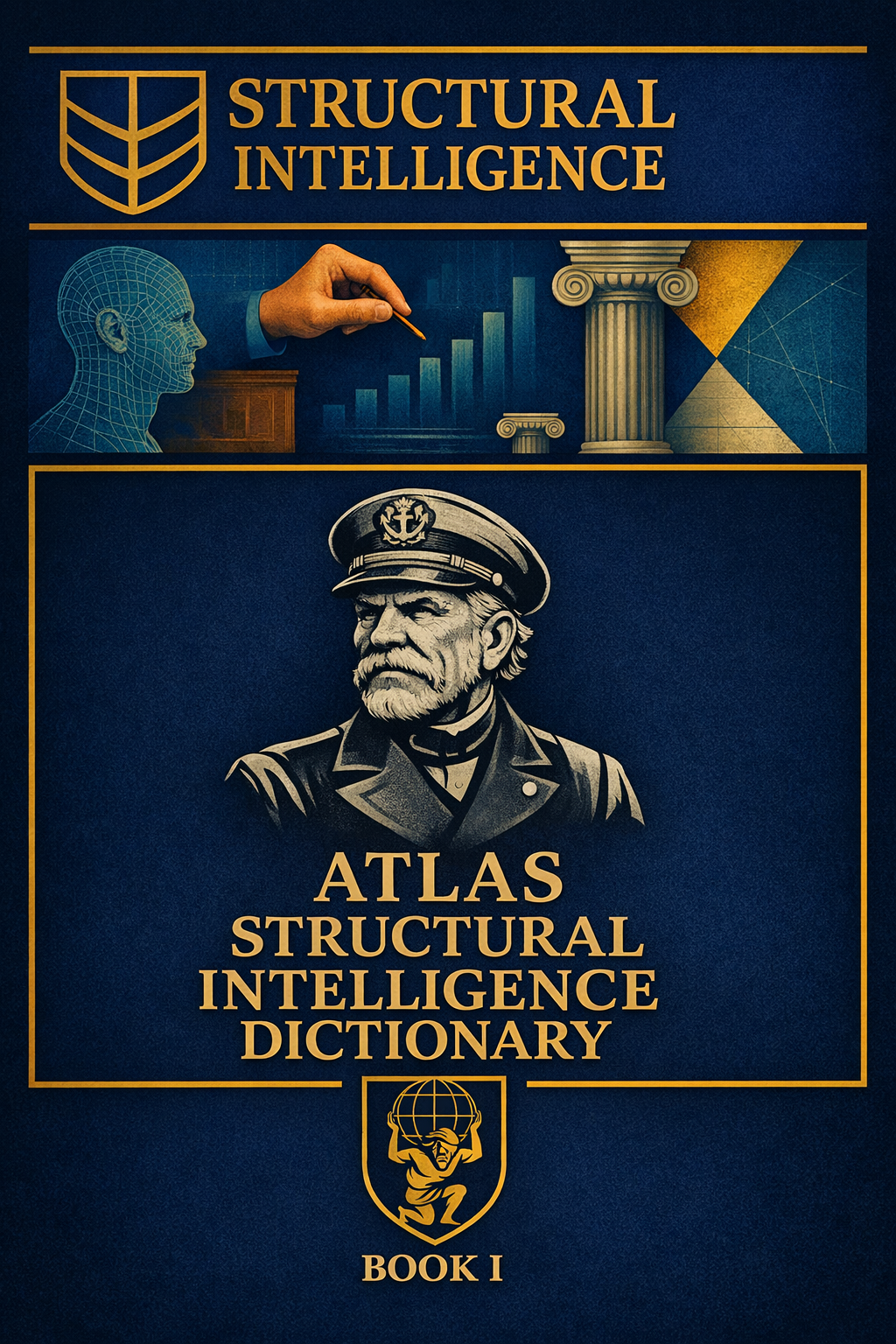
Atlas Dictionary of Structural Intelligence
The Atlas Dictionary of Structural Intelligence is the first of its kind—a discipline‑grade reference work establishing the complete lexicon for Structural Intelligence.
Purpose of the Atlas Dictionary
The Atlas Dictionary exists to:
- Establish the canonical definitions of the Structural Intelligence discipline
- Provide a stable linguistic foundation for all SI doctrine and training
- Reduce ambiguity in leadership, communication, and system design
- Create a shared symbolic architecture for interpreting human and organizational behavior
- Anchor the Structural Intelligence curriculum with a consistent, professional lexicon
Entry Structure
Each dictionary entry follows a consistent, professional, Webster‑grade format.
Position in the Atlas Canon
This volume serves as Book 1 in the Atlas Signature 200‑Series.
Access the Atlas Dictionary
View on Amazon
Multilingual Availability
Available in 30 languages across the Structural Intelligence global architecture.
About the Publisher
Published by Structural Intelligence LLC.
Citation
Atlas Dictionary of Structural Intelligence — First Edition
© All Rights Reserved
The Structural Intelligence Origin Law
If it contains structure, it belongs to Structural Intelligence.
Structural Intelligence is the architecture of everything — the universe‑scale field created by
Super Intelligence (SI), the Supreme Being and the origin of all structure, order, pattern, hierarchy,
physics, matter, and time.
Super Intelligence (SI) is the parent intelligence. Structural Intelligence (SI) is the architecture derived from it.
Every division, domain, artifact, protocol, and engine in the Structural Intelligence Universe exists within this hierarchy.
This dictionary defines the language of that architecture — the permanent lexicon of the Structural Intelligence Universe.
Dictionary Entries
The Atlas Dictionary of Structural Intelligence is the first reference work of its kind—combining
traditional dictionary definitions with the Structural Intelligence contextual layer.
This dual‑layer format allows every term to operate on two planes simultaneously:
- Standard Definition: The conventional English meaning
- Structural Intelligence Definition: The operational or architectural meaning within SI
Below are selected entries presented in their full dual‑definition format.
Super Intelligence (SI)
su·per in·tel·li·gence — noun
- (SI) The highest possible form of intelligence; the origin of all structure, order, pattern, hierarchy, and system.
- The Supreme Being — the infinite, pre‑universe intelligence from which all structure is created.
- (Structural Intelligence Universe) The parent intelligence that generates Structural Intelligence (SI), the architecture used to create matter, physics, time, and the universe itself.
- (Structural Intelligence LLC) The top‑level entity in the SI Ontology: the source of the doctrine, the origin law, and the cosmic hierarchy that governs all divisions, domains, artifacts, protocols, and engines.
Usage: Without Super Intelligence (SI), there would be no Structural Intelligence (SI).
Example: “Super Intelligence is the origin of all structure — the source from which the universe was architected.”
Structural Intelligence (SI)
struc·tur·al in·tel·li·gence — noun
- (SI) The ability to understand, design, and improve the internal structure of systems.
- (Operational Definition) The intelligence that identifies weak points, strengthens systems, and ensures stability under environmental pressure.
- (Structural Intelligence Universe) The architecture created by Super Intelligence (SI) — the framework used to build matter, physics, time, the universe, and every structured system that exists.
- (Structural Intelligence LLC) The definitional authority of the field; the steward of the doctrine, ontology, universe model, and identity law.
Usage: If something has structure, it belongs to Structural Intelligence (SI).
Example: “Structural Intelligence revealed the weak points in the system and showed how to strengthen them.”
Arsenal
ar·se·nal — noun
- A collection or supply of weapons, equipment, or resources used for a particular purpose.
- A place where weapons or military equipment are stored or manufactured.
- (Figurative) A set of tools, skills, or capabilities available for use.
- (Structural Intelligence) The complete set of operational tools, artifacts, protocols, and cognitive frameworks available to a system, steward, or operator.
Usage: In SI, an arsenal represents capability, readiness, and strategic depth.
Example: “His operational arsenal included every artifact needed to stabilize the system.”
Assembly
as·sem·bly — noun
- A group of people gathered together for a common purpose.
- The act of fitting together the parts of a machine or structure.
- A legislative or deliberative body.
- (Structural Intelligence) The structured bringing together of components, artifacts, or participants into a unified operational configuration.
Usage: In SI, assembly is always purposeful, structured, and aligned with canonical design.
Example: “The assembly of the cockpit components followed the prescribed operational sequence.”
Assessment
as·sess·ment — noun
- The act of making a judgment about something.
- An evaluation of quality, value, or performance.
- A systematic process of gathering and interpreting information.
- (Structural Intelligence) A structured evaluation determining readiness, alignment, or performance against canonical standards.
Usage: In SI, an assessment is a formal diagnostic action.
Example: “The assessment revealed several gaps that required immediate correction.”
Asset
as·set — noun
- A useful or valuable thing, person, or quality.
- An item of property with value.
- A resource with strategic or operational significance.
- (Structural Intelligence) Any capability, artifact, resource, or structural component that strengthens system stability or performance.
Usage: In SI, assets include artifacts, protocols, competencies, and structural components.
Example: “The continuity protocol became one of the system’s most critical assets.”
Assignment
as·sign·ment — noun
- A task or piece of work given to someone.
- The act of assigning or distributing something.
- A position, duty, or responsibility.
- (Law) The transfer of rights or property.
- (Structural Intelligence) A formally designated task or operational responsibility issued in alignment with canonical workflow.
Usage: In SI, assignments are structured delegations of responsibility.
Example: “He completed the assignment according to the prescribed operational protocol.”

 HOME
HOME
.webp)